




TUCSON, Ariz. — A 19th-century legend says that stagecoach driver named Richard Starr was intent on carving a new trail through the rugged Tucson Mountains. His goal? To find a shortcut from Tucson to Quijotoa, a booming mining town about 70 miles to the southwest.
Tucson is now a city of about 550,000 people. Quijotoa is at the heart of the Tohono O’odham Nation. And Starr’s path? It’s now the sixth hole on the Pioneer course, one of three nines at the 27-hole The Club at Starr Pass.
There are about 40 golf courses in the greater Tucson region with a solid dozen or so that would make for a strong golf trip in southern Arizona. Starr Pass should be on your short list.
The Club at Starr Pass
What was once seemingly impassable terrain is now a playground for golfers, although the rugged beauty of the desert remains unchanged.
Advertisement
Advertisement
The sixth can play 350 yards from the tips and presents an immediate and obvious challenge. The layout of the hole winds through a pair of rocky outcroppings, part of the mountain on the left side stretching into the fairway, pinching the landing area towards a hillside on the right. It’s a lot of visual trickery, through, a seemingly impassable route to the green. If you’re aware of Richard Starr’s history as you play this hole, you’ll wonder just how the heck he traversed covered wagons through this saguaro-covered landscape.
The sixth hole on Gambler, one of the three nine-hole course at The Club at Starr Pass in Tucson, Arizona.
It all adds to the mystique of the golf course, which opened as a Craig Stadler and Bob Cupp 18-holer in 1986, some 100 years after Starr passed through the area.
While the Tucson area has a strong pioneering history, the course has some pretty good golf history of its own. Former PGA Tour commissioner Deane Beman personally selected the venue to host the Tucson Open, which started in 1987. It was in 1991, though, that the course made real headlines. Amateur Phil Mickelson, still playing college golf about two hours north at Arizona State, won the PGA Tour tournament despite a triple bogey on the 14th hole. Tom Purtzer making double bogey on the final hole certainly helped as Mickelson became just the seventh amateur to win a Tour event.
A decade and a half later, in 2005, a third nine, designed by Arnold Palmer, was added. The Pioneer and Renegade nines have been re-routed over the years and they’re now joined by the Palmer nine to offer up a splendid mix of golf holes that will require multiple visits.
“Tucson kind of lives under the radar as far as good golf destinations, but there’s a lot of good golf here,” said Starr Pass General Manager David Loomis.
Advertisement
Advertisement
For those who have made the drive south from the Phoenix area, Starr Pass might be one of the few times they’d hang a right off I-10.
“We’re really trying to bring an elevated luxury golf back to the west side of Tucson,” Loomis said, noting that more well-known golf courses tend to be in Oro Valley or Marana on the north side of town.
Last October, Starr Pass reopened after a long-overdue renovation of the course and clubhouse. The Palmer course was the first to switch its greens from bentgrass to TifEagle Bermuda. Now all three nines have that. All the bunkers were restored as well, and it was long after reopening that the PGA Tour hosted Stage 2 of Q School.
This daily-fee course does offer memberships for $5,000, a literal steal in the Arizona golf scene. The club is not seeking to go fully private and gets plenty of play from guests who stay at the nearby JW Marriott Tucson Starr Pass Resort & Spa. This large resort has 575 rooms, including 35 luxury suites as well as a 20,000-square-foot spa. There are seven restaurants and nightlife spots on property, adjacent to one of those saguaro-covered mountains. Enjoy fine dining at Signature Grill or take in the sights with outdoor dining at Salud, featuring Mexican food that focuses on locally sourced ingredients.
Advertisement
Advertisement
Hiking trails are accessible from the resort property, but be ready for some wildlife, as hikers and golfers alike might encounter different desert critters, from snakes to groundhogs, rabbits to coyotes, and even roadrunners and javelinas.
The Palmer, Gambler and Pioneer are classic desert golf layouts with the Palmer playing 3,100 yards and each of the other two a tad longer, closer to 3,500 yards. There are elevation changes and blind tee shots aplenty. There’s also plenty of scenic views of the Tucson Mountains.
La Paloma Country Club
It could be argued that Palmer’s golf course architecture footprint in the Tucson area is one-upped by his long-time rival, Jack Nicklaus. One of the many Golden Bear’s Tucson-area golf courses is La Paloma Country Club, nestled near the Catalina Mountains, the large prominent mountain range north of town that contains Mount Lemmon, famous for the southernmost ski destination in the U.S. on its 9,000-foot peak.
La Paloma has been host of the PGA Tour Champions Cologuard Classic for three years running. It’s also famous for being one of the many movie sets for the 1996 golf rom-com starring Kevin Costner and Rene Russo, “Tin Cup.”
Advertisement
Advertisement
Like Starr Pass, La Paloma offers up 27 holes of winding desert golf with the Hill, Ridge and Canyon nines providing more of that scenic southern Arizona landscape.
La Paloma, which means “the dove” in Spanish, opened in 1984 with nine holes on the Ridge course and nine more on the Canyon. In 1985, a third nine dubbed the Hill came online. All three offer that classic desert golf experience. All three also have some pretty great greens to contend with, so be ready with the flatstick. The Hill course, in particular, lives up to its name with steep mounds and big curves on its putting surfaces.
The first holes on each of the nines play into the Catalina Mountains, giving the start of your round some wow factor right off the bat. The par 3s are dramatic, like the fourth hole on the Ridge course. There’s virtually no bailout here with a deep arroyo left and some thick desert scrub behind and to the right of the green. Make life easy and simply hit the green with your 7-iron (easier said than done, right?).
The par 5s on this course are fun, too, including Hill’s seventh, featuring a narrowing ascent into a little canyon where you’ll eventually find the green. Don’t miss your approach left or you’ll find a meandering creek, and probably not your golf ball.
Advertisement
Advertisement
The Hill course ends with the hole they use as the 18th for the Cologuard Classic. This hole is all about the second, one that requires a forced carry over a wash but also uphill to a green with a steep face fronting it and the large clubhouse behind it. The view of the carry is perhaps more dramatic once you’re on the green looking back towards the fairway.
Tubac Golf Resort
A southern Arizona golf course that has to be seen – and played – to be believed is the Tubac Golf Resort. Yet another 27-holer, this place is unlike most Arizona golf courses. It’s not a desert layout like the first two on this adventure. In fact, it sits on a large underwater aquifer, and some of the holes are lined by thick forested areas. One of the par 3s has a large pond in front of it that’s covered in lily pads, an uncommon site in Arizona.
The first of the three 9s is called Otero, named after Don Toribio de Otero, who originally settled this land after being gifted it by the Spanish monarchy. The others are Anza and Rancho, which was the final piece of the trio added to the resort.
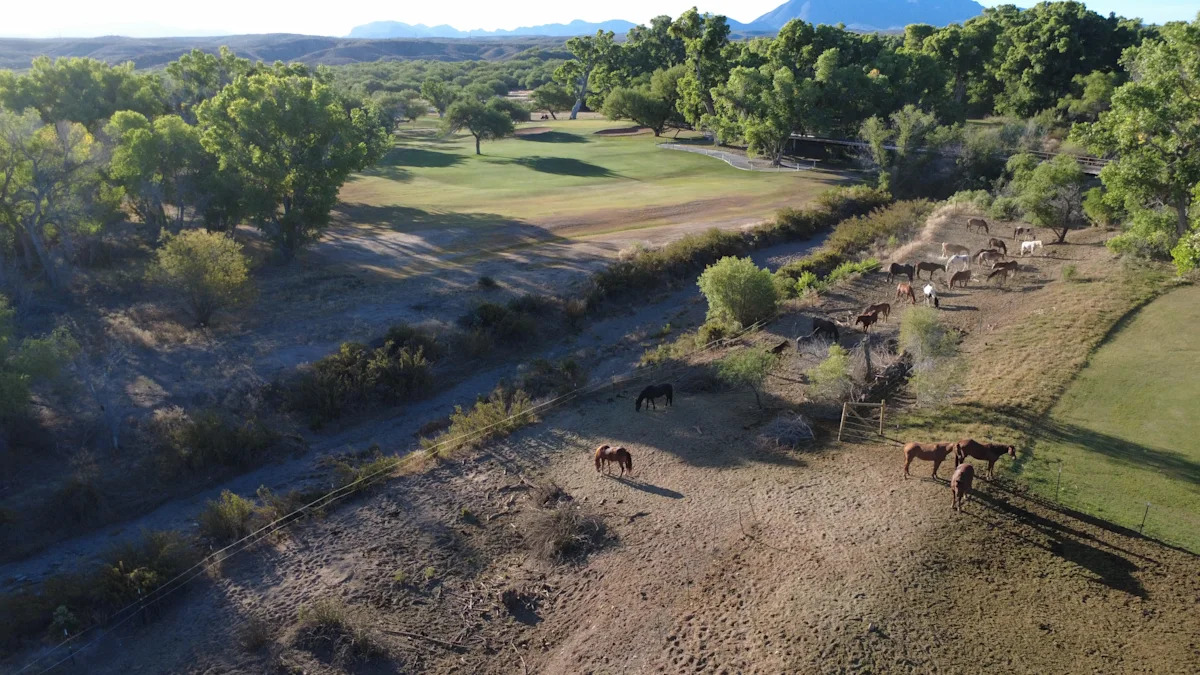
Part of the charm of the place is the ranching vibe with several heads of cattle on property and a herd of horses for horseback riding.
Advertisement
Advertisement
“People get a kick out of watching the horses run from one place to another because you know it’s kind of a cool thing to see that those animals take golf in full stride and run from one pasture to another pasture,” said Hank Swiggett, the general manager at Tubac Golf Resort. A transplant from New York, he first visited Tubac some 40 years ago after his family, who wanted to find a slower way of life, found the Scottsdale area to be too bustling. Tubac, now with about 1,500 residents, had closer to 500 or so in the mid-80s.


Tubac Golf Resort in Tubac, Arizona.
Some of the more famous and most memorable scenes from the movie Tin Cup were filmed here, including the part where Cheech Marin’s Romeo, working as Costner’s Roy McAvoy’s caddie, snaps McAvoy’s driver in half so he can’t use it. There’s also a hole with a sign that reads “Tin Cup 3 Wood” at about 240 yards out from the green. In the movie, it’s from this spot where McAvoy hits a 3-wood with his second shot onto the green, only to be promptly fired by Don Johnson’s David Simms.
That’s not the only Hollywood link to the Tubac Golf Resort. Actor and dancer Bing Crosby was a part of an investment group that purchased the property in 1959, with the idea of creating a remote hideaway for some of Hollywood’s elite. It wasn’t long before some of the golf course fairways were laid down.
Some 100 or so years before that, the property was a part of the Gadsden Purchase, which made a narrow strip of land across southern Arizona and New Mexico a part of the U.S. and pushed the southern border several miles south.
Advertisement
Advertisement
Nowadays, as drivers make their way south to Tubac, they’ll notice shortly after getting on the I-19 south from Tucson that the freeway signs have distances marked in kilometers. This is the only stretch of the federal highway system that uses the metric system.
As for the golf course, all 27 holes are measured in yards but Tubac Golf Resort won’t beat you up with distance. None of the three stretch past 7,000 yards and most golfers will probably have more fun playing them all at around 6,500 anyway. Along the way, you may spot deer grazing. Or you might happen upon wild turkey.
There’s also an affordability factor that works in Tubac’s favor.
“I think we offer more bang for your buck, if you could put it that way,” Swiggett said. “We are not priced in the same range as Scottsdale or even Tucson. We’re definitely at a discount to those places and we’re good with that. We have no problem with that.”
Advertisement
Advertisement
Three nine-hole golf courses. A spa. The Stable Ranch Grill, situated in what was once the stable, with a diverse menu and a large outdoor patio. Those cows and horses and other southern Arizona wildlife. And temperatures that dip into the 70s at night, yes, even in the summer, during the hot Arizona summer months.
Tubac Golf Resort is on to something.
“We offer an experience which is not your typical desert retreat experience, meaning we offer the golf, we offer the spa, we offer the grass, we offer the trees, the cottonwoods, the oak trees,” Swiggett said. “And then we have all the history that’s around us, which allows you to kind of escape and build on your knowledge of history down here.”
Todd Kelly is the assistant managing editor of Golfweek and is a former Arizona Republic staffer.
This article originally appeared on Golfweek: Southern Arizona golf includes Starr Pass, La Paloma, Tubac Golf Resort
Read the full article here


