



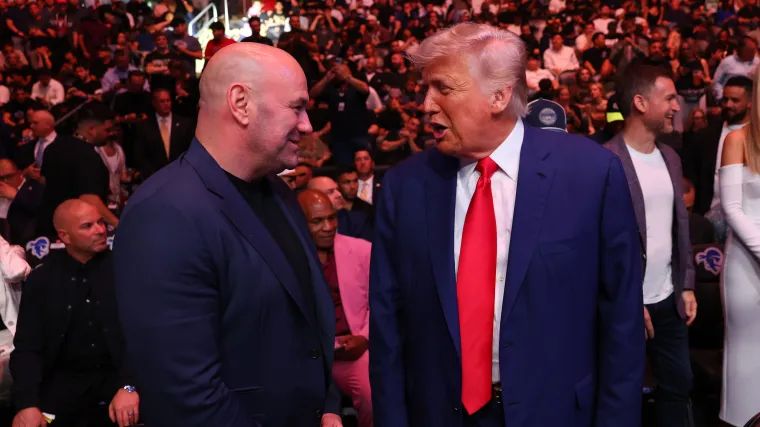
Zuffa Boxing has made most of the loudest noise in the sport so far in 2026.
The joint venture from Dana White’s TKO Group and the Saudi Arabian-owned Sela has sought to disrupt the established order in boxing, with moves such as their audacious $15 million signing of British fighter Conor Benn.
White, the CEO of the UFC, has made it clear he wants to bring as many aspects of his trailblazing mixed martial arts format over to boxing. Those moves have already begun, as we’ve seen with the launch of the fledgling Zuffa championship belts.
However, to do this to the fullest extent possible, boxing’s separation between sanctioning bodies, promoters and managers—enshrined in the Muhammad Ali Boxing Reform Act of 2000—will need to be navigated.
As such, White and the TKO Group are the most prominent backers of the Muhammad Ali American Boxing Revival Act, a bipartisan piece of legislation that will go before the U.S. House of Representatives on Tuesday, March 24. The bill needs a two-thirds majority to pass, which is 290 votes if all 435 members are present.
MORE: Tom Aspinall signs with Eddie Hearn: Why UFC star joined Matchroom Talent Agency amid Dana White beef
What is the Muhammad Ali Boxing Reform Act (2000)?
The new legislation is linked by both name and intention to the transformative act that was passed into federal law after the turn of the millennium. It followed on from the Professional Boxing Safety Act of 1996.
Together, these pieces of legislation are commonly referred to as the Ali Act and established three pillars to protect boxers from exploitation.
Ban on coercive contracts
Prior to the Ali Act, promoters were able to manoeuvre fighters into long-term contracts as a condition of getting a fight. Coercive contract provisions written into Section 9 (b) of the Professional Boxing Safety Act, including Ali Act amendments, declare contracts that condition a fighter’s participation in a bout upon the granting of future promotional rights to be “in restraint of trade, contrary to public policy, and unenforceable”. Contract options are capped at one year and tying mandatory title shots to promotional concessions are prohibited.
Financial disclosure
Under the Ali Act, promoters must disclose all income from a fight card, including broadcast fees, sponsorship deals and ticket sales, to any fighter taking part in bouts of 10 rounds or more. Legally, the fighter has the right to know how much money is in the pot before they fight.
Separation of manager and promoter roles
A legal separation between the inherently conflicting roles of managers and promoters to protect the fighter’s interests. A promoter can make more money if a fighter accepts less; a manager’s job is to get the best deal possible for their fighter. If one person or company is playing those roles in tandem, the logic goes that the fighter is more likely to be exploited.
What is the Muhammad Ali American Boxing Revival Act?
In July 2025, US representatives Brian Jack, a Republican from Georgia, and Sharice Davids, a Democrat from Kansas, introduced the Muhammad Ali American Boxing Revival Act to Congress. Davids is a former MMA fighter.
The bill is not intended to repeal the Ali Act but it features provisions for organisations such as Zuffa to become “Unified Boxing Organisations” (UBOs) that have control of rankings, titles and fighters, essentially mimicking the UFC model.
In some readings, this runs contrary to the spirit of the Ali Act, but UBOs would not be obliged to operate within the three pillars outlined above. The Revival Act also sets out compliance requirements for UBOs, including minimum per-round payments for fighters, mandatory medical examinations, expanded health insurance and consistent drug-testing procedures aligned with the World Anti-Doping Agency.
“I am incredibly proud to introduce the bipartisan Muhammad Ali American Boxing Revival Act, which provides boxers with more opportunities, better pay, and greater safety standards,” Jack said in the press release last year. “Professional boxing is the only sport regulated by Congress, and ambiguity in current law – adopted over a quarter-century ago – has stifled investment. Congressional action is needed to revive this once-great American sport, and this bipartisan legislation establishes a framework for innovation to flourish.”
“I’m definitely not trying to get rid of [the Ali Act],” White told Ring Magazine in October 2025. “We’re going to add on to it. I think the Ali Act was done with the right intentions. Just because it was put in place, it doesn’t mean it works, and it doesn’t mean it fixes anything. It actually complicated a lot of things.”
MORE: How Manny Pacquiao transitioned from Boxer to Politician
Support for the Muhammad Ali American Boxing Revival Act
Backers of the bill pulled a masterstroke by getting the seal of approval from Ali’s widow. Lonnie Ali, who said: “Muhammad would be proud to have his name associated with this bill.”
Former heavyweight champion Mike Tyson is also on board.
“Muhammad Ali has always been my hero, both inside and outside the ring,” Tyson said in his statement to the United States House Committee on Education & Workforce last December. “Supporting these revisions honors the spirit of the original Ali Act by closing loopholes that have allowed some promoters to regain monopolistic control over fighters’ careers.
“This new legislation restores balance — allowing boxers to choose their own path while preserving the integrity of the sport. The Act does not alter the opportunities of those who are comfortable with the current system; it simply adds options for fighters who wish to pursue a different path that better suits their career goals.”
© Kevin Jairaj
Critics of the Muhammad Ali American Boxing Revival Act
For those opposed to the Revival Act, the commitments around fighter welfare amount to little more than a smokescreen for Zuffa to drive through their ambition to become an all-powerful entity. The example of UFC fighters taking home far smaller purses than their boxing counterparts, despite being the faces of a multi-billion dollar product have been cited as a cautionary tale when it comes to giving White and his associates the keys to the kingdom.
Speaking to The Athletic, former five-weight world champion and head of Golden Boy Promotions Oscar De La Hoya said: “It would legalize the very conflicts of interest the original Ali Act was written to outlaw.”
This is a battleground where the lines are clearly drawn. Alongside De La Hoya, Matchroom’s Eddie Hearn and Top Rank’s Bob Arum have also voiced opposition to the Zuffa-backed bill.
“This is a concerning bill for professional boxers,” Erik Magraken, a combat sports regulatory lawyer and founder of combatsportslaw.com, told The Guardian. “It guts the key protections from the Ali Act for promoters that choose to use the ‘unified boxing organization’ model. It allows a promoter to control rank and title … and achieve a stranglehold on the sport.”
Read the full article here