






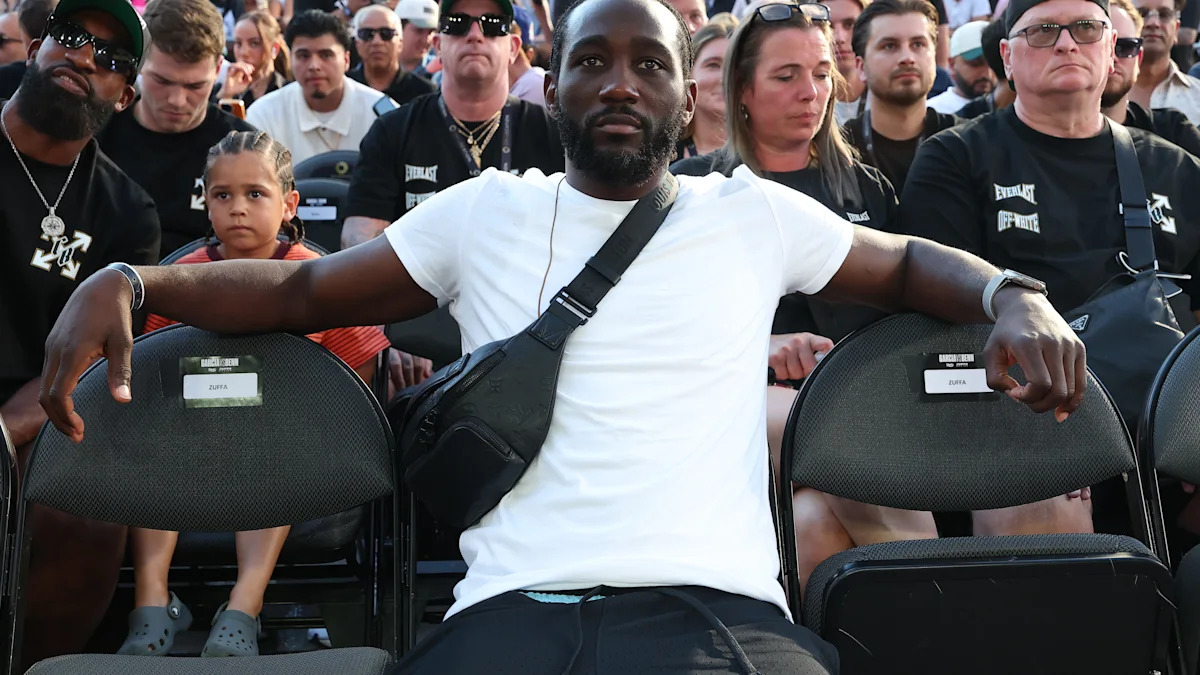
Few boxers have ever been more effective at mid-range, or in no-man’s land, than Terence “Bud” Crawford. It was there, where a boxer is neither in nor out, Crawford would prove too tough for the brawlers and too sharp for the boxers, and soon realize that he could beat both at their own games. Rather than run, or hide, or hold on for dear life, he would simply stand there, in that middle ground, switching stance and saying to opponents: “Come on then. You decide how this goes. You choose how it ends.”
Now, having retired from boxing last year, Crawford again finds himself in this same and familiar position. Though he is currently more out than in, he is not yet far enough out for damage to be mitigated or, better yet, nonexistent. He is, after all, still close to the sport; still in its slipstream, still engaging with it, still present at ringside. He is also still commenting on it, still being interviewed about it, and still partaking in social-media spats with various other boxers — younger ones, louder ones, active ones.
Advertisement
It might, in the end, all mean nothing, yet whenever we see or hear from Crawford nowadays, we assume that he is edging closer to the fire, not away from it. We view it as a tease, possibly even a cry for help, and we start to imagine a scenario in which the former three-weight world champion does what almost every great champion before him has done: follow retirement with a comeback.
For now, Crawford resists.
Terence Crawford looks on during the Ryan Garcia vs. Conor Benn ceremonial weigh-in in Las Vegas.
(Ed Mulholland/Zuffa Boxing via Getty Images)
On Monday he turned 39 years old — the age at which Archie Moore defeated Joey Maxim to win the world light heavyweight title in 1952 — and to cope will no doubt have told himself that boxing is increasingly an old man’s game. That is the lie all professional boxers tell themselves to stave off the fear of retirement, though it might, thanks to advances in nutrition, training and performance-enhancing drugs, also be the truth. Either way, should he return at 39, Crawford would not be out of place on a pound-for-pound list comprising numerous fighters in their mid- or late-30s. Besides, if he were to return at 39, Crawford wouldn’t have even been away for all that long. In fact, his last fight, a defining one against Saúl “Canelo” Álvarez, happened only 12 months ago, with memories of it fresh enough to ensure any switch in stance would be a relatively smooth and natural one for Crawford.
Advertisement
Therein lies the conundrum, I suppose. Twelve months out from Álvarez and 12 months away from turning 40, Crawford is now not only marooned between two landmarks but quickly approaching crunch time. Wait any longer to return to boxing and it might be too late. Wait until he is 40, for instance, and the prospect of a return will appear all the more reckless and desperate.
Because, irrational though it sounds, there are just some things harder for one to contemplate and do at 40. Suddenly, at that age, getting out of bed becomes a process and injuries are accrued as much through inactivity as activity. Suddenly, at 40, the very idea of wearing a hoodie becomes a decision second-guessed in front of the bathroom mirror and “new music” becomes something best listened to alone with the volume turned down. Next thing you know, you’re reading Dostoyevsky, or any novel from the 19th century, and discovering that 40 is not middle age but in fact old age and that, healthy or not, you’re just one hacking cough away from dropping dead in an empty room, never to again see your grandkids.
Crawford, you can tell, is feeling some of this, too. Only two weeks ago, following his latest back and forth with an active fighter, he tweeted to the world: “I’m bout to go to the gym f*** it! Don’t make me too mad I’ll be 39 in 10 Days dam.”
Whether he did go to the gym that day, or was genuinely made “mad” by Ryan Garcia, only he will know. But what is clearly on Crawford’s mind is the passing of time — the “dam” of it — and how, at 39, he now stands on the precipice. “Never can say never,” he recently said on “All the Smoke Fight,” a YouTube channel, yet that’s not strictly true, is it?
Advertisement
At some stage, whether Crawford likes it or not, a comeback will be out of the question, too much time having elapsed. This feeling is only then intensified when a fighter leaves the sport with an unbeaten record and has therefore much more to lose by coming back. These men, after all, are perfectionists by nature. A fighter like Crawford, for example, has separated himself from the crowd by virtue of achieving something only a tiny percentage of boxers have ever been able to achieve: perfection in the ring. And never are the margins finer than when perfection is the goal.
For other retired fighters, such as Joe Calzaghe, 40 was always considered the cutoff point. He also retired unbeaten, you might recall, and did so at the age of 36, having just conquered Bernard Hopkins and Roy Jones to win and then defend the world light heavyweight title in 2008.
No different than any other retired fighter, Calzaghe, by his own admission, struggled early on in retirement and formed destructive habits to replace the highs boxing delivered for almost three decades. Yet, to his credit, he dug in, he got back on track, and he sensed that if he could just get to 40, things would be OK. He knew then that the decision would be as good as taken out of his hands.
“Forty was a big age for me,” Calzaghe said when I interviewed him in 2013. “I’m now 41 and I’ve been retired for five years. I think — I hope — I’ve gone past that stage where it still seems like a realistic idea to get back into it. I’ve managed to get through the tough years and have resisted the urge. Now I’m content. And now I think about boxing differently. At 41, I don’t want to get hit in the head anymore. That doesn’t make sense to me now. I did that for a long, long time and, looking back, that part of it was never nice.”


Ex-champ Joe Calzaghe is one of few all-time greats to retire in his 30s and actually stay retired.
(James Chance via Getty Images)
Turning 40 seemingly brought a maturity and clarity to Calzaghe’s thinking. That still wouldn’t have made the sensation of drifting away from the sport any less painful, of course, but it did scratch certain itches — the awkward, unreachable ones at the top of his back — on the Welshman’s behalf.
Advertisement
“Do I miss it? Yeah, I do miss it,” he admitted. “Of course I do. You can’t have something be a part of your life for 27 years and then not miss it. What I did, though, was I stayed away from the gym, I moved away from the area completely, and I stopped watching boxing for a while. I moved to London from Wales to get away from the gym and then I took acting lessons.
“Anything that took me away from boxing was considered worth doing at the time. It took boxing off my mind for a while. I knew the bug was still there and I knew that if I stuck around in my same environment doing the same thing, I’d have likely given into it and boxed again. Even last year when I did some pad work, the bug kicked in again and I started to think I could beat this guy and that guy. It’s a dangerous thing, man, that inner competitor us fighters all have. I don’t think it will ever go, no matter how old I get. I’m just happy now to watch boxing and other boxers and not feel tempted. That’s a good place to be.”
Another great unbeaten super middleweight and light heavyweight champion who retired and managed to stay retired is Andre Ward. He retired even earlier than Calzaghe, in fact, at the age of just 33, and has since then watched countless champions come along and defend his old belts — and has, without exception, or hesitation, believed he would’ve beaten each of them.
Even so, Ward, though often tempted, has remained still, steadfast. He, like Calzaghe, saw 40 as a significant milestone and revealed, just before reaching it, that every day leading up to it was pushing him closer and closer to the place from which he had escaped. “I am hard-wired to compete,” Ward said in an interview with Stephen A. Smith in 2023. “The problem with retirement, and why other guys go to different vices, or depression sets in, is because they lose their identity and don’t redirect that drive. I’ve always been a man on a mission.
Advertisement
“But every now and again that hard-wiring gets active. It’s like I’ve had to retire multiple times. I’ve had to talk myself off the ledge [of coming out of retirement] multiple times. It’s not easy. Retirement is the hardest thing I have ever done in my life. It’s been six years and nobody has called my name. There is a reason for that.”
In terms of Crawford (42-0, 31 KOs), it has been slightly different. Perhaps because he was active in the age of the social-media callout and widespread clout-chasing, there have been several fighters who have mentioned his name and attempted to make him “mad.” One of those fighters is Jaron “Boots” Ennis, the supposed heir apparent whose rise to becoming Crawford’s IBF mandatory challenger failed to prevent Crawford moving from welterweight to super welterweight in 2024. Then you have Ryan Garcia, the current WBC welterweight champion, who is a far more unlikely Crawford rival but a man whose star power could be the thing that ignites something in the comparatively low-key Nebraskan. If it’s a big fight he wants, Crawford could do a lot worse than Garcia. If it’s money he wants, he knows where to find it.
Legacy, though, that’s another thing. Legacy is something Crawford has already established, or so both he and the rest of us thought. Yet the truth is, it is really only in retirement, with the benefit of space and time, that we can properly assess and contextualize a fighter’s legacy. It is only in retirement that a fighter stops considering title challengers or big names on a pound-for-pound list as his peers and instead now measures himself against other fighters preserved in retirement. The ones who have completed their work; created their legacies. The ones we like to call legends.


WBC welterweight champion Ryan Garcia continues to call for a fight against Terence Crawford.
(Steve Marcus via Getty Images)
“I’m a big Terence Crawford fan; I think he’s tremendous. I did a ton of his fights,” said Brad Goodman, the longtime matchmaker for Bob Arum’s Top Rank. “But how would he have done with guys like Tommy Hearns and ‘Sugar’ Ray Leonard? Even guys like Marlon Starling. How would he have fared against him? I can tell you, he wouldn’t have been dominant. He would have had a couple of losses, and a couple of wins, and that’s OK. But when you really look at his record before he fought Álvarez, who was the best guy Terence Crawford fought? It was probably Shawn Porter. It wasn’t Errol Spence — he was completely depleted by the time that fight happened. So it was probably Shawn Porter. That’s nothing really to brag about.
Advertisement
“Look, I have the utmost respect for Crawford. I’m not knocking him for who he has fought. It’s just that in retirement we look at these guys’ legacies and we compare them to other retired fighters. No longer do we compare them to active fighters. In Crawford’s case, that means you compare him to the likes of Hearns and Leonard. He can only fight the guys who were around in his time, it’s true, but he is also a competitor and I’ve no doubt he would have wanted a better level of competition to put himself among the true greats of the sport. He was a special fighter, absolutely, but only in this era. It’s unfortunate in a way. He walks the streets by himself and nobody even knows who the hell he is. He became a “star” later on in his career. You know who else became a “star” later in their career? Floyd Mayweather. He became a star after beating Oscar De La Hoya and Ricky Hatton. Before then nobody really cared.”
For the vast majority of fighters, it is only in the cruel silence of retirement that they find out how much anybody cared. It is maybe for that reason some of them continue to talk and tweet and tease, just to fill both this silence and their days. It is maybe for that reason some tend to go back on their word and return to the ring, despite the fact that those who care for them warn against it.
At least then, doing what’s comfortable and familiar, a fighter has the noise of the crowd and a feeling of being alive and relevant. It is that, more than anything, a retired fighter misses and struggles to replace. Even the ones who profess to be perfect, like Terence Crawford, still want to know that you care, especially in their first year of abstinence, when reminders of their perfection are less forthcoming.
Only much later, once a comeback is out of the question, does a retired fighter reluctantly lower their expectations and face reality. At that point, forget caring. They just want to be remembered.
Read the full article here


