




The manicured square of grass nestled into a peaceful Upper Arlington neighborhood would seem an unlikely spot for a torture chamber, but Scioto Country Club can be as brutal as it is beautiful, which 156 of the world’s best senior golfers are likely to discover when they tee it up July 2-5 at the U.S. Senior Open.
Scioto is where Upper Arlington native Jack Nicklaus learned to play golf. It makes sense then, that the course that produced the Golden Bear is a grizzly in its own right.
Advertisement
More on U.S. Senior Open: Older golfers still pack punch as U.S. Senior Open comes to Scioto CC
Ranked the fifth-best private course in Ohio by “Golfweek,” behind Muirfield Village (Dublin), Camargo (Indian Hill), The Golf Club (New Albany) and Inverness (Toledo), Scioto’s rippling greens and fairways resemble an earthen version of the adjacent river with which it shares a name.
The Scioto River runs more than 230 miles along an Ohio route that passes ancient mounded burial grounds. And not-so-ancient ones, too, as the national senior golf championship is preparing to prove. Beginning July 2, Scioto will try to send such notables as Ernie Els, Vijay Singh and defending U.S. Senior Open champion Padraig Harrington to their graves.
Already a tough 18-hole track, the USGA performed its usual toughening of the rough and tightening of the fairways for the tournament. And with temperatures expected in the mid-to-upper 90s all week, Scioto will become a test of survival.
Advertisement
“I hope it’s not too hot, but that could be challenging at this time of year in this part of the world,” said Henrik Stenson, who turned 50 in April and is making his first appearance in the U.S. Senior Open.
Stenson planned to focus his practice sessions on figuring out Scioto’s slick and undulating greens.
“If the golf course and the strategy force you to be a bit more defensive at times, then you have to be on the ball with your mid and long-range putting,” he said. “That’s one of the things I’ll focus on the next two days, getting the speed down.”
Noted Scottish golf course architect Donald Ross did not set out to make Scioto so diabolical. The idea was to create an idyllic gathering place where Upper Arlington residents could relax and recreate.
Scioto Country Club, 2196 Riverside Dr, is a private country club and golf course in Upper Arlington, photographed Wednesday, Apr 16, 2025.
Co-founded and developed in 1916 by four Columbus businessmen, including industrialist Samuel P. Bush, the paternal grandfather of former President George H.W. Bush and great-grandfather of former President George W. Bush, the golf course was to be a city gem.
Advertisement
As founding member James Hamill explained it at Scioto’s opening, “Our club, in time, will become one of the most important social centers of the community, and will constitute one of the show places of the city.”
That last part definitely comes to fruition this week as some of the biggest names on the Champions Tour stroll across Scioto’s approximate 150 acres. None is bigger, however, than the golf course’s designer. Donald Ross’ creations include Inverness, Oakland Hills, Oak Hill and Pinehurst.
Like those famous courses, Scioto’s history is rich in high-level golf.
“The club is very big on the traditions of golf and hosting things related to golf,” said U.S. Senior Open tournament chairman Paul Heller.
Advertisement
Here is a look at the six biggest events that shaped the country club’s history:

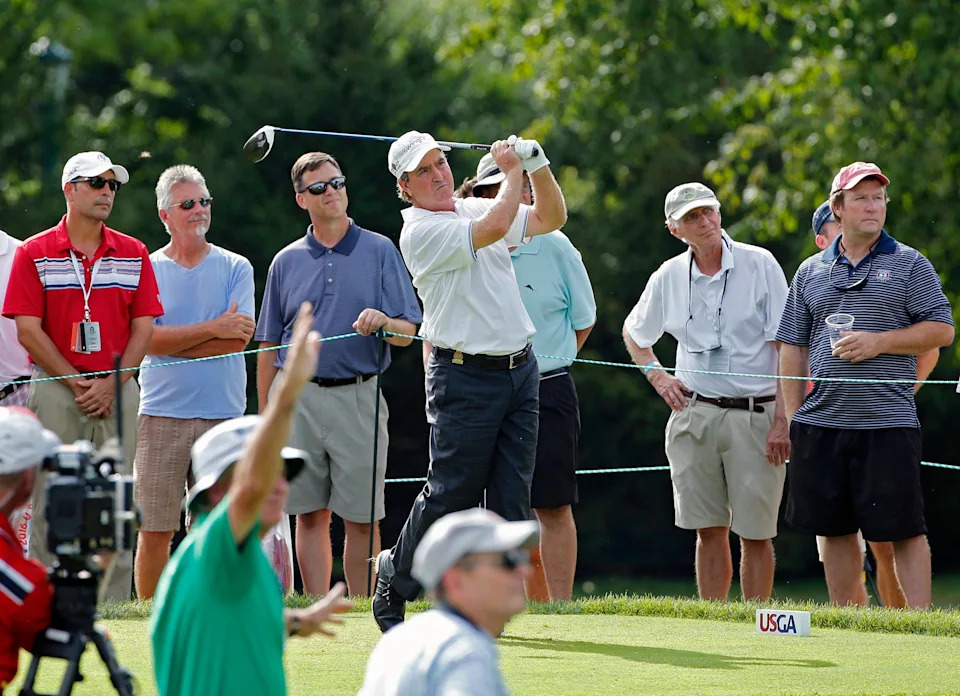
Gene Sauers tees off on the 16th hole during the 4th round of the 2016 U.S. Senior Open at the Scioto Country Club on August 15, 2016. (Kyle Robertson / The Columbus Dispatch)
2016 U.S. Senior Open
Gene Sauers showed up for the final round of the U.S. Senior Open sporting a Donald Ross signature golf shirt – appropriate attire considering Ross was the renowned course architect who designed Scioto Country Club in 1916.
But more than just wearing Scioto history, the 53-year-old Sauers made it by winning the national senior championship by one shot over Miguel Angel Jimenez and Billy Mayfair.
Sauers, who in 2011 nearly died from a rare skin disease, made a 5-foot par putt at No. 18, after Jimenez missed his par attempt, to win his first senior major title and the $675,000 winner’s check. The victory capped a week in which players experienced intense heat the first three days, then heavy rains that postponed Sunday’s final round to Monday and delayed Monday’s round for four hours.
Advertisement
“It means the world to me. I saw the light at the end of the tunnel, and I was heading there,’’ said Sauers, who was so disabled by Stevens-Johnson syndrome, a serious disorder of the skin and mucous membranes, that doctors gave him only a 25% chance of living.
Sauers finished at 3-under-par 277 for the tournament, but through 16 holes on Monday, it appeared he would come up short. Jimenez, also seeking his first senior major, led Sauers by one heading to No. 17 before stumbling to a bogey-bogey finish. The wine-loving, cigar-smoking Spaniard failed to get up-and-down from greenside bunkers on the last two holes.
1986 U.S. Senior Open
In the spring of 1986, Dale Douglass experienced a change of fortunes usually found in feel-good Hollywood movies.
Advertisement
In March of that year, Douglass, an unheralded golfer from Oklahoma, turned 50, and his golfing life almost immediately went from tough to terrific.
Douglass won the U.S. Senior Open wire-to-wire in June for his only major professional title.
Douglass’ ascension to senior stardom was as unexpected as it was sudden. He had joined the PGA Tour in 1960 and had a nondescript career outside of a 10-month span in 1969 and ‘70, when he won three tournaments.
That changed when he hit the over-50 circuit. He entered the Senior Open having finished in the top 10 of eight of his nine events.
“I hit the ground running when I got on that tour,” Douglass said in 2016. He died in 2022.
Advertisement
He did the same at Scioto. Douglass opened with a tournament-record 5-under-par 66 to lead Lee Elder by two strokes, then increased his margin to three shots after the second round and four shots after the third.
Gary Player made sure Douglass would earn the $42,500 winner’s share of the $275,000 purse. The South African mounted a final-round charge but came up one stroke short.
1968 U.S. men’s amateur
Bruce Fleisher entered the final round of the stroke-play tournament with a two-stroke lead but soon found himself facing a charge from Marvin “Vinnie” Giles, who trimmed his six-stroke deficit at the start of the final round to one after 15 holes.
Advertisement
On No. 16, Fleisher lofted a 9-iron over willow trees from the rough to make par, parred No. 17 and stood on the tee at No. 18 needing a par to become the third-youngest player to win the Amateur, behind Robert Gardner (1909) and Jack Nicklaus (1959).
The native Tennessean found the middle of the fairway at 18, hit his approach shot to 15 feet and two-putted for par and an Amateur-record 284.
“It was like an out-of-body experience,” Fleisher said in 2016, five years before his death in 2021. “The last three holes, I never remember swinging a club. It was like I was three feet off the ground, watching myself play. I was that focused. It was a mystical week.”
Fleisher later won 18 times on the Champions Tour, including the 2001 U.S. Senior Open.
Advertisement
1950 PGA Championship
The PGA has had its share of quirky and anonymous winners, in large part because of the vagaries of match play, the format used by the PGA to determine its champion from 1916 until 1957.
Among the most out-of-left-field winners was Chandler Harper, a part-time tour pro from Portsmouth, Virginia, who emerged from a field of 129 professionals to win his only major.
Harper came to Columbus with only one PGA Tour title. He was not a long hitter but was renowned as a short-game master; he needed only 21 putts, a tour record at the time, in a third-round 63 at Tucson.
Entering the PGA Championship, though, the 36-year-old Harper and other club pros were an afterthought. Sam Snead was the prohibitive favorite. He showed up as the defending champion and the tour’s leading money-winner, then won the PGA qualifier and its $250 cash prize.
Advertisement
Among the other major champions in the field were reigning Masters winner Jimmy Demaret, Henry Picard, Lloyd Mangrum and Denny Shute, a Cleveland native who had worked as a club pro at two central Ohio country clubs, York Temple and Brookside.
Snead was stunned early, losing his second-round match to unheralded Eddie Burke, who chipped in for eagle on the 18th hole for a 1-up victory.
Harper stayed out of the spotlight until the 36-hole quarterfinals, when he edged heavily favored Mangrum 1-up in a match that the Texan described as the “greatest I’ve ever played in.”
That sent Harper to the semifinals, where again he was a prohibitive underdog, this time to the brash and natty Demaret, a three-time Masters champion. But Harper never flinched in a 2-and-1 victory.
Advertisement
In the 36-hole final, Harper defeated Henry Williams 4 and 3 to pocket $3,500.
1931 Ryder Cup
Samuel Ryder, the English seed salesman whose later-in-life obsession with golf fostered biennial matches between players from the United States and Great Britain, skipped the 1931 event named for him.
Just as well. The pasty Brit might have melted in the heat dome that descended upon Columbus in late June 1931.
Ryder’s absence was not the only British vacancy that contributed to the United States’ 9-3 victory, allowing the Americans to reclaim the 17-inch, 4-pound trophy that Ryder had commissioned four years before at a cost of 250 English pounds.
Advertisement
Three of Great Britain’s top players – Henry Cotton, Percy Alliss and Audrey Boomer – also missed the matches because of arcane rules in place at the time. Alliss and Boomer were disqualified because they weren’t working in Britain, and Cotton was kept off the team because he chose to stay in the U.S. after the Ryder Cup, and the Brits demanded that the team travel as a group.
Just 15 years old at the time of the matches, Scioto had been awarded the Ryder Cup by the PGA of America in November 1930, and the event was hyped as the rubber match of the competition, the Americans having won in 1927 in Worcester, Massachusetts, and the British capturing the cup two years later at Leeds, England.
The format called for four foursome (alternate shot) matches on the first day and eight singles matches on the second day. Each match was scheduled for 36 holes.
The British were swamped from the start, both on the scorecard and in their heavy, sweat-inducing wool golf clothing.
Advertisement
The 10-player American team included veteran captain Walter Hagen and standouts including Gene Sarazen, Horton Smith and Leo Diegel.
Hagen delivered the Cup-clinching win for the U.S. team by beating British captain Charles Whitcombe 4 and 3, and Shute finished it off with an 8 and 6 romp over Bert Hodson.
The Brits were gracious in defeat publicly, but behind the scenes criticized the conditions, and the British PGA filed a petition to never have to play again in the dead of summer in the States. Since then, no Ryder Cup matches in the U.S. have been held before mid-September.

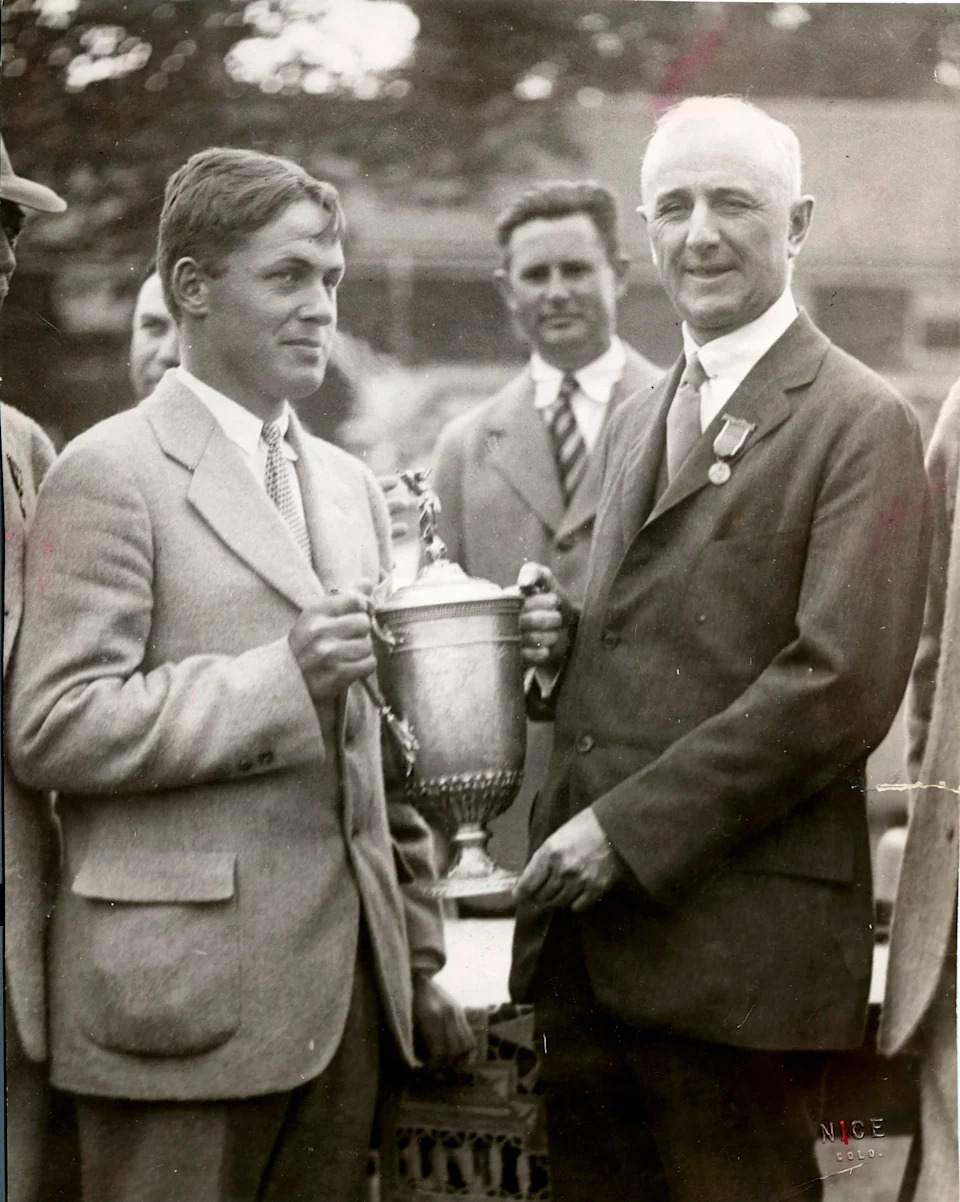
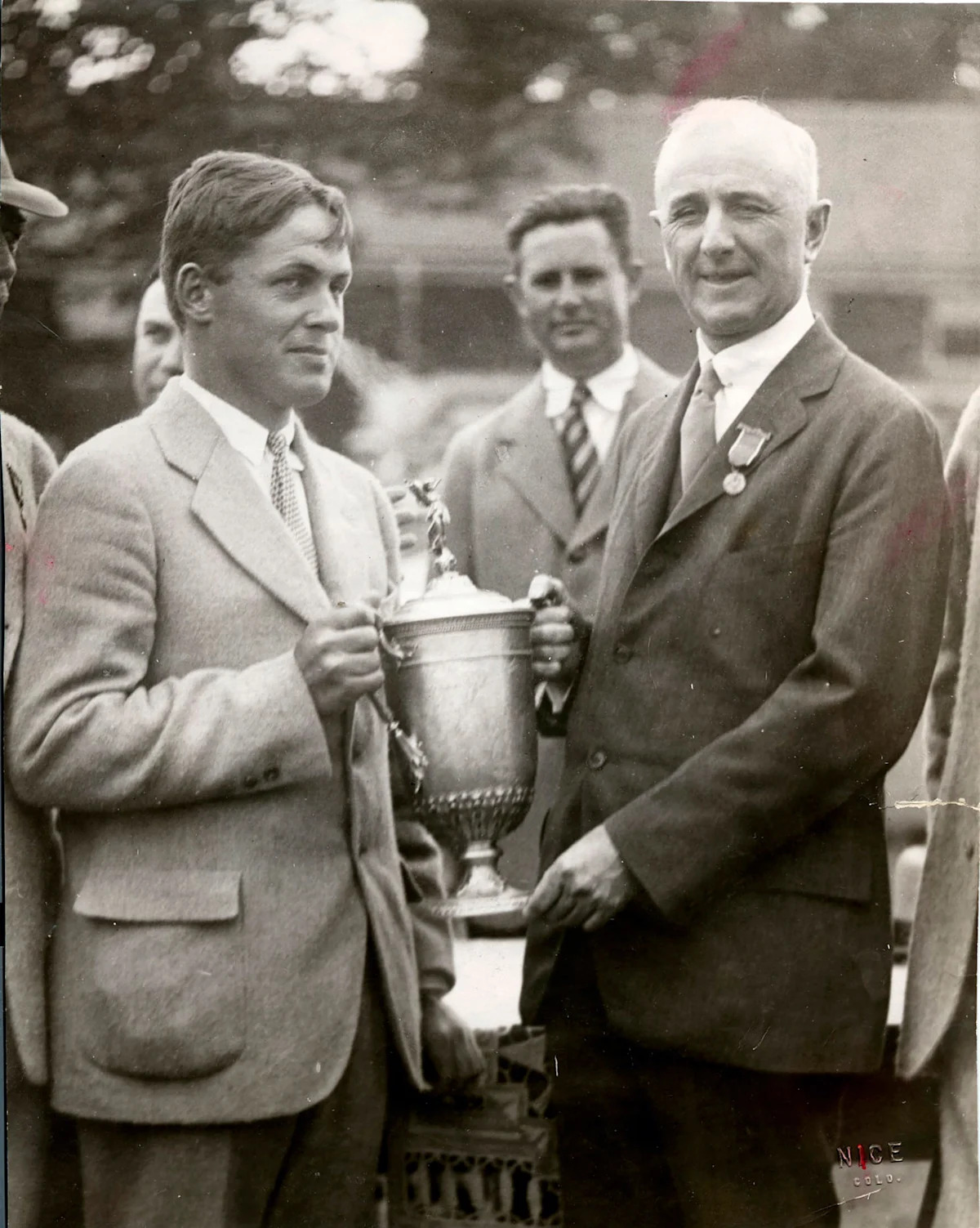
Golfer Bobby Jones won his second U.S. Open at Scioto Country Club in Columbus, Ohio in 1926. Jones, left, receives his cup from W.C. Fownes, president of USGA on July 12, 1926.
1926 U.S. Open
Bobby Jones already was tired from having won the 1926 British Open a few weeks prior, followed by a ticker tape parade in New York, when he arrived in Columbus for what was in the U.S. then called the National Open Championship.
Advertisement
Wearing his traditional plus-fours, the famous amateur got off to a decent start, shooting 2-under on Thursday before stumbling to a 79 on Friday. The U.S. Open played its four rounds over three days for the first time since 1919, because of the number of entries (153) and size of the galleries. The final 36 holes were played on Saturday.
Jones, who won his first U.S. Open in 1923, was joined in the field by eight other previous champions, including Gene Sarazen, Walter Hagen and Chick Evans.
None of those stars, however, became the man to beat. Cleveland’s Joe Turnesa entered the final 18 holes with a three-shot lead, only to blow up on the back nine with five bogeys in six holes. Jones went on to win his second U.S. Open championship by one stroke, becoming the first player to capture British and U.S. Open titles in the same year.
Sports columnist Rob Oller can be reached at roller@dispatch.com and on X.com at @rollerCD.
This article originally appeared on The Columbus Dispatch: Ohio club hosting this week’s U.S. Senior Open has a rich golf history
Read the full article here


