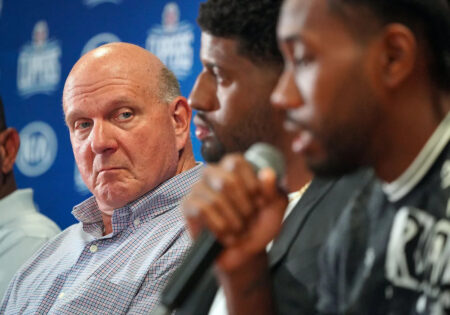



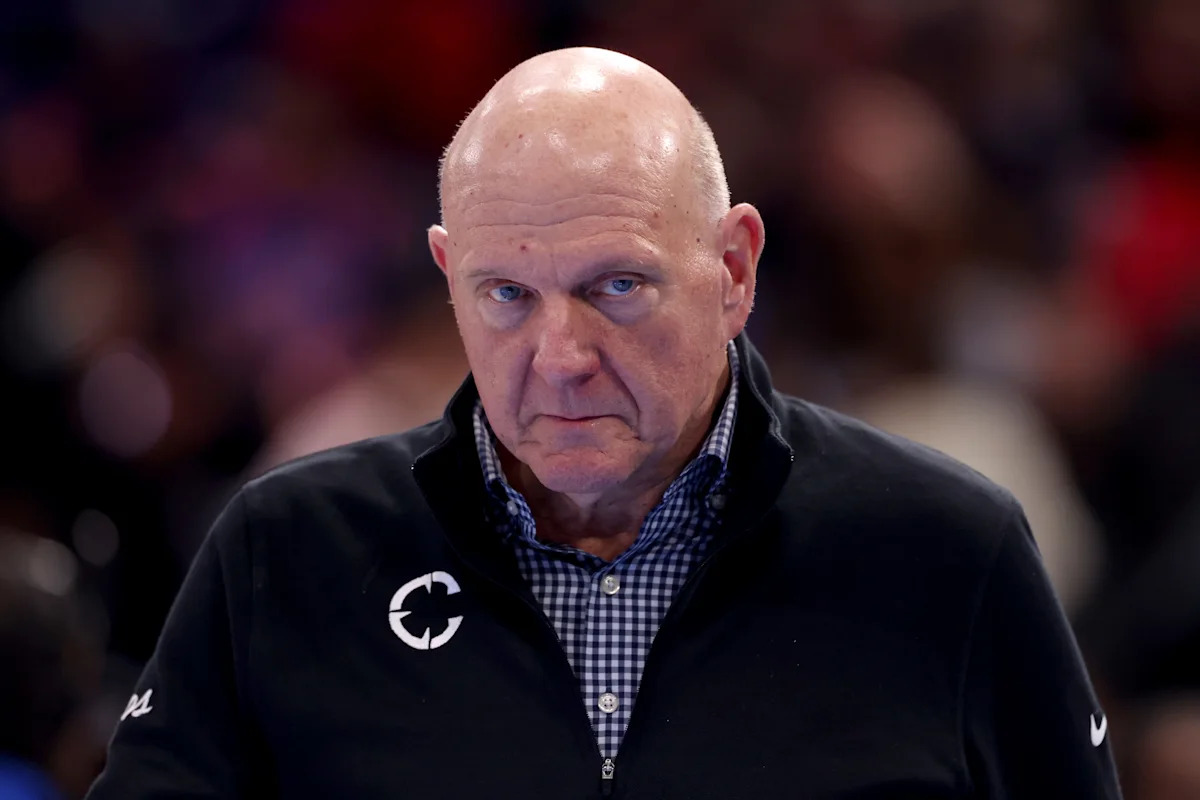
A day short of a full year since Pablo Torre unearthed evidence that the Los Angeles Clippers under owner Steve Ballmer circumvented the NBA’s salary cap in their dealings with star forward Kawhi Leonard, the league released the findings of its own investigation into the franchise and Leonard.
The 35-page report from the law firm of Wachtell, Lipton, Rosen & Katz served as a damning rebuke to the Clippers’ denials they had sidestepped league rules. NBA commissioner Adam Silver evidently concurred, stripping the Clippers of five future first-round draft picks, fining them $30 million, suspending Ballmer for a year and levying no-pay suspensions of two of the franchise’s highest-ranking executives.
Advertisement
The Clippers — through their lawyers — continued to proclaim innocence and seem intent on trying to take their fight to court.
Until then, here are five of the NBA investigation’s key revelations with passages from the report:
Fool me once …
The Clippers’ repeat offender status for cap circumvention factored into the severity of their punishment in the Leonard case.
The report concluded that if any team should have a full understanding of the NBA’s rules regarding salary-cap circumvention, it was the Clippers. In 2015, the NBA fined the Clippers $250,000 for their efforts “to facilitate an endorsement agreement” between free-agent center DeAndre Jordan and a new team sponsor.
Advertisement
In addition, the league questioned the Clippers in 2019 about reports that Leonard’s uncle and business adviser, Dennis Robertson, was seeking impermissible benefits from teams courting Leonard. The NBA left that investigation open, pending additional evidence.
From the report: “Mr. Ballmer also failed to create conditions under which his organization abided by the NBA’s circumvention rules — an especially egregious lapse because the Clippers are a prior offender of those rules and were previously and specifically investigated by the NBA with respect to Mr. Leonard.”
It pays not to lie
The investigators found Clippers president of business operations Gillian Zucker to not be forthcoming, or even honest. In contrast, Lawrence Frank, the Clippers’ president of basketball operations, was described in the report as being cooperative during questioning. That factored into the difference in the two executives’ punishment: Zucker was given a one-year suspension; Frank received six months.
Advertisement
From the report: “Ms. Zucker made several statements that proved inconsistent with contemporaneous documents, other witness statements, and the broader chronology of events, professed a lack of recollection on important issues, placed responsibility on subordinates, and offered inconsistent renditions of facts in separate interviews. By contrast, Mr. Frank openly discussed with investigators his conduct from the relevant time period, recalled details of key events, took responsibility for the actions of subordinates, and was generally consistent across his interviews. While the determination of any consequences for the rules violations described herein lies with the NBA, investigators believe that it would be appropriate in making such determinations to take cooperation and credibility — or the lack thereof — into account.”
Some Aspiration executives initially didn’t want Leonard
Torre’s investigation centered on Leonard’s sponsorship agreement with a now-bankrupt company called Aspiration, a tree-planting service funded by Ballmer. Aspiration reportedly entered a $28 million legal agreement with KL2 Aspire, LLC, a company owned by Leonard.
Joe Sanberg, the co-founder of Aspiration, pushed for the arrangement. Not everyone at the company was on board.
Advertisement
“In December 2021, Mr. Sanberg discussed with senior Aspiration executives his desire for the company to enter into an endorsement agreement with Mr. Leonard on the terms described above. Mr. Sanberg did not have the authority to sign such an agreement on Aspiration’s behalf and, according to internal Aspiration emails, the reaction among its C-suite executives who did have this signing authority was swift and uniformly negative: ‘I have no idea why we’d do this,’ wrote one senior executive; ‘this is not a good investment of our capital [. . . .] It’s $48M over 4 years for Kawhi, who is not a big name [. . . .] Not sure why we would make such a commitment considering we are already paying a huge sponsorship fee to Clippers,’ wrote another.
“When these concerns were conveyed to Mr. Sanberg, he told the Aspiration executives that ‘the Clippers are asking us to do this with Kawhi Leonard’ and that the team would provide additional business back to Aspiration to help offset the financial impact on Aspiration. In an email exchange among Aspiration’s CEO, CFO, and general counsel, one wrote, “[Mr. Sanberg said] that the Clippers are promising to increase the amount they pay us per quarter in line with what we pay this guy [i.e., Mr. Leonard].” Another responded: “Thanks for verifying. . . . We should be fine if it’s cashflow neutral.”
Aspiration wasn’t alone
The investigation was first focused on the Clippers’ and Leonard’s relationships with Aspiration. It led to so much more.
Advertisement
The sponsorship deals between Leonard and three other companies (Boingo, Daktronics and Lockton) — and whether they were arranged by the Clippers — served as the foundation for a lot of the investigators’ findings.
From the report: “Each agreement was signed in the depths of the COVID-19 pandemic, when, according to both the NBA and an expert in athlete endorsement deals, companies were rarely signing such agreements, particularly with endorsers with whom they did not have an existing relationship; investigators received no reasonable explanation why it was necessary for these companies to quickly finalize and begin paying Mr. Leonard under these agreements at a time of general economic uncertainty and when activation or performance by the player would be difficult at best;
“Each agreement was signed by a company that had never before (and has never since) signed an endorsement agreement of remotely the same financial magnitude as the one it entered into with Mr. Leonard; and none of the companies has ever signed any other athlete endorser of Mr. Leonard’s caliber;
“Each agreement imposed minimal performance obligations on Mr. Leonard relative to the amount he was paid;”
Advertisement
“None of these agreements were publicly announced, defeating the foundational purpose of an endorsement agreement: to obtain associational benefits of the company’s relationship with the endorser; and
“Investigators did not uncover or receive evidence reflecting that the companies exercised their rights for meaningful player activation; the record reflects that Mr. Leonard’s only confirmed activity under any of the agreements was a visit to a military base on a single occasion under one agreement and signing some memorabilia under another.”
According to the report, Leonard was paid a total of $18 million by the three companies. In return, he made a trip to a military base and signed a few autographs.
There might be more to come
Investigators admit they might not have uncovered the full depth of the Clippers’ attempts to sidestep the NBA’s rules. (And they might not be done looking.)
Advertisement
From the report: “There is always more that could be done — and, considering the public’s interest in this matter, more information will likely surface over time. Investigators continue to receive information relevant to the subjects discussed in this report, including as recently as this week. Investigators will supplement their findings as appropriate.”
Read the full article here