




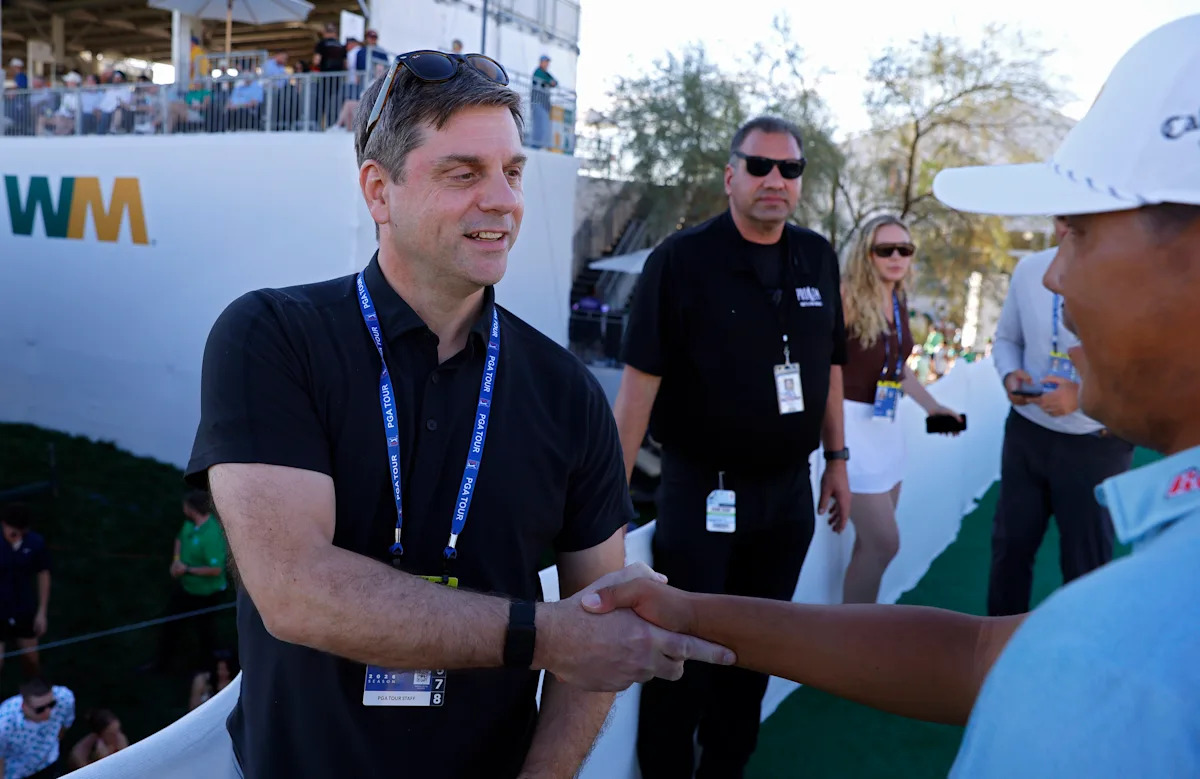
ORLANDO, Fla. — This week at The Arnie, the conversation around the driving range and inside the locker room hasn’t just been about green speeds, Bay Hill’s gnarly rough, or whose new putting grip is going to last longer than nine holes.
It has been about the future.
Advertisement
And more specifically, it’s about the man tasked with shaping it:
His name is Brian Rolapp.
Rolapp is replacing outgoing commissioner Jay Monahan, yet his title will not be commissioner; it will be the decidedly more corporate designation of “CEO” — and for good reason. The PGA Tour, which used to be strictly non-profit, is now in the business of making money … big money.
And Rolapp arrives from the biggest money-making sports endeavor in the history of the world — the National Football League. His career was built inside the NFL, where he served as chief media and business officer and helped oversee the most powerful sports media ecosystem on the planet.
Advertisement
And if there’s one thing Rolapp learned in football, it’s that success in modern sports often comes down to something simple: public attention and interest.
When asked recently about rooting interests during his time in the NFL, Rolapp gave a revealing answer.
“I didn’t cheer for teams,” he said. “I cheer for television ratings. So whoever is behind, that’s who I’ll cheer for.”
It wasn’t just a funny line; it was an instructive one.
Because Rolapp now oversees a business that is very much about generating value.
The Tour is no longer just a comfortable nonprofit content to carry on as it always has, staging tournaments, handing out prize money and calling the model a success. It is now partly backed by the massive investment from Strategic Sports Group — $1.5 billion injected into the sport with the expectation of a return.
Advertisement
That not only changes the calculus; it likely will change the entire structure of professional golf.
If Rolapp’s early comments are any indication, the NFL’s influence is already showing. He recently outlined three guiding ideas he wants a new competition committee to explore:
Parity, simplicity and scarcity.
Those three words might sound abstract.
But they are essentially the core principles of the NFL.
Parity keeps fans engaged.
Simplicity makes competition easy to follow.
Scarcity makes events feel important.
And in golf, at least two of those ideas feel particularly relevant.
Parity, for example, is already alive and well, but simplicity and scarcity hint at something potentially transformative.
Advertisement
Let’s face it, for years, the Tour’s season has been anything but simple. To this day, does anybody really understand how the FedEx Cup works? It’s the only playoff system in the world that requires a flow chart.
“Competition should be easy to follow,” Rolapp said recently. “The regular season and postseason should be connected in a way that builds towards a Tour Championship in a way that all sports fans can understand.”
As for scarcity, the NFL’s secret weapon since the beginning has always been “less is more.” Fewer games mean more important games. Meanwhile, the Tour Championship last year was the 38th event of the season. At that point, the only scarce thing left was the attention span of golf fans.
“A focus on the Tour’s top players competing together more often in events that feel special for fans and feel special for the players,” Rolapp says.
Advertisement
That philosophy has already taken shape in the Tour’s signature events, such as The Arnie, which feature smaller fields and larger purses. Even more of these types of star-studded events will create a college football landscape in which you have elite programs in the Power 4 and then Group of 6 leagues like the MAC and Sun Belt playing for scraps.
“Here’s as eloquently as I can put it,” PGA Tour veteran and former U.S. Open winner Lucas Glover told esteemed Sports Illustrated golf writer Bob Harig. “It’s a shame that we’re continuing to trend in this direction. It’s legitimately becoming two tours, which is sad.”
It may be sad for the PGA Tour’s middle and lower tiers, but it’s much more enticing for the fans and the TV viewers. What could soon be happening in golf should be a lesson for other sports.
Consider the NBA, which continues to grapple with the challenges of its 82-game season: Load management. Tanking. Long stretches of games that feel inconsequential. Imagine if the NBA adopted more of the NFL’s scarcity mode — fewer games, higher stakes, more urgency.
Advertisement
The result might look a lot like what Rolapp is trying to build in golf: a schedule built around events that truly matter. From a business perspective, Rolapp’s thinking reflects a broader reality across sports:
The biggest stars drive the biggest audiences.
Some of the Tour’s most influential players are already engaging with Rolapp and are raving about his no-nonsense, git-r-done approach. Like when he accelerated five-time major winner Brooks Koepka’s return to the PGA Tour after spending four seasons on the rival LIV Golf circuit.
“You look at a situation like Brooks,” Scottie Scheffler says. “That was something where Brooks had a desire to come back (to the PGA Tour), and he’s a guy that provides a ton of value for our fans and sponsors. … And Rolapp’s like, ‘OK, he wants to come back, let’s figure out how to do this.’ And then he gets it done in pretty quick fashion.”
Advertisement
Says Rory McIlroy: “I like him. I like him a lot. I like that he doesn’t come from golf. I like that he doesn’t have any preconceived ideas of what golf should look like or what the Tour should look like. I think he’s going to bring a fresh perspective to everything.”
There is no doubt about it, the PGA Tour is entering a new era shaped not just by players, but by business realities. And if Brian Rolapp ultimately brings a pro football mindset into golf’s DNA, well, you rarely go wrong by following the NFL’s blueprint.
If that transformation begins anywhere, it might as well start this week at Bay Hill, where the game’s past, embodied by Arnold Palmer’s legacy, meets with the uncertain but fascinating future of the sport.
Read the full article here


