




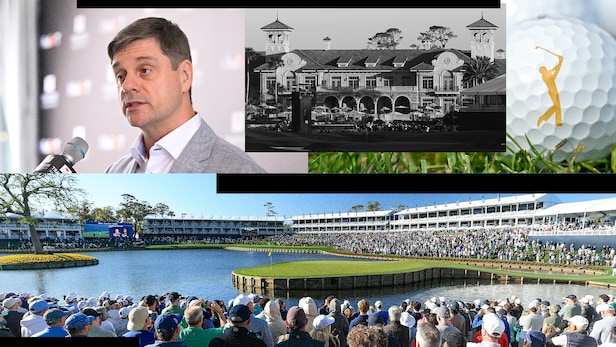
The PGA Tour wants something it cannot ask for, something that benefits no one but itself, from people who have every reason to say nothing at all.
That is the quagmire Brian Rolapp’s predecessors overseeing the tour could never solve. For decades, the tour’s overtures on calling the Players Championship the fifth major backfired in the most predictable way possible, because the moment you have to explain why you matter is the moment you’ve already lost the argument. The volume came down during the Jay Monahan era, and perhaps unsurprisingly, that quiet correlated with genuine growth. Freed from its own anxiety, the Players found something more valuable than a major-in-waiting: It became the best non-major in the world, earning its footing not by chasing a designation it couldn’t have, but by being an event nobody could dismiss.
Advertisement
Then last month, a promotional video surfaced with the tagline “March Is Going to Be Major.” Tournament director Lee Smith confirmed what everyone already suspected. “This is a signal of the confidence, momentum and offense that is coming out of our building these days,” Smith said at last month’s Players Championship media preview. “We wanted to start a conversation.”
Why, after a decade of calculated restraint, is the tour comfortable letting the “m-word” breathe? Instead of asking for a seat at a table without an empty chair, it’s bringing its own. The only way to become a major is to act like you already are one.
• • •
To call this a full-throated campaign by the PGA Tour, at least right now, would be overstating things. Rolapp, his tenure in Ponte Vedra Beach still measured in months, understands the optics. After spending two decades working at the NFL, he’s earning positive reviews from most corners of the professional game, but he’s also the new man with no background in the sport. Showing up in Year 1 to declare the Players a major would come off as exactly what his critics already fear: a non-golf guy who doesn’t know what he doesn’t know. Besides, the new schedule is his chief priority, a restructuring with the potential to upset a significant portion of tour constituents. Threading that needle is Job No. 1. The major conversation is, for now, a whisper, and the Players as currently constructed is not a major championship. The people inside the tour are the first to say so.
Advertisement
Start with who isn’t in the field next week for the 52nd playing of the event. The Masters, U.S. Open, PGA Championship and Open Championship emerged from the professional golf’s civil war with something unexpected: authority. As the best players in the game continue to play on separate circuits, the four majors remained open to anyone who could qualify, regardless of which league signed their checks, and that universality became inseparable from their legitimacy. The Players, meanwhile, is a tour event, which means LIV headliners Bryson DeChambeau, Jon Rahm and Tyrrell Hatton aren’t in it. Calling that a major is a fight the tour cannot win in public, and privately, it knows it. Which is why a future where LIV players can earn their way into the Players field is not off the table, according to one tour source. It may, in fact, be the price of admission to the conversation.
But solve that and geography is waiting. Three of the four majors are already American, a ratio that already seems unbalanced for a sport that has spent the last decade insisting on its global character (and particularly tough when considering tennis’ four majors are across four countries on three continents). A fifth golf major, anchored permanently to a tour-owned Florida venue, would hand critics in Europe and Asia—especially those who would argue the Australian Open deserves major consideration—an argument requiring no elaboration. The tour isn’t moving the Players from Sawgrass—nor should it, because the course is the event’s identity and its financial engine. But that means the one thing that makes the Players the Players is also the thing that makes it hardest to call it a major anywhere east of the Atlantic. There is no resolution here; only the hope that, eventually, everyone would buy in.
Beneath all of it sits Augusta National. Not as an obstacle exactly, but as a gravitational force the tour has no interest in disturbing. The unspoken compact is that the Masters is the sport’s new year, the event that tells the casual fan the season has truly begun. A March Players doesn’t directly threaten that. But a March major might. Which is why some inside the tour believe the Players would eventually need to move back to May, requiring the PGA of America to shift the PGA Championship to August, a calendar surgery that seemed unthinkable until you remember it was only 2019 when the PGA moved in the first place. If there is ever a moment to restructure, a full schedule overhaul is it. But it requires coordination between organizations that are not, at the moment, coordinating especially well.
More Players Championship Preview stories
What-If History 11 ways golf would be different if the Players Championship was a major all along

Ranking Players Championship picks 2026: Our 13 best bets to win at TPC Sawgrass
FAQ Players 2026: Everything you need to know about the PGA Tour’s flagship event at TPC Sawgrass
Advertisement
And then there’s tradition. It’s the oldest objection, and in some ways the weakest; the number four has felt permanent, but it was invented. The Western Open and the Canadian Open were once considered majors. The amateur championships counted until a research committee led by then-tour commissioner Deane Beman quietly decided in the late 1980s that only professional tournaments should apply, which is why Jack Nicklaus has 18 majors instead of 20.
More to the point, the modern four-major construct was essentially lobbied into existence. Augusta National used Grantland Rice, its charter member and the most influential sportswriter of his era, to build the Masters’ early prestige. In the 1960s, sportswriter Bob Drum effectively invented the modern Grand Slam in conversation with Arnold Palmer—a framework that was sold as historical symmetry with Bobby Jones’ 1930 season, but functioned mainly to cement Palmer’s legacy. Majors, in other words, have always been partly a matter of who controls the narrative.
The difference now is that no single personality or entity commands that kind of authority. The fans give professional golf its meaning, but they don’t have knighting power either. For the Players to become a major, the bodies that run the existing four would have to consent, and as previously noted, the relationship between the tour and those bodies, while not broken, is unsettled. They rallied behind the tour during the LIV conflict, then were blindsided by the secret framework agreement with Saudi Arabia’s Public Investment Fund. The distance rollback debate has fractured the coalition further: the USGA, R&A and Augusta National support it; the PGA of America opposes it; the tour, wary of alienating its players, equipment manufacturers and a LIV operation that would happily market itself as the non-conforming alternative, has tried to stay out of it. Things are not harmonious. And it is into that specific climate that Rolapp is now trying to introduce the most self-serving request the tour has ever made of its partners.

2071908189
James Gilbert
Advertisement
This is where Rolapp’s standing becomes important, and why the whispers have been revived. The leaders of golf’s other governing bodies regard him well, according to multiple sources at each organization. But a quiet skepticism lingers. There is a belief, real or perceived, that Rolapp, 53, may be using this job as an audition for NFL commissioner once Roger Goodell retires. The implicit question, posed by more than one source, is pointed: Why should they do the tour a favor for an individual who may not be invested in the sport long-term?
The question, however, assumes Rolapp needs their goodwill more than they need his.
Those underestimating Rolapp because of his inexperience with golf could be in for a rude awakening. He was the NFL’s apprentice, and the NFL does not produce diplomats; it creates people who understand leverage. Rolapp has already shown with LIV that the tour’s old defensive posture isn’t going to cut it anymore, and that applies to the Players push. Set aside the “independent contractors” framing of tour membership for a moment and consider the simpler reality: Rolapp leads the organization that the major championships need to stage their events. The players who make those tournaments worth watching play tour golf 30 weeks a year. That is not a small thing to hold.
• • •
A nuclear options exist for Rolapp. A biennial PGA Tour versus DP World Tour match-play event, pitting America against Europe, would cut directly into the Ryder Cup’s oxygen. Players could, in theory, be steered away from the Ryder Cup entirely, and after the event’s black eye from Bethpage, the PGA of America isn’t in the best position to counter. It was just seven years ago that players, fed up by a series of gaffes from the USGA, openly wondered if the tour should host a national open instead. And though the USGA has Augusta National in its corner on the rollback, what it doesn’t have is the tour’s relationship with the people who actually watch the sport—and governing bodies that lose that relationship tend to find their authority goes with it. Nobody is pulling those triggers, or even suggesting they should. But Rolapp knows they’re loaded, and the other bodies know he knows. That is a different kind of conversation than the one the tour has been having for 50 years.
Advertisement
But perhaps the most underrated reason the push is happening now is the cover of everything else. There is a theory in business—the “big bang”—that radical changes are most effective when they arrive together, creating a new status quo before resistance has time to organize. The PGA Tour has learned this lesson the hard way. Five years of incremental adjustments have produced five years of rank-and-file pushback, each change relitigated in isolation. But if you are already overhauling the schedule, restructuring the competitive hierarchy and reopening the door to LIV players, then folding major status for the Players into that same moment is not addition. It’s camouflage. The ask doesn’t disappear. It just becomes harder to single out. New leaders, historically, have a narrow window when momentum is on their side and inertia hasn’t yet calcified against them. Rolapp sees that window. The question is whether he has the patience to use it correctly, and the nerve to use it all at before it closes.
Which is why the soft push begins now. The Players getting major status will not happen in a single announcement or a single season. It will happen gradually, through the work of getting the right people to say the right things. About the Players’ strength of field, about the identity of the course, about not letting the past dictate the future, about what it means to the players who compete for the title. Recently, Russell Henley said publicly that he believes the Players is a major. That is not an accident. That is how the conversation starts.
Rolapp has decided the stategy is to not keep asking, because the answer has always been No. Instead, it’s to make the outcome feel inevitable—to build the case so quietly, so patiently, that by the time the governing bodies are asked to render a verdict, the jury has already decided. The tour doesn’t need to proclaim the Players a major. It just has to let everyone else catch up with what it already believes.
More Players Championship Preview stories
Crunching the Numbers 52 fun stats for 52 years of the Players Championship
Read the full article here


