





Shortly after being named the PGA Tour’s CEO last summer, Brian Rolapp laid out three pillars upon which he planned to remake the business: parity, scarcity and simplicity. The latter referred mainly to the convoluted FedEx Cup system, but by now Rolapp knows simplicity is scarce elsewhere too. Every week further illustrates the labyrinthine nature of Tour operations, and the acute delicacy of the balance he needs to strike. An eager-to-impress C-suiter ought to gift the boss a throw pillow for his upcoming birthday that bears the words of Douglas Horton, a former dean of Harvard Divinity School: “The art of simplicity is a puzzle of complexity.”
Last week’s CJ Cup Byron Nelson was educative: marrying a newish sponsor with an established tournament to leverage the legacy of a man who died 20 years ago, staged on an insipid TPC course and awarding a trophy that, despite its name, isn’t a cup. Add some parochial Texas loyalties, which showed Rolapp how tough it will be to get stars to stay in their lane if the Tour splits into upper and lower tiers in 2028 as proposed. Scottie Scheffler and Jordan Spieth always play the Nelson because they got their starts there as pimply teens, and won’t like being told to stay away if it isn’t part of their upper tier schedule in future. Not a lot of simplicity to be found there.
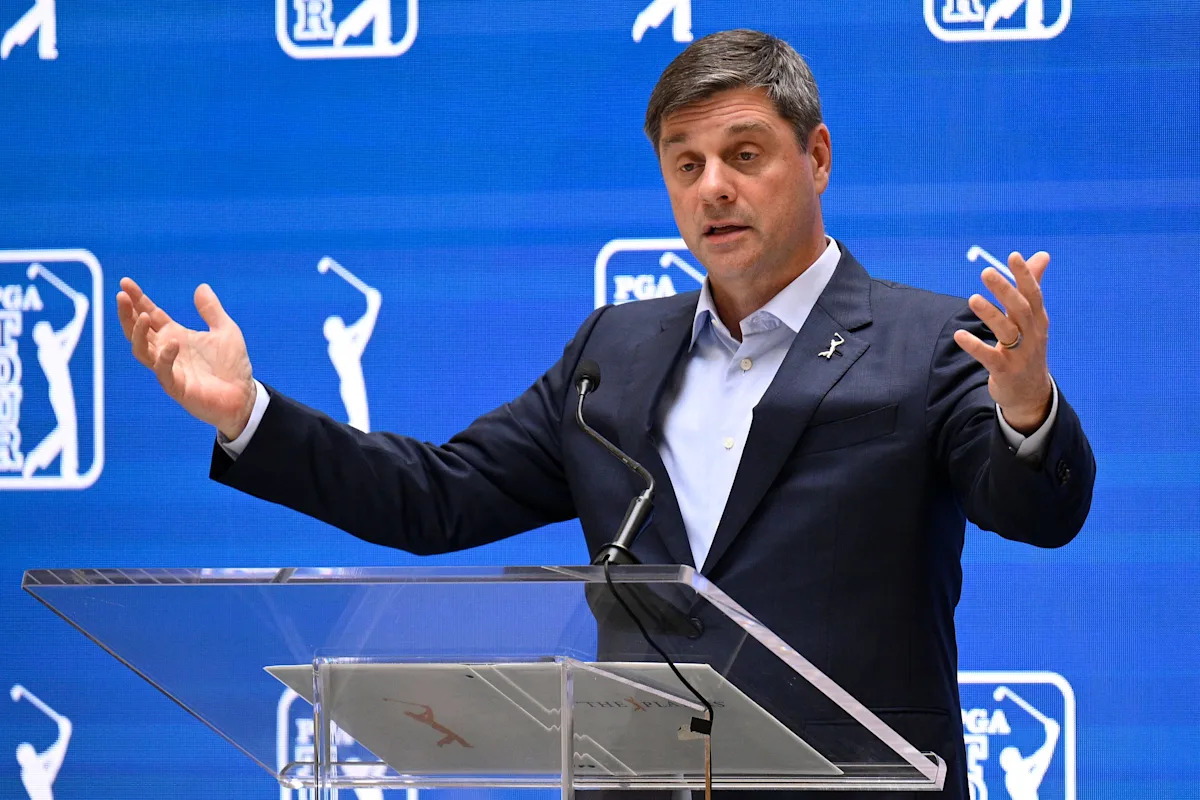
Brian Rolapp, CEO of the PGA Tour, speaks to the media prior to the Players Championship 2026 at the Players Stadium course at TPC Sawgrass on March 11, 2026 in Ponte Vedra Beach, Florida.
At this week’s tournament, the Charles Schwab Challenge at Colonial, romance smacks into reality. The event dates to 1946, when Ben Hogan won and Mr. Schwab was nine years old. It’s a familiar stop for fans and is held at a respected venue. Yet top players are as scarce as Ted Cruz during an ice storm. Things are more straightforward at next week’s Memorial Tournament, on paper at least. Jack Nicklaus hosts, it always draws an elite field, and is assured upper tier status in perpetuity. But all three events highlight Rolapp’s challenge when it comes to fashioning a new schedule structure.
Advertisement
The Tour platforms, markets and monetizes the tournaments, but doesn’t enjoy ownership of any of them. The Nelson belongs to the Salesmanship Club, the Schwab to Colonial Country Club, and the Memorial to Muirfield Village Golf Club. And that isn’t uncommon. The WM Phoenix Open is owned by the Thunderbirds, who organize it. The Western Golf Association controls the BMW Championship, which traces itself to the old Western Open, originally contested in 1899, decades before any vehicle rolled out of the Bavarian Motor Works factory. The RBC Canadian Open is under the writ of the Royal Canadian Golf Association, while any calls on the AT&T Pebble Beach Pro-Am fall to Pebble Beach Company and the Monterey Peninsula Foundation.
There are elements of the schedule that Rolapp will find comparatively easy to manage as he restructures. The Hawaii swing was expendable, for example, and the eight events on the Fall slate generally lack stature, history or complicated management structures to accommodate. He can rely on Tour marketing to manufacture connective tissue between Sam Snead’s win at the inaugural Greater Greensboro Open in 1938 and Cameron Young’s triumph at the last Wyndham Championship, or from Harry Cooper’s victory that same year in New Orleans to the Fitzpatrick brothers’ team foursomes win. But there’s a lot he can’t control, and that must by now be a gnawing frustration.
The golf ecosystem is a product of decades of compromises and uneasy co-existence, but not something one would ever seek to recreate if starting over. As a schematic, it makes little sense, but somehow seems to function. But it surely proves confounding for Rolapp and his investors at Strategic Sports Group, who are accustomed to operating in sports where the league is the sole, absolute authority — on governance, on rules, on scheduling, on equipment, on talent obligations, on venues. Not a single one of which the PGA Tour has complete control over.
Rolapp watches major championships generate huge revenue on the backs of his players, in which he doesn’t share. He hears members gripe about where and when they’re willing to compete as they prioritize those majors, forcing him to reverse engineer a schedule around them. He awaits the unwelcome distraction of the governing bodies taking executive action on golf ball distance, which is largely opposed in his locker room. And he can’t even guarantee the stadia in which his games are played. To wit: Rolapp wants to be in the biggest media markets, but he may need to source a new home in Los Angeles. There are rumblings that Riviera Country Club might take a break from hosting the Tour’s annual Genesis Invitational because of a glut of significant events on its docket, including next week’s U.S. Women’s Open, the 2028 Olympic golf competition and the men’s U.S. Open in 2031.
Advertisement
The approach Rolapp could deploy in his old job at the NFL — being a blunt instrument — doesn’t fly in golf, no matter how impatient he gets. He can’t arbitrarily create a schedule shorn of the old ownership and obligations (because that would be a LIV-style cash grab with no meaning), can’t hastily dismiss the governing bodies (because he’s not so dumb as to want to get into rule-making and governance), and can’t hold the majors hostage for a ransom (because, well, good luck getting Fred Ridley to pay).
A little more than three weeks from now, the PGA Tour’s board meets in Hartford, Connecticut, after which Rolapp has promised an update on the progress toward rebuilding the business around his aforementioned three pillars. For all the unknowns in those negotiations there’s one thing he knows for sure. Simplicity isn’t a luxury he enjoys.
Eamon Lynch is a columnist for Golfweek.
This article originally appeared on Golfweek: Lynch: Brian Rolapp wants simplicity at PGA Tour. He’s finding out that’s a complicated goal
Read the full article here