





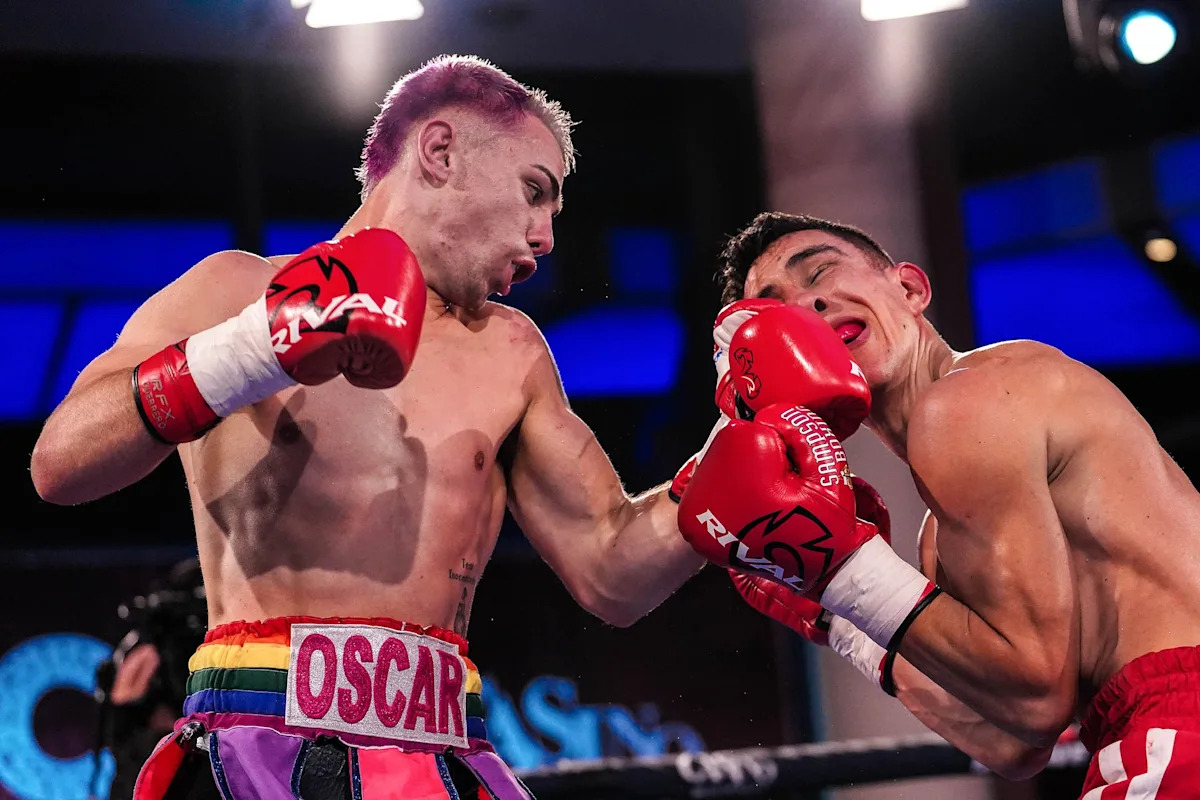
Oscar Bonifacino is gay.
This isn’t how an article about a 22-year-old boxer should start, but it’s how the Uruguayan wants to be seen and known. He has spent much of his life hiding who he is. Now, he insists that if people are going to know his name, they should know the whole story.
Advertisement
Bonifacino is an unbeaten prospect in the featherweight division in ownership of a 4-0-1 (3 KOs) record, but while speaking to Uncrowned via a translator, it’s easy to understand why his standing in the sport is bigger and more important than his in-ring achievements.
As of this writing, he is widely recognized as the only openly gay male in professional boxing.
“I could never talk about it before,” he explains from his training base in Las Vegas. “And I think this is why I have had a lot of problems in my life. I lived in darkness. I never had that confidence to say who I really am. But now I can be free and tell the world that I am gay.”
Bonifacino returns to the ring this Saturday night in his sixth pro fight on ProBoxTV. He’s scheduled in a six-rounder against Spain’s Raul Escudero (4-0, 0 KOs) inside California’s Orange Show Events Center.
Advertisement
This will mark just the fourth fight of his life as “openly” gay to the boxing public, having announced himself to the world in Buenos Aires last June, draping a Pride flag over his shoulders in victory over Matias Leandro Yanguas and wearing a rainbow belt throughout the contest.
“I am a free person, I am a gay man,” he told the crowd in attendance that evening.
Bonifacino’s fight has been lifelong, and not constrained to inside the boxing ropes.
Growing up in the Maldonado countryside, his parental attention was shared between 10 other siblings. And when he did receive focus from his father, it was for the wrong reasons.
Advertisement
“My father would hit me,” he says matter-of-factly. “He knew I was different and wanted to ‘straighten’ me out.”
The beatings weren’t the hardest part. For Bonifacino, living every day convinced he couldn’t be himself proved even more damaging.
“I led a life of hiding who I was,” he says. “I was scared to speak to anyone in my family, or friends, as I didn’t know how they would react. Would they react the same as my father? I was forced out on the streets for a lot of my childhood — this was where I learned to fight for myself.”
Drug use, Bonifacino explains, initially felt like little more than teenage experimentation before developing into something much darker. Violence became commonplace. He was eventually shot in the foot after finding himself somewhere he shouldn’t have been.
Advertisement
“I was carrying a lot of negativity,” he says.
The trajectory seemed obvious. Then someone intervened.
Jacqueline Rodriguez, the woman Bonifacino describes as being “like a mother,” refused to watch him throw his life away. She told him bluntly that he would either end up dead or in prison unless something changed.
“You don’t have a choice in life, you don’t have a future, why don’t you get into a boxing gym?” he was advised. Jacqueline funded his sessions, and from day one he knew it was the right path for him.
“I fell in love with boxing as soon as I put the gloves on,” he explains. “Once I stepped into that gym, I never wanted to leave. I was able to channel the aggression inside of me and hit someone, something, but with rules. It was a great escape.”
Advertisement
Bonifacino strung together a 14-7-1 amateur record before turning professional in February last year, becoming the only openly gay professional male boxer. But statistically, there must be more.
Research from large international surveys suggests that about 2-5% of adults identify specifically as gay or lesbian. If you include bisexual people, around 5-10% of adults identify as LGBTQ+ in many countries, with higher percentages among younger generations.
A 2021 study by the Williams Institute at UCLA School of Law found most suicide attempts (61%) among LGBTQ+ people occurred within five years of realizing one’s sexual minority identity, which is more than likely going to be very early on in a boxer’s career.
Bonifacino attempted to take his own life in 2020, after being plunged into a deep emotional abyss. The lack of role models for someone like him to turn to made being a male gay boxer seem almost alien.
Advertisement
He was made aware of Orlando Cruz’s story after he came out. Puerto Rico’s Cruz, now retired, fought between 2000-2018 and was a boxing flag-bearer for the LGBTQ+ community. The biggest difference between their two stories was the support and encouragement Cruz received as a young adult when he announced his sexuality.
Orlando Cruz (R) throws a punch at Orlando Salido during their WBO featherweight title bout in 2013.
(Jeff Bottari via Getty Images)
“I was lucky as I was given such support from my mother from an early age,” Cruz explained to me in 2021. “She has always been my best friend and she would accept me for whatever I would be in life. ‘Don’t cry, don’t be scared,’ she would tell me, but this comfort can’t always be found so close to home.
“I am currently talking to six male boxers from around the world who are gay, yet don’t have that support network to give them the confidence to come out publicly. These guys are from all over — Spain, Colombia, USA, United Kingdom and Panama. They are able to confide in me and receive the support from me that I was lucky enough to get from my family.
Advertisement
“It’s a great honor for me to be able to share some wisdom with them, but it shouldn’t be up to me,” he continued. “I am scared that our sport will never move on far enough for them to be comfortable to be who they really are as a professional.
“It’s now down to me to educate those who are born or raised to be ignorant. Life is so short and tomorrow is never promised, so any day that is spent hiding from the world is a day wasted. Sure, it’s scary, but together we can build a world, and a sport, where people are free to be who they really are.”
Bonifacino made it his mission to find out more about Cruz when he first heard of his journey. “I wish I knew about his story sooner,” he admits, candidly.
“Every day is still a fight for me. Against stereotypes, taboos, stigmas, everything. There are so many barriers to knock down in a sport like boxing where traditional machismo is championed.
Advertisement
“There shouldn’t be set rules as to what all boxers should look like. I am still a fighter, I have just chosen to be free and love who I want to love.”
Bonifacino went on to explain that he isn’t the only person fighting an uphill battle in boxing. He alluded to the struggles women go through in order to compete and excel in a sport that had long excluded them.
Bonifacino is managed by Sampson Lewkowicz and is complimentary on the support that he has received from his Uruguayan compatriot. Under Lewkowicz’s wing, Bonifacino believes he can become Uruguay’s first male world champion and inspire a generation of gay fighters who are proud to participate with freedom and pride.
“I’ve chosen to be happy, and turned pain into strength throughout my life,” he concludes.
Advertisement
With such self-belief, the sky is the limit.
Read the full article here