





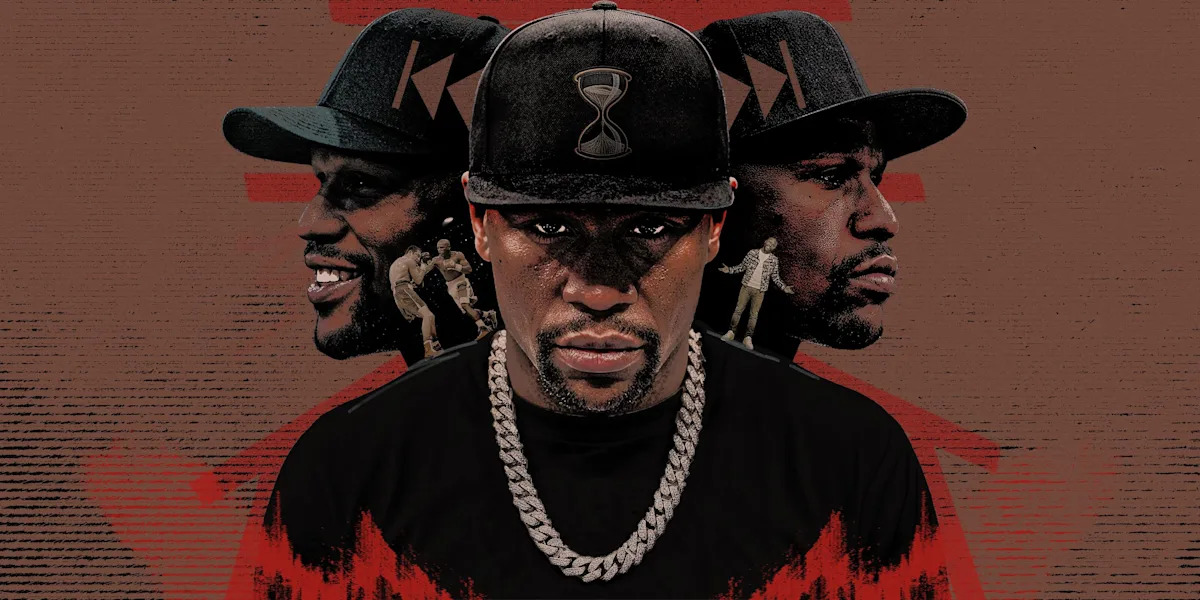
Perfectionist
It is only in a boxing ring that a man like Floyd Mayweather is ever close to perfect. In that domain, where he is both safe and glorified, Mayweather has everything in his otherwise chaotic life in order. He has his jab, his check hook, his shoulder roll and anything else he requires to give him a sense of control in the presence of danger. He also knows he is slicker, smarter and better than anyone who threatens his control. This has been proven countless times. It is why his professional boxing record stands at 50-0 and why no blueprint to beat Mayweather exists.
Advertisement
He is perfect, after all, at least in the ring. There, within the ropes, he barely puts a foot wrong and has, in a sport famous for comebacks, never once had to dust himself down and return from a loss. He was, it turns out, too good for all that, despite boxing for 21 years professionally and giving just about everybody a go. There was, of course, the odd mini-crisis, expected given the nature of his sport, but of all the champions who have called a ring their home, few have been able to keep it as clean and as orderly as Floyd Mayweather. He was a stickler for it, cleanliness. He couldn’t bear getting touched, let alone beaten. It became an obsession if anything. Everything in its right place. Everything just so.
Frankly, to pinpoint Mayweather’s imperfections is no easier than doing the same on the face of a runway model. Look hard enough and you can always find something, but when perfection becomes one’s stock-in-trade, one works that bit harder to uphold the illusion of it. For Mayweather, the idea of perfection wasn’t just a goal, it was a mindset. It was what he used to bait and belittle opponents — intimidate them, too — and it was a weapon he used for leverage at the negotiating table. Belts were one thing, yes, but better than belts was being perfect, of which Mayweather had evidence in the form of his pretty, unbeaten record.
Floyd Mayweather Jr. retired at 50-0 in 2017 after a win over Conor McGregor.
(Christian Petersen via Getty Images)
Even the number on which it all ended — 50-0 — was perfectly round, solid and satisfying. To get there he fought Conor McGregor in his final fight — admittedly, far from perfect — but by then everybody else had had their turn, with only a few coming close to exposing Mayweather’s imperfections.
Advertisement
The first fighter to show that Mayweather was human was Jose Luis Castillo. The Mexican challenged Mayweather for his WBC lightweight title in 2002 and was aggressive and ambitious enough to win rounds. Whether he ultimately won the fight is debatable, but by virtue of him attacking Mayweather with the belief that he could win, Castillo immediately separated himself from all who had boxed Mayweather to that point. It wasn’t just huff and puff, either. Castillo did some excellent work in that fight and plenty, to this day, believe he was unlucky not to get the nod after 12 rounds harassing Mayweather.
The next time Mayweather felt discomfort was two years later, in 2004, when DeMarcus “Chop Chop” Corley nailed him with a big left hand and suggested in the process that Mayweather’s weakness could be southpaws. It was only a moment — Corley was otherwise well beaten over 12 rounds — but with such moments few and far between, the mere shock of seeing Mayweather rocked by a punch would suffice. Now others had the hope of landing that one shot in the future.
“I remember everything,” Corley told me. “We trained hard for Floyd and the game plan was there. We knew he wasn’t a power puncher. He doesn’t have explosive punching power. But he’s very quick. The game plan was to get Floyd to exchange. We wanted to get him in a shootout where we could hurt him and try to finish him.
“I got him in a shootout in the first and second rounds and in the third round I caught him. Then, in the fourth round, we tried to finish him, but he went to the ropes where he recovered and listened to his corner very well. His Uncle Roger told him, ‘Don’t bang with him. Box him.’ He listened. He stopped banging with me and started boxing with me. He knew if he banged with me anymore, I was going to knock him out. I would have caught him again. It was just a matter of time.”
Advertisement
By resisting the temptation to “bang” with Corley, Mayweather tightened up and tidied up, running out a clear winner on the scorecards in the end. It was a concern, though, for him to be caught like that, hurt like that, seem vulnerable like that.
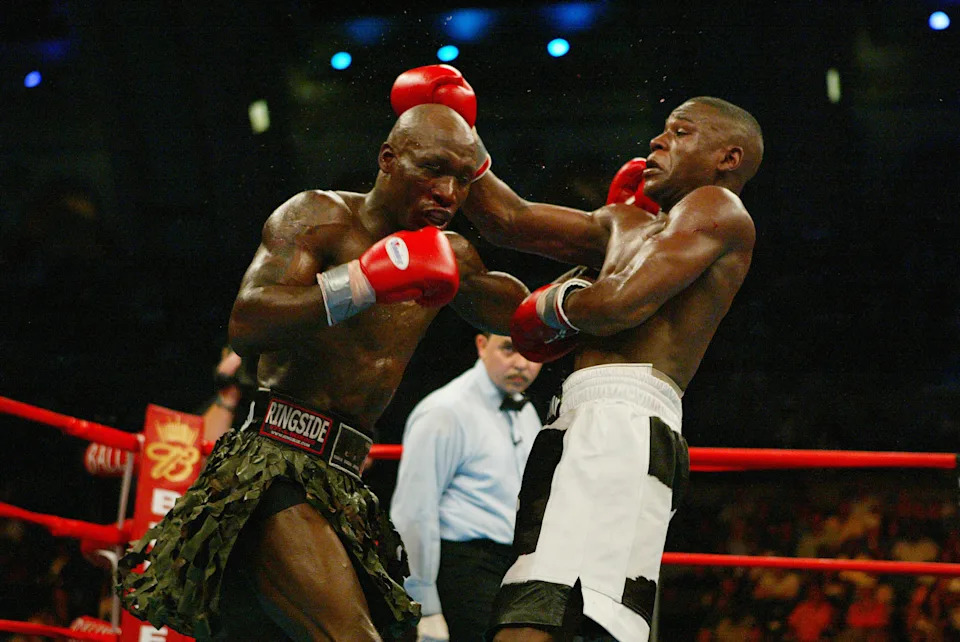
Demarcus Corley was the first to really bother Floyd Mayweather.
(Al Bello via Getty Images)
The only thing more concerning for a clean freak like Mayweather was to be beaten at his own game. Because while it is true that any fight can turn with the landing of one significant blow, the prospect of Mayweather getting outboxed or struggling for an extended period in a fight was something else; something he couldn’t comprehend; something we had never before witnessed. Even against Castillo, whose aggression made him restless, there was never a sense that Mayweather was being outboxed or outfoxed. He was simply fighting the wrong kind of fight at times.
In fact, it wasn’t until Mayweather met Zab Judah, another southpaw, in 2006 that we saw, for perhaps the first time, Mayweather meet his match in terms of both speed and skill.
Advertisement
“He struggled because I was quick and because we knew each other,” said Judah, reflecting on his unanimous decision loss to Mayweather 20 years ago. “I knew him; he knew me. There was nothing that surprised me. Nothing I hadn’t seen before. In ’96, we were best friends — me, him, Zahir [Raheem]. I’d been around Floyd at a younger age in different tournaments. He was always Detroit; I was always New York. We always kicked it.”
There was certainly an uneasiness about Mayweather that night, particularly early on. For four rounds, Judah was not only in the fight but arguably leading, and time and time again he got to Mayweather before Mayweather could get to him. Such was his speed, you see, Judah was able to lead when he wanted to, as well as counter whenever Mayweather tried stepping to him and initiating an attack. All in all, Judah had every reason to feel pretty comfortable throughout the first half of the fight and only his tendency to fade, coupled with Mayweather’s tendency to solve problems, saw Judah fall off in the fight’s second half.
“Like he says, I won six rounds, he won six rounds,” said Judah. “If he won six and I won six, what does that mean? I would have accepted a draw. At least then I know I would have messed up his pretty record. Back then he was known as ‘Pretty Boy’ and I would have messed up the ‘Pretty Boy’ record.
“But it was a great night, a very big night. I felt excellent in there. I felt like at the end of it I would get a draw. I really believed that.”
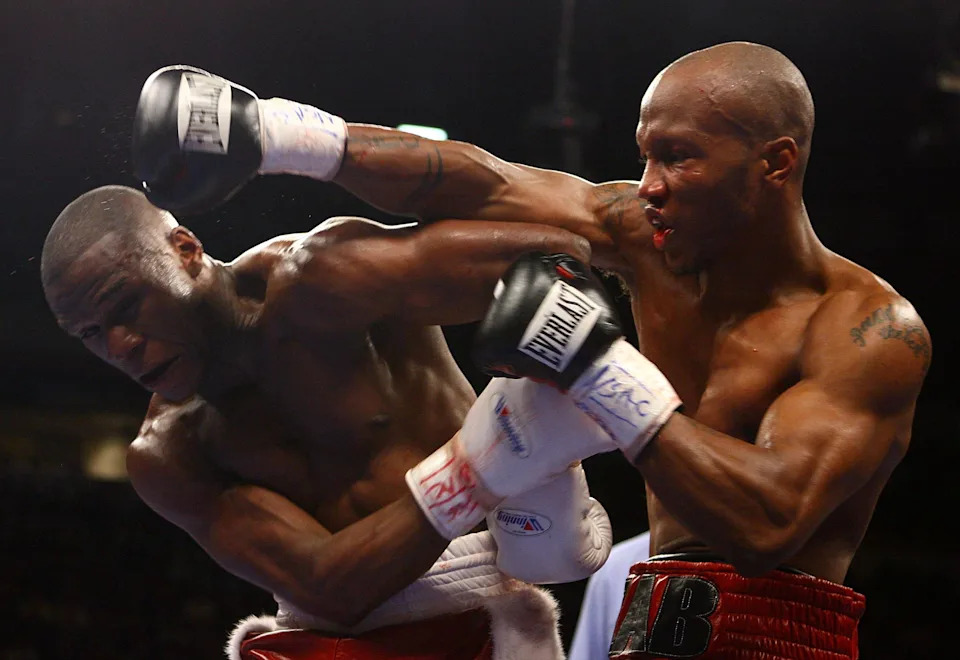
Zab Judah nearly took a draw against Floyd Mayweather in 2006.
(Al Bello via Getty Images)
Usually when Mayweather beat an opponent, it was by decision, and usually when he won a fight by decision, it was unanimous, meaning nobody disputed it. In a career awash with decisions, only Marcos Maidana and Saul “Canelo” Alvarez received even scores against Mayweather (one scorecard of 114-114 in both cases, with Maidana’s far more deserved than Alvarez’s), and only one opponent had ever beaten Mayweather according to a scorecard: Oscar De La Hoya. He, according to the scorecard of judge Tom Kaczmarek, edged Mayweather by a score of 115-113 in 2007, and if it wasn’t for that score being overruled by the scores of the two other judges — 116-112 and 115-113 — De La Hoya could have been the one to take Mayweather’s zero. “I thought I landed crisper punches,” De La Hoya said at the time. “If I didn’t press the fight, there would be no fight. I hurt him with a few punches that I know he felt and I was pressing and wanted to stop him. I was trying to close the show. I am the [WBC super welterweight] champion and you’ve got to do more than that to beat the champion.”
Advertisement
The one other time Mayweather’s perfect record came under threat was in 2010, the night he failed to get out of the way of a Shane Mosley right hand thrown in Round 2. As with Corley in 2004, Mayweather, upon taking the shot, all of a sudden found that his legs were unsteady and that his instinct was to hold. He was, in the tradition of so many of his opponents, now looking to survive.
“History could have been changed,” said Mosley. “I think Floyd thought, ‘Oh, he’s an older guy, he’s not as strong or as fast as he used to be.’ He didn’t believe in the power. When I hit him the first time, I think it caught him off guard. You could see him thinking, ‘How did he get that right hand in?’ He still wasn’t convinced, so then he tried his little check hook and I went over the top again with the right hand. That’s when I almost knocked him out.
“I think for a moment he saw black and thought he was going to be knocked out. But in some kind of way he proved he was a champion by recovering from it. He started holding and doing what it takes to survive. That’s what champions do. They find a way to survive and then win. He did just that.”
In the end, like all of Mayweather opponents, Mosley was left ruing what could have been. He had tasted it, victory, but hadn’t been able to secure it.
Advertisement
“Back in my day I know I would have knocked him out,” claimed Mosley. “I didn’t believe he could take my punches. I rocked him in the second round and it wasn’t really that hard. I just kind of slid in and got him. So I knew I was going to get him again. But it just never happened. I could never get another clean shot.
“I think if I was a little bit younger and in better shape, I would have been able to throw a lot more punches and get different positions, and I think I would have been able to catch him with the shot I was looking for. My timing wouldn’t have been as bad as it was when I fought him. I would have timed him and caught him.”
In every respect, Mosley’s timing was wrong in 2010. The timing of the fight was wrong and, for the most part, the timing of his punches wasn’t much better. Worst of all, after hurting Mayweather in Round 2, he quickly ran out of time.
By 2017, the year of Mayweather’s retirement, so had everybody else.
Advertisement
Exhibitionist
When the great American novelist Phillip Roth decided his time was up at the age of 80, he stopped doing what he loved and what fueled him and refused to look back. Eighty, he felt, was a good number on which to exit. It was round. It was solid. It had a nice ring to it. “I had reached the end,” Roth said in an interview with the BBC around that time. “There was nothing more for me to write about. I was fearful. Yes, I was fearful that I would have nothing to do. I was terrified, in fact. But I knew there was no sense continuing. I was not going to get any better, and why get worse? So I set out upon the great task of doing nothing.”
In retirement, Floyd Mayweather had only his perfect 50-0 record to remind him of his perfection. He no longer had the ring in which to show it, nor could he experience that addictive thrill of seeing fear in the eyes of an opponent. All that had gone on account of his decision to call it a day at the age of 40.
Now all Mayweather had was his imperfect civilian life, only without the escape and relative serenity of the boxing ring whenever it got too real. Some still called him perfect when referencing his 50-0 record, of course, but seldom would Mayweather ever feel perfect once he chose to quit boxing in 2017.
Advertisement
To try to remedy this, he sought a middle ground. Ideally, he wanted to remind us of his excellence in the boxing ring, but to do so with the risk mitigated and no possibility of him spoiling perfection. After all, he had worked so hard to obtain his perfect record and reputation inside the ring. The last thing he would want in his advancing years was to sully his 50-0 and have to acknowledge the imperfections we all experience as we grow older.
The best thing for it, he believed, was to partake in exhibition bouts. That way he could still offer the impression of being an active boxer without the danger the profession entails. For Mayweather, the danger was always less about what an opponent could do to him in the ring and more about the damage done to his reputation should he lose that precious zero by which he is defined. But still, damage is damage and Mayweather had, where he could, often looked to minimize it. He had also loved nothing more than being seen and admired and showing off and there is no place better for an aging fighter to indulge such narcissistic urges than in exhibition matches. Mayweather sensed that in his final pro fight, against McGregor in 2017, and then fully immersed himself in the culture the following year, when he agreed to an exhibition bout with kickboxer Tenshin Nasukawa in Japan. “It wasn’t easy to make this happen,” he said, “but we told the people anything is possible, so now we’re here and we want to make sure that we give the people in Tokyo what they want to see: blood, sweat and tears.”
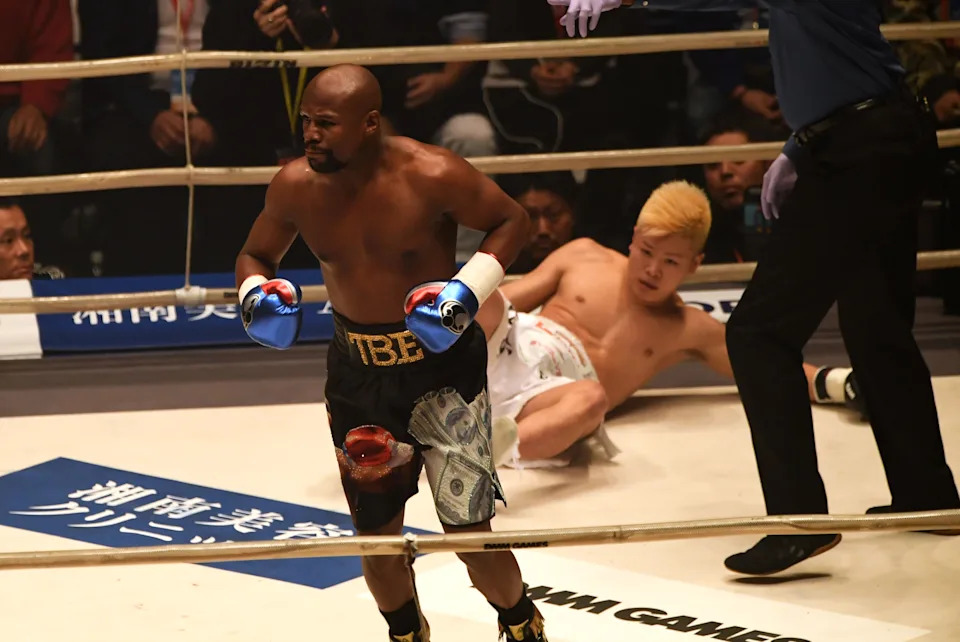
Tenshin Nasukawa never stood a chance.
(TOSHIFUMI KITAMURA via Getty Images)
In reality, the “people” were served a mismatch at the Saitama Super Arena that New Year’s Eve, with Mayweather dropping Nasukawa three times in Round 1 before the kickboxer’s corner cut short the spectacle. Afterward, Mayweather confirmed that he was still retired and said that he only appeared in the exhibition bout to entertain fans.
Advertisement
He then used that same line ahead of an exhibition bout against internet personality Logan Paul on June 6, 2021, at Hard Rock Stadium in Miami Gardens, Florida. He also used it before an exhibition bout with Don Moore, one of his former sparring partners, in Abu Dhabi on May 21, 2022, and again when he returned to the Saitama Super Arena on Sept. 25, 2022 to stop mixed martial artist Mikuru Asakura in two rounds. Now, at this point, you started to wonder what exactly Mayweather wished to exhibit and for whom he was exhibiting it.
Regardless, there was no stopping him. More exhibitions soon followed: One against YouTuber Deji Olatunji, the younger brother of KSI, on Nov. 13, 2022, at the Coca-Cola Arena in Dubai; one against UK reality TV star Aaron Chalmers on Feb. 25, 2023, at The O2 Arena in England; and then not one but two exhibitions with John Gotti III, the offspring of mafiosi, in 2023 and 2024.
Following all that, Mayweather, with interest starting to wane, turned his focus to other retired boxers finding it just as hard to say “no.” There was, for instance, a deal to do an exhibition bout with “Iron” Mike Tyson, now 58 and of course a heavyweight. That was announced in September 2025 only to promptly fall apart under the weight of its own baggage. In its place, a different direction was then proposed: Mayweather rematching Manny Pacquiao on Sept. 19, 2026 at The Sphere in Las Vegas, live on Netflix. This, coming as it did off the back of Mayweather vs. Tyson, was an easier proposition to stomach, though still it reflected badly on the ability of both men to walk away and be content.
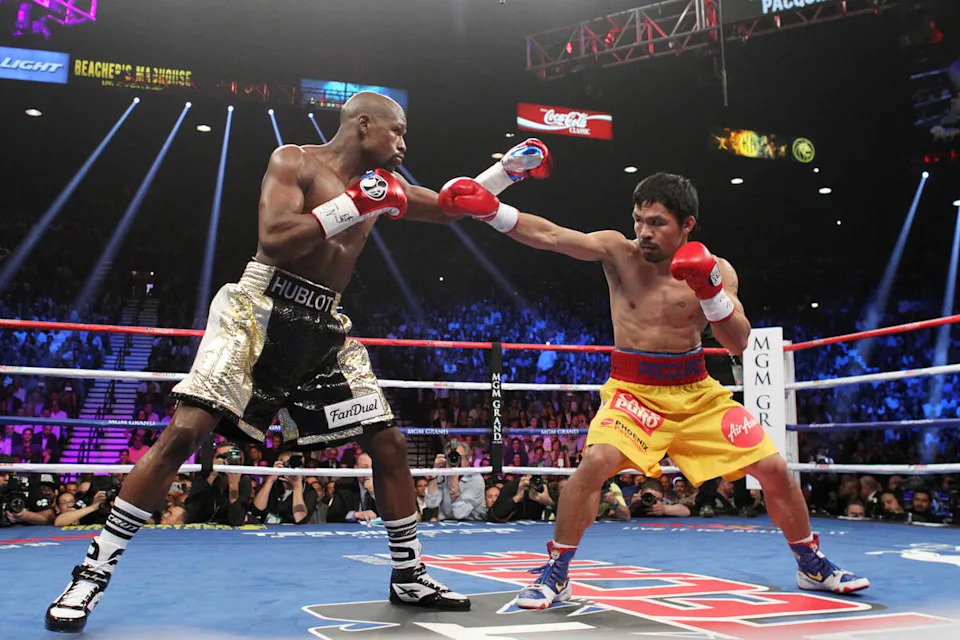
Eleven years later, they’re set to do it again.
(Las Vegas Review-Journal via Getty Images)
For Pacquiao, he has revenge in mind, having lost to Mayweather by decision in 2015. Yet, for Mayweather, the impetus to go over old ground is less about competition, legacy, or even proving something. That is perhaps why he has insisted that the reunion with Pacquiao is an exhibition rather than a sanctioned fight, as Pacquiao was led to believe. At least that way Mayweather can maintain control and get from it everything he wants from it — attention, money, relevance — without anybody, especially Pacquiao, showing him how imperfect he has in time become.
Advertisement
Then again, we don’t need to see Mayweather dirty his 50-0 record to know he is as imperfect as any other prizefighter. We know this simply because he is, at the age of 49, losing the toughest fight of all: The great task of doing nothing.
That he has failed in that task reveals how flawed and human Mayweather really is. For no matter his brilliance inside the ring, retirement is clearly a fight for which he had no plan; unlike an opponent’s punches, he never saw it coming. Now, in the year of 2026, he has neither the tools nor the humility to concede that he is losing this fight. Which is why, whether it is sanctioned or “fun,” no longer is a Mayweather appearance in the boxing ring a demonstration of perfection. It is instead the opposite.
Read the full article here