






There are things in life you’d rather have and not need than need and not have. Jumper cables. A plunger. An alibi? And in the case of a professional basketball organization, two-way contracted players.
If your two-way players are getting substantial minutes with the big league club, something probably went wrong along the way. Injuries would be the most obvious culprit, but you could also add roster additions that didn’t work out, players who didn’t fit within the scheme, or a team that has shifted its focus toward development rather than winning in the present.
Advertisement
The Phoenix Suns are a team that, in recent years, has fully utilized all of its two-way roster spots. As part of the latest Collective Bargaining Agreement in 2023, teams were allowed to expand from two two-way contracts to three. Two-way contracts were introduced prior to the 2017–18 season to strengthen player development. Of course, there are restrictions. Players on two-way contracts must have fewer than four years of NBA service time, and each player can be active for a maximum of 50 regular-season NBA games. That means available, not necessarily playing.
This change has also come at a time when the Suns have shifted their strategy regarding the draft. In the past, you could punt second-round picks because you assumed they weren’t going to be part of your future. Now, there is a legitimate developmental path for those players. You can draft them, develop them, and hope they eventually become depth pieces or even rotational players for the big league club.
When you look back at last season, the Suns did make use of their two-way contracted players. Koby Brea and CJ Huntley combined for 124 minutes, while Jamaree Bouyea logged 644 minutes across 46 games. Bouyea joined the Suns on a two-way contract in November before being converted to a regular contract in early March. That is exactly how you want to utilize your feeder system, providing minutes, development, and opportunity to players who can potentially grow into something more.
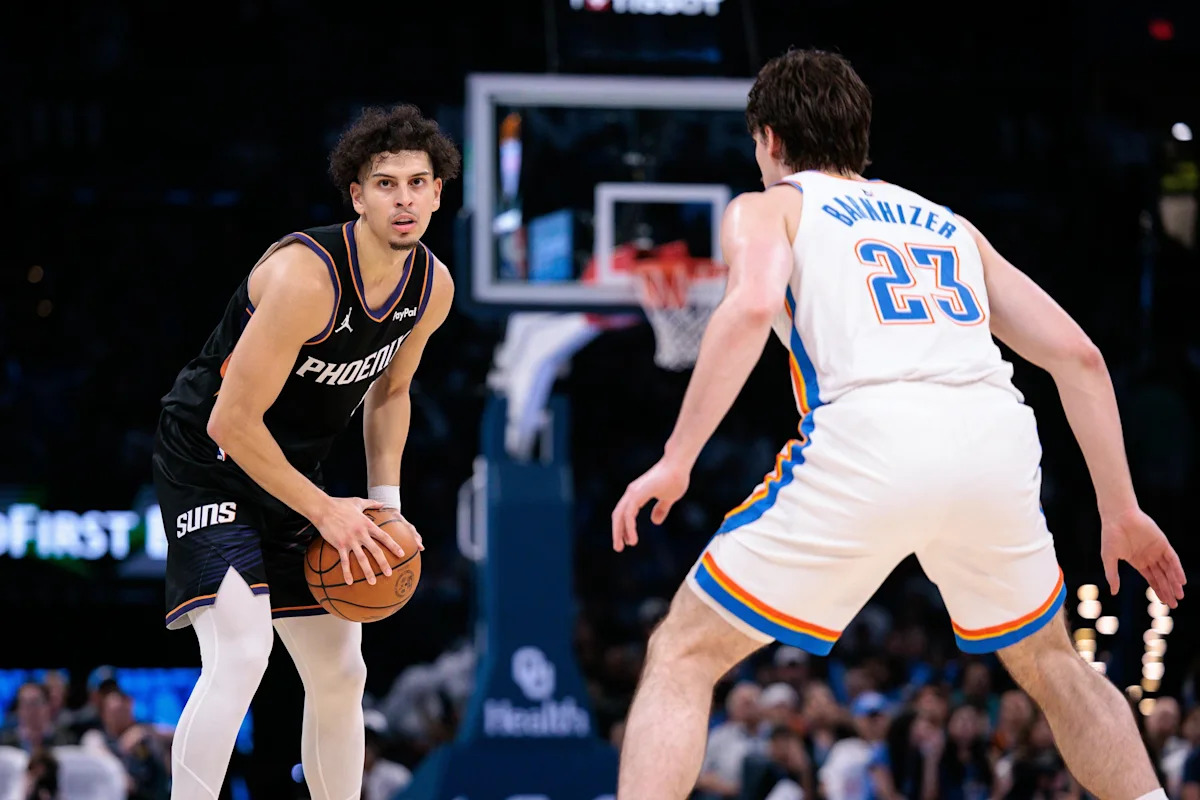
Now look at this year’s crop of two-way players, and you’ll find two familiar faces. Both Brea and Huntley return under the same premise. Joining them is Pat Spencer, who enters his fourth NBA season and has followed a path similar to Bouyea’s. Spencer signed a two-way deal with the Golden State Warriors before eventually being converted to a regular contract, a pattern that has held in each of the last two seasons. And Golden State needed him. The Warriors were riddled with injuries last season, and Spencer ultimately appeared in 66 games, starting 14.
Now he finds himself with the Phoenix Suns, and the fan base clearly believes he has the best chance of earning meaningful minutes with the big league club. In our latest survey, 78% of the community believes Spencer will see time with the Suns this season.
Advertisement
It’s an interesting outcome to the poll, and I think people voted that way because Pat Spencer feels like the most NBA-ready player of the group. We’ve already seen it from him, and he is easily the most experienced of the Suns’ three two-way contracted players.
What’s interesting about the way Phoenix has structured this group is that each player represents a different archetype. Spencer is a hard-nosed defender at the point guard position. Koby Brea is more of a three-point shooting specialist. CJ Huntley provides size and rebounding while also possessing the ability to stretch the floor as a big.
So while 78% of the community believes Spencer will see the most minutes because he has the most experience, appears the most ready, and brings the most maturity, I think it ultimately depends on where the need comes from. I don’t expect any of these players to come in and materially change the FanDuel over-under win total based purely on their performance. They are fortifications. Something you’d rather have and not need than need and not have. Pat Spencer is a plunger.
If the Suns have issues with their bigs, you bring up CJ Huntley and let him fill some minutes until health is restored. If they need more help shooting the three-point ball, which is something this team could certainly use, Brea might have the easiest path to meaningful minutes. He’s actually the player I voted for. Then there’s Spencer. If Phoenix wants to lean further into its defensive identity, or if injuries hit the guard rotation, he gives them another option with those characteristics.
Advertisement
At the end of the day, it’s a good problem to have because it speaks to the Suns’ strategy around both development and flexibility. They have different types of players waiting in the wings and can adjust as the season throws at them. That’s strategic roster building.
And ideally, that’s where the story ends. Spencer, Brea, and Huntley spend most of the season developing, waiting for opportunities that rarely arrive because the players ahead of them remain healthy and productive. But NBA seasons rarely cooperate that neatly. Injuries happen, needs change, and rotations evolve. When they do, Phoenix has three distinctly different answers waiting. You hope you never need the jumper cables, the alibi, or Pat Spencer. But you’ll be glad they’re there if you do.
Read the full article here