





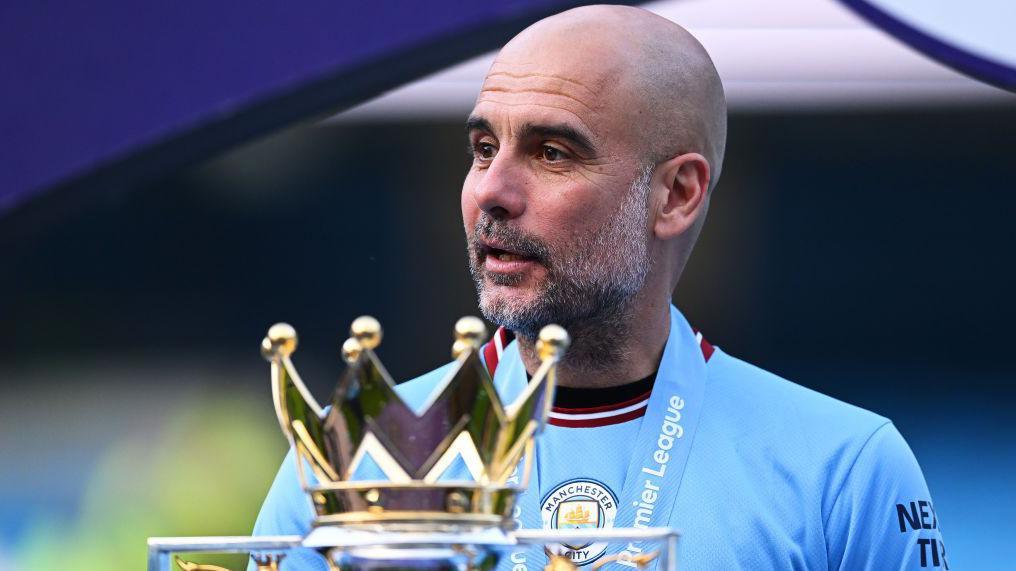
To understand Pep Guardiola’s true weight in football history, consider this. His fingerprints are on everything.
It really started with a sentence. When Joan Laporta was weighing up whether to give Guardiola the Barcelona job, Pep looked at him and said: “No tindras els collons.” (“You don’t have the balls.”)
Advertisement
His only managerial honour at the time was the Spanish third division. Laporta gave him the job. Football changed. Guardiola changed it.
By the way, can Pep do it on bad pitches, with small crowds, with a small team? He did it in the third division with Barcelona B, with kids. Another tick.
The school he came from had two Dutch headmasters: Rinus Michels and Johan Cruyff. Later on came Louis van Gaal.
At Barcelona, Guardiola turned their ideas into the most complete club side the world had seen. At Bayern Munich he pushed deeper into positional play, leaving ideas German football is still working through today.
Advertisement
Then came the hardest test he could find: England. The home of football. The place where received wisdom said his style – all the ball, all that control and all that demand for space and movement – would not survive. The queue of people predicting failure was long.
They were wrong, but here is what makes his time as a club manager unique. Guardiola has changed how football is played across three phases of the game.
If you follow the most common framework for analysing football with the ball – building from the back, transition through the middle, play around the box, and the finishing of the action – he has systematically revolutionised the first three.
The fourth phase, the finishing itself, is one football culture is not yet ready to absorb in the way he envisions. But no manager in history has done what he has done with the first three. Now others can come and continue the work.
Advertisement
And at City specifically, he has built not one great team but three.
The first: a beautiful side that won league titles playing football that made neutrals stop and watch.
The second: a battle-hardened version with four centre-backs in the back four and a centre-forward – Erling Haaland – who broke every record in sight.
The third: this current iteration, still evolving, still capable of winning domestic trophies. Going back to win with each new generation of players is one of the most significant marks of a truly great manager.
Read more from Balague about what sets Guardiola apart
Read the full article here