





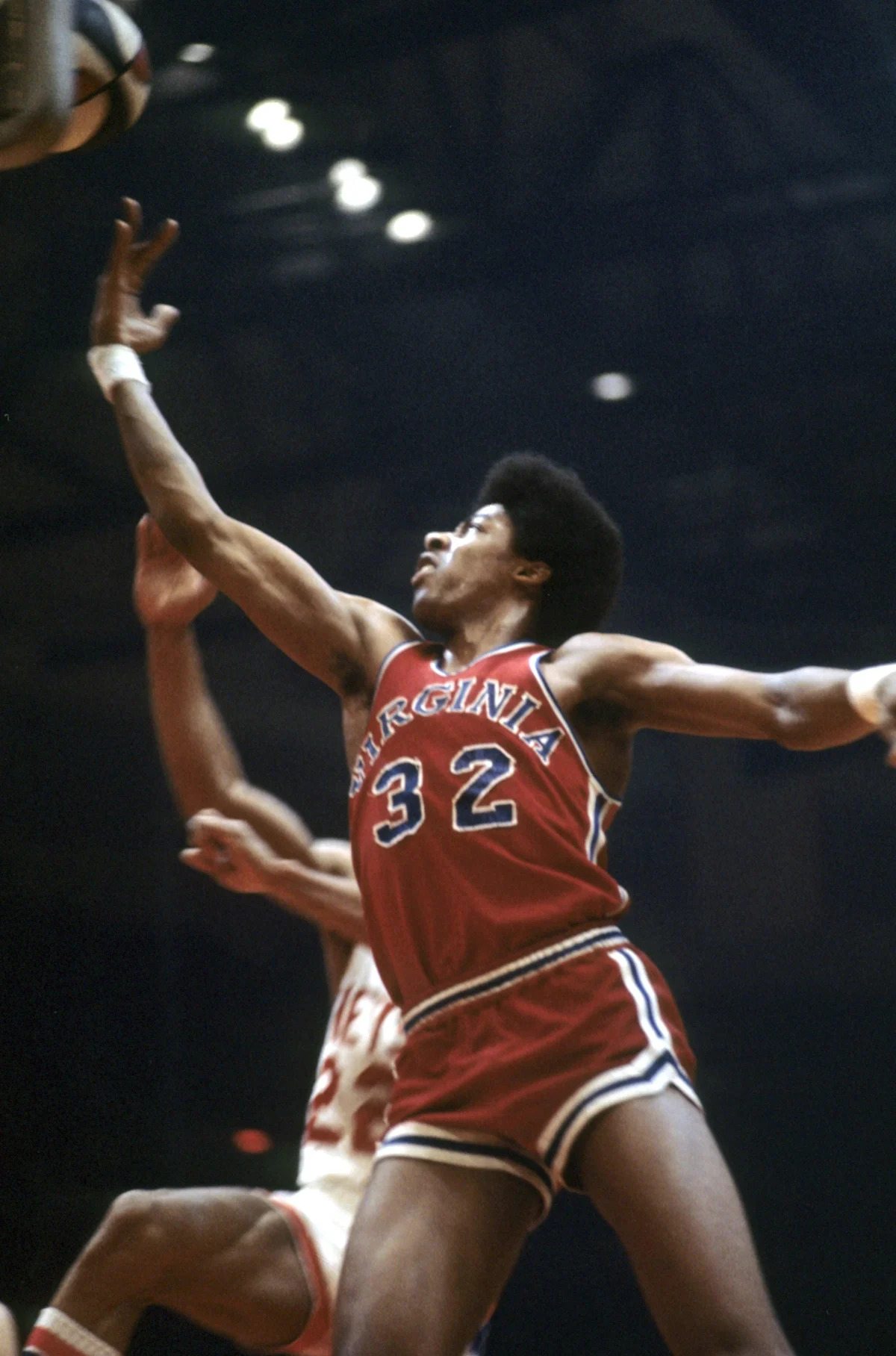
Julius Erving had a bit of a rough start to his professional career. He was drafted by the Milwaukee Bucks, but signed contracts with the Atlanta Hawks and the ABA’s Virginia Squires.
The first dispute was settled by the NBA: his draft rights belonged to Milwaukee, and the Hawks were out of luck. The second dispute was settled by the courts: he had to play for the Squires.
Advertisement
This was really too bad, because if he had played for Milwaukee, he would have suited up with Oscar Robertson and a young Kareem Abdul-Jabbar, while in Atlanta, he would have teamed up with an equally young Pistol Pete Maravich.
It’s rather mind-boggling either way you look at it, but the idea of Maravich having Erving to pass to in the open court is simply incredible.
He did just fine in the ABA, of course, revolutionizing the game to the point where he was the main factor behind the 1976 ABA-NBA merger.
Well, other than money, of course, which the ABA greatly lacked. Nonetheless, the greatest show in basketball was in the upstart league, and the NBA could not abide that.
Advertisement
When he arrived as a Squires rookie, Erving – there’s no other way to put this – freaked people out. It was like young Elvis Presley in the 1950s: no one had ever seen anything like that before, and that includes the people who knew Erving at UMass, who were stunned at the transformation.
Erving later said that he felt liberated when he turned pro and could let his talent and imagination run wild.
This video explores that glorious era.
It didn’t last long, at least not for the Squires. Money woes forced them trade Ervng to his hometown New York Nets for $750,000, and with the Nets, he went from being a curiosity in Norfolk to the most glittering star in the Big Apple.
In other words, he was a Net when he truly became a legend.
Go to the DBR Boards to find Blue Healer Auctions || Drop us a line
Read the full article here