





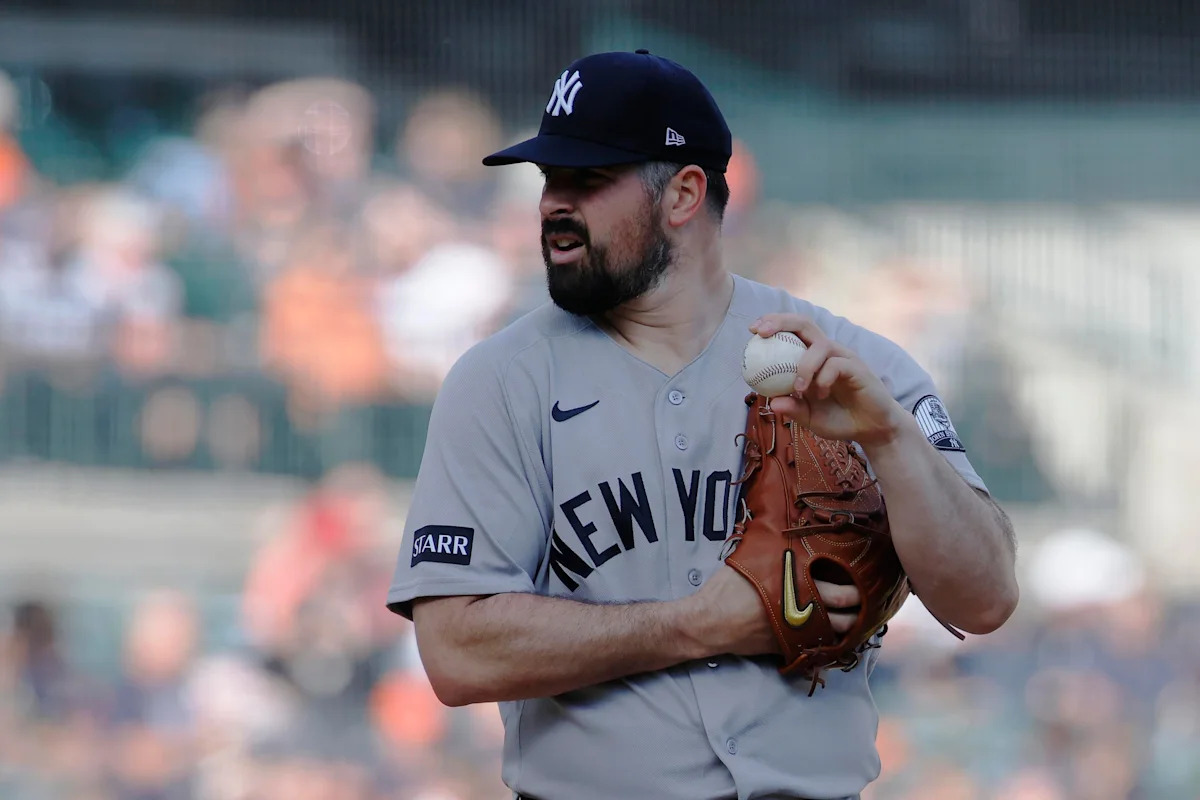
Carlos Rodón marked his return from a seven-week absence with left elbow inflammation with four strong innings against the Orioles on Tuesday. He allowed a run on two hits and two walks with four strikeouts, the lone damage a Coby Mayo solo homer in the third, as the Yankees took the series opener, 3-1, thanks to some clutch hitting from Trent Grisham. By far, the most important moments from his start were the pair of strikeouts to strand the bases loaded in the second, so let’s dive in.
We join Rodón with one out in the bottom of the second, Trent Grisham having given them the lead with a solo home run in the top half of the frame. However, he faces a serious threat after a Jazz Chisholm Jr. error on a potential inning-ending double play ball loaded the bases. Stepping to the plate is former Yankee farmhand Carlos Narváez, who memorably crushed them in three games with the Red Sox last year before getting shipped to Baltimore in the Adley Rutschman blockbuster at this year’s deadline.
Advertisement
To this point in the contest, Rodón’s four-seamer has been sitting at about 93-94 mph, so you can tell he senses the gravity of the situation when dialing this first-pitch heater to 96.
View Link
Austin Wells sets a high target and Rodón nails it with the four-seamer. Between the velocity, placement, and elite 19 inches of induced vertical break, Narváez swings right through the pitch underneath as the ball gives the illusion of rise on its path to home.
After the spot-on execution of that fastball, Rodón looks to keep the feeling of that release with another four-seamer to the same spot.
View Link
Advertisement
Rodón throws an almost identical pitch to the one before. This one had two more inches of drop than the previous one, which is why Narváez is able to foul it back rather than whiff through it. All the same, it’s an advantageous result to give Rodón all the count leverage, 0-2.
With Narváez showing a willingness to offer at the high fastball, the obvious choice is to keep climbing the ladder with the four-seamer.
View Link
Unfortunately, this pitch is a little too high and a little too high to entice the hitter to chase. Nonetheless, it is still an effective pitch to keep the hitter’s eye level looking for an elevated heater.
Advertisement
Rodón plays off that eye level with the classic back-foot slider.
View Link
This is the absolute perfect pitch to follow the preceding high heater. The slider looks exactly like a fastball right down the middle before diving down and in as the hitter is starting his swing, leaving Narváez no chance to make contact. Perfect release, perfect spot, perfect execution — that’s pitch sequencing at its finest.
Here’s the full sequence:
Courtesy of Baseball Savant
Now needing just one out to escape the jam, Rodón faces the top of the order again, Jackson Holliday stepping in after having popped out in the first. Rodón threw all fastballs — three four-seamers and three sinkers — to retire Holliday in the first, so he switches things up here with a first-pitch slider.
Advertisement
View Link
It’s clear Rodón’s first-inning attack plan had an effect on Holliday’s approach here. This is not a particularly good slider — in fact it’s a hanger pretty much down the middle. However, given that the pitch looks like a fastball off the plate up and in out of Rodón’s hand, he’s able to freeze Holliday for strike one looking.
Once you show the hitter that you can land your breaking ball in the zone for a called strike, it should amplify the chase potential when following it up with another bender out of the zone.
View Link
Instead, Rodón throws pretty much the same pitch as the one he just threw, another mistake slider that catches the heart of the plate. Luckily for him, it appears Holliday is still hunting the fastball given how early and off-balance this swing is to pop it weakly foul and out of play.
Advertisement
After getting away with a pair of mistake sliders, I wasn’t at all surprised to see Rodón change course to the four-seamer here.
View Link
Rodón hurls his fastest and best located fastball of his entire outing, and not just because of the leverage of the situation. He pinpoints this 96 mph heater right on the corner up and away, a successful ABS challenge from Wells overturning the initial ball call for the inning-ending strike three looking to strand the bases loaded. In a way, he was almost helped by the first two not-so-great sliders he threw. It feels like Holliday is now sitting on a third straight slider in this spot, meaning he is even more likely to take an up-and-away fastball given the way he saw the last two sliders move away (not that he was likely to make contact with this flawlessly executed four-seamer even if he had swung).
Here’s the full sequence:

Courtesy of Baseball Savant
Given Rodón had completed just a pair of rehab starts following the seven-week layoff, there was a lot to feel encouraged by in these four innings of work and particularly these two ABs. First and foremost was the four-seamer, whose velocity, shape, and command looked to be in mid-season form rather than a first MLB start in almost two months. However, I was most impressed by Rodón dialing up his focus when facing this massive early jam. Having just scored in the top of the inning, it would have stung that little bit extra to immediately throw it away, especially following the error. Rodón made some of his best pitches of the start when he needed them most. I’m sure he would love to rein in the walks which have peppered his ten starts and steadily increase the pitch count beyond the 60-70 range set for this outing, but all in all you have to feel optimistic about where he’s at.
Advertisement
Rodón’s somewhat surprising early activation off the IL to start this game was accompanied by an even more surprising corresponding roster move, the Yankees placing Max Fried on the 15-day IL with a recurrence of the elbow bone bruise that kept him out for over two months. While the prognosis on Fried’s injury is far more encouraging this time around, it shows how important it was for Rodón to return when he did and pitch with the sharpness he exhibited.
Read the full article here