




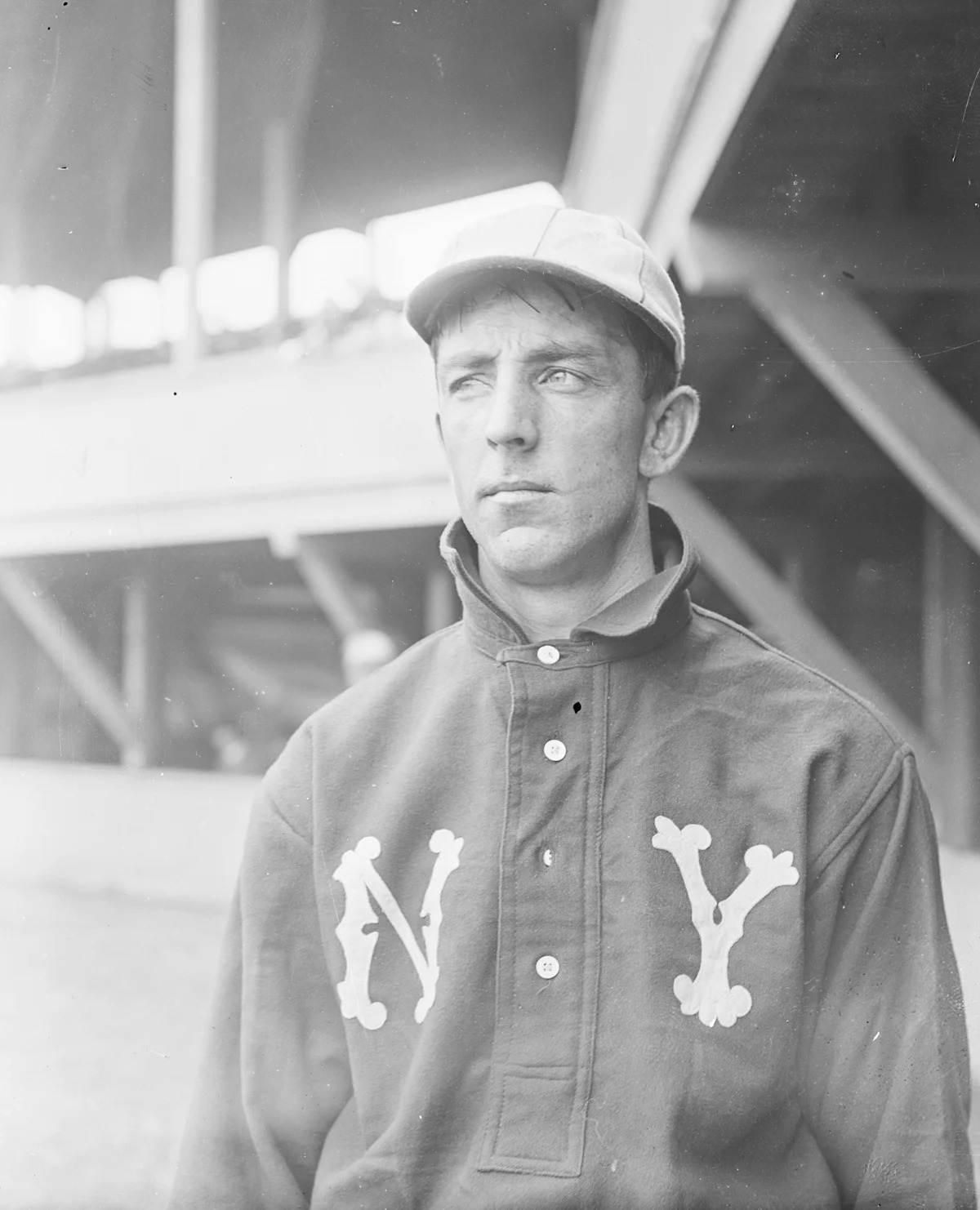
The early years of the Yankees’ franchise famously weren’t great until they acquired a certain Babe Ruth. There were some good seasons here and there, occasional pennant chases, and a few superb individual seasons. They just never got to the World Series or brought home a title until Ruth began donning the pinstripes in the 1920s.
However, it would be a disservice to act like franchise history only began on the day that Ruth’s sale from the Red Sox went through. Plenty of players had a role in getting the franchise to that point. Today happens to be the 149th birthday of one notable Highlander: Wid Conroy.
Advertisement
William Edward “Wid” Conroy
Born: April 5, 1877 (Philadelphia, PA)
Died: December 6, 1959 (Mount Holly, NJ)
Yankees Tenure: 1903-08
Conroy was born in Philadelphia but was mostly raised in neighboring Camden, NJ. He gained his nickname as a youth in Camden, as it was “Widow,” eventually shortened to “Wid.” His SABR bio says that people began calling him that name because he used to look out for younger kids in the neighborhood and had what was described as a “motherly interest.” I’m basically imagining a bunch of kids in flat caps roaming around, all talking like they’re in the movie Newsies.
Conroy also developed an interest in baseball as a youth, which led to a career in the sport. Conroy first caught on with a pro team in 1896 with the Carlisle (PA) Colts. His travels eventually led him to a stint with the (first) Milwaukee Brewers of the American League. His second season in Milwaukee was in 1901, which was the first in which the AL was recognized as a “major league.”
However after 1901, Conroy jumped over to the National League and signed with the Pittsburgh Pirates. (The Brewers themselves decamped for St. Louis, where they became the Browns.) While in the Steel City, he notably got into a fight with the Cubs’ Joe Tinker—of “Tinker to Evers to Chance” fame—leading to him receiving a 20-game suspension.
Advertisement
Ahead of the 1903 campaign, Conroy became one of a number of Pirates who jumped to the AL and joined the league’s new New York Highlanders. The 1902 Bucs utterly dominated their opposition en route to a 103-victory, pennant-winning season, with a staggering .741 winning percentage over 140 games that would equate to a record 120 in a 162-game slate. The upstart AL attempted to poach several of the team’s starts, as the league was still trying to find its footing. Rumors about that began going around the Pittsburgh clubhouse before the 1902 season, and Conroy ended up as one of a couple Pirates branded as a “spy” for the AL. In the end, Conroy and several of the team’s stars made the jump to New York, including future Hall of Fame pitcher Jack Chesbro. Things ended up alright for the Pirates though, as Conroy’s departure opened up the regular shortstop position, which ended up occupied by Honus Wagner instead.
While they made runs at Boston and Chicago for the AL pennant in 1904 and 1906, respectively, the Highlanders often weren’t great during Conroy’s tenure at Hilltop Park. However, Conroy himself frequently fell within the range of decent-to-very good. Upon coming to New York, Conroy moved to third base, with the team already employing a decent shortstop in Kid Elberfeld. Modern stats state that he was worth 10.7 fWAR and 11.5 rWAR for the Highlanders from 1903-06.
Conroy’s best overall season came in 1904, when New York came agonizingly close to toppling the defending World Series champions for the AL pennant. At the plate, he peaked in 1905, when his .723 OPS equated to a 120 OPS+.
Advertisement
By 1908, Conroy’s hitting skills had fallen off, and the Highlanders sold him to the Washington Senators. He spent the last three seasons of his MLB career there. Conroy continued playing on in the minors for a little while after that and later managed the Elmira Colonels to the 1914 New York State League pennant. He also spent some time as a major league coach for the Phillies. He did appear on the 1945 Baseball Hall of Fame ballot, but fell off after receiving only one vote.
After leaving baseball, Conroy settled back in New Jersey. On a sad note, the son who was named after him was killed in action at age-23 while serving as a First Lieutenant in the U.S. Army during World War II. Conroy passed away himself in 1959 at the age of 82.
Conroy is by no means an all-time franchise great nor a Hall of Famer. However, he was one of the first notable players in Yankees history, and that’s something.
See more of the “Yankees Birthday of the Day” series here.
Read the full article here


