




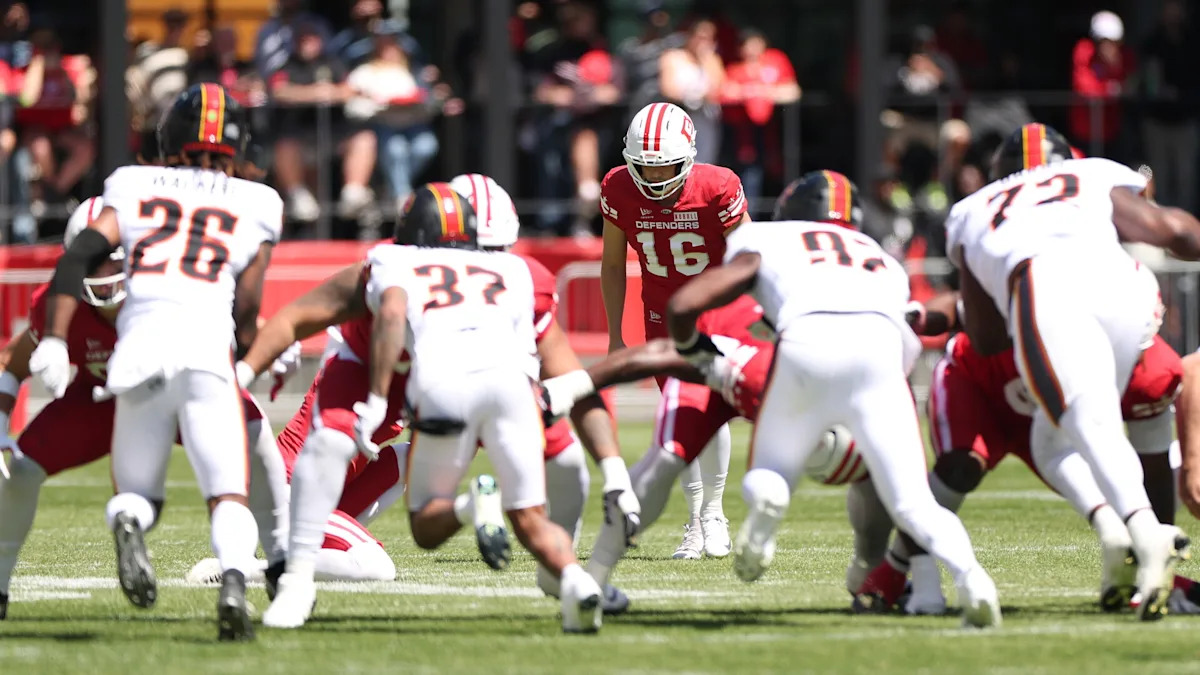
The UFL made an interesting tweak to the rules in 2026, boosting the points for a 60-yard field goal from three to four. Which raises the question of whether the NFL would follow the UFL’s lead.
Michael DiRocco of ESPN has addressed the question, by talking to a variety of UFL kickers. And a couple of Pro Football Hall of Famers.
Advertisement
On the surface, it creates a reward for converting a kick from a distance that, while more and more commonplace, remains a long stretch of grass (or turf) to cover. At a deeper level, it introduces an incentive to strategically take the foot off the gas while otherwise pushing for paydirt.
“I think it’s a little weird,” Cowboys kicker Brandon Aubrey told DiRocco. “Kind of incentivizes you to stall the drive in a certain spot. It makes you really, really question your playcalling around that 50-yard line area. It’s interesting for kickers that have the leg to get it there, maybe [there’s] a little bit more value there. But kind of perverses [sic] the incentives of football where the goal is to get it as close to the other person’s half as possible. . . . So, I’m conflicted on it. I like it for the kickers. I think it’s a nightmare for the playcallers.”
Adam Vinatieri, who’ll officially get his bronze bust next month, likes the idea.
“I think it’s actually a really good idea, to be honest with you,” Vinatieri told DiRocco. “I played one season in the NFL Europe and anything outside of a 50-yarder was worth four points. Probably makes kickers even more valuable … but it changes the [game].
Advertisement
“If you’re at 57 yards, do you lose three yards on purpose to get an extra point? Because now all of a sudden you’re down by three, but now you can go for the win. So it will definitely change the philosophy of teams and their analytics and what they want to do. Guys are really hitting long field goals and being really prolific at it right now. So I like it. I think it’s pretty awesome.”
Hall of Famer Jan Stenerud, one of the first “soccer-style” kickers in a league that previously launched the ball with the toe, doesn’t like the idea.
“That doesn’t make much sense because the score is supposed to indicate how well the team is moving the ball,” Stenerud told DiRocco. “So you move 90 yards all the way down to the one-yard line and you get [three points], but if you have a good kicker and then you go off of midfield and you can make [more] points? . . . That doesn’t make sense to me at all. Total opposite, I would think.”
The creation of a new area of the field in which, for example, losing a yard on third and long would be the analytically sound move for the likely field-goal try turns the incentive to gain as much yardage as possible on its head. And there would be teams that decide to take a knee on third and 12 from the plus-41 in order to swap a likely three-point try for a four-point attempt.
Advertisement
The fact that the NFL tried a four-point field goal in NFL Europe and never brought it to the NFL says something. The fact that, as DiRocco notes, there’s no momentum within the NFL’s Competition Committee to make the change says even more.
It’s an intriguing gimmick for a spring league looking for something different. For the established pro football league, it’s an unnecessary twist that would create periodic disincentives to gain as many yards as possible.
That doesn’t mean the NFL should ignore the UFL’s innovations. The current NFL kickoff formation came from the XFL. (That formation was dumped when the XFL and USFL merged.) And the NFL should be taking a close look at the UFL’s embrace of transparency in officiating.
When it comes to the four-point field goal, however, that’s probably a UFL idea that should stay in the UFL.
Read the full article here


