Outplayed throughout the first half, down 10-0 after the first quarter and 17-14 at halftime, No. 12 Texas Tech secured a come-from-behind, 28-26 win against No. 23 Houston before a sold-out Galaxy Stadium home crowd.
Barely. It took a two-point conversion stop from the Red Raiders’ defense – which had just coughed up a 78-yard touchdown drive to the Conner Weigman-led Cougars offense.
Advertisement
Still wearing a brace on his right leg after missing almost all of the 2025 season due to injury, Red Raiders quarterback Will Hammond cemented his control of the offense in a poised effort that showcased both Hammond’s ability to read through his progressions in the passing game and flash enough mobility to uncork a 22-yard run.
Defending Big 12 Conference champion Texas Tech had an awful lot riding on this game for just the season’s third contest. The Red Raiders presently do not have another ranked foe on their schedule.
But debuting their new, signature Patrick Mahomes custom-designed all-black Adidas uniforms with electric-red trim, the Red Raiders dodged Houston’s final-minute gasp to force overtime.
Here are the winners and losers of the contest:
Advertisement
WINNERS
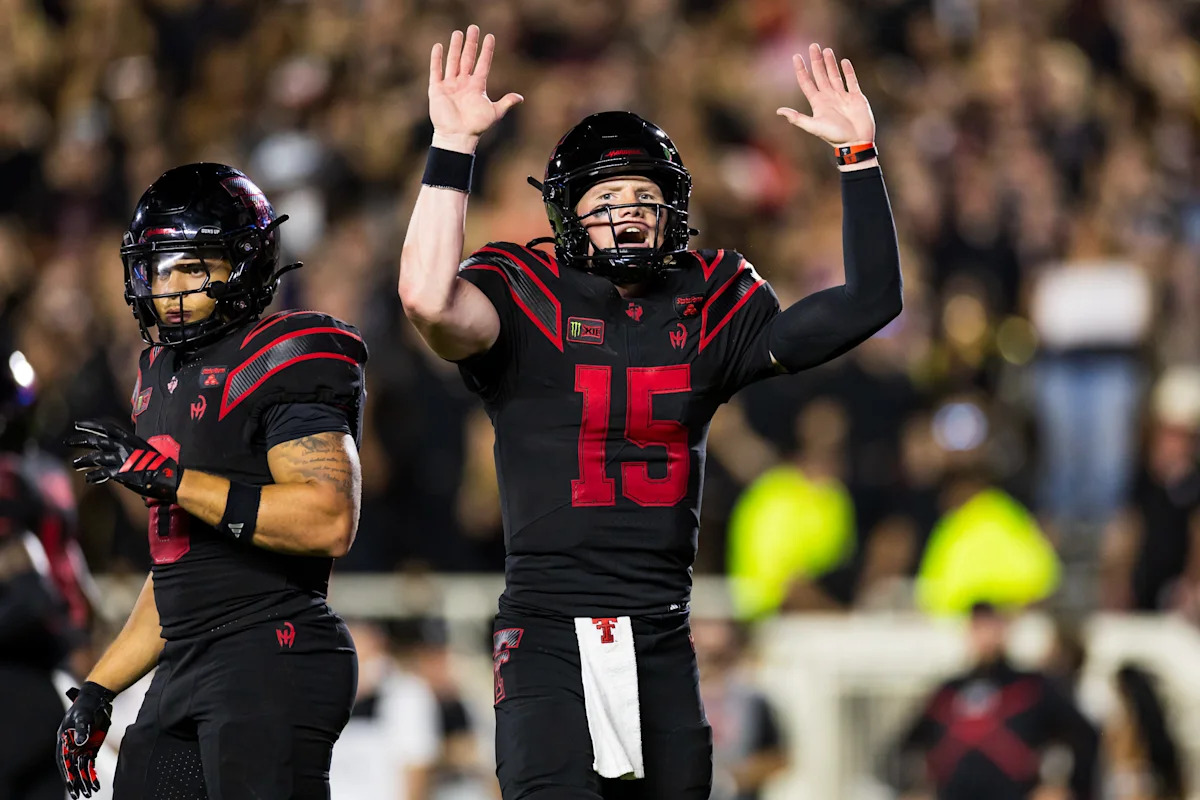
Will Hammond
Hammond technically doesn’t get the win in this game at quarterback. Why? Because Texas Tech coaches outsmarted themselves by starting Tommy Castellanos – who rewarded them with a first-snap interception on a throw-away that didn’t get away.
Completing 17 of 27 passes, Hammond threw for 257 yards and a touchdown. He added 30 rushing yards and his only turnover came when his wideout slipped to the turf and Houston’s Jalen Mayo made an acrobatic, leaping, one-handed pick.
But the gritty Hammond led two second-half touchdown drives that totaled 162 yards and that was the difference in the game.
Will Hammond of the Texas Tech Red Raiders gestures for the crowd to be quiet during the second half of the game against the Houston Cougars at Galaxy Stadium on September 18, 2026 in Lubbock, Texas.
Mack Leftwich
Texas Tech’s offensive coordinator, by his own quarterback’s postgame admission, endured a miserable week after the Red Raiders mustered just 352 yards and fumbled three times in their 35-24 win Sept. 12 at Oregon State.
Advertisement
And their first four offensive plays in this game resulted in an interception and minus-3 yards.
The rest of the night was a masterclass from Leftwich, Tech’s second-year offensive play-caller after a previous run at Texas State.
“I want everyone to respect Coach Leftwich, man,” Hammond said postgame on the field. “He got a lot of hate this week. He went in there and dialed it up.”
1 / 27
Are your picks among the top college football players of the 2000s?
Look back at who we picked as the best college football players of this millennium. The challenge was difficult. There were all-time greats in competition for spots on the first and second team. Heisman winners, Hall of Famers and future NFL superstars were among those left out in the voting by more than 10 college football writers and editors at USA TODAY Sports. Nineteen schools are represented on the first team that includes spots for specialists. Six teams have multiple players among that group with Alabama and Miami (Fla.) leading the way with three apiece. First-team offense QB Cam Newton, Auburn Newton was only a college starter for one season, but he certainly made it count. On his way to the Heisman Trophy in 2010, he racked up 4,327 total yards and 50 touchdowns while leading Auburn to a national championship despite playing on offense with no players who ever recorded a rushing or receiving yard in the NFL. There are other passers with gaudier career numbers, but no college quarterback in the sportÕs modern history has been so singularly impactful.
(John Reed, Imagn Images)
1 / 27
Are your picks among the top college football players of the 2000s?
Look back at who we picked as the best college football players of this millennium. The challenge was difficult. There were all-time greats in competition for spots on the first and second team. Heisman winners, Hall of Famers and future NFL superstars were among those left out in the voting by more than 10 college football writers and editors at USA TODAY Sports. Nineteen schools are represented on the first team that includes spots for specialists. Six teams have multiple players among that group with Alabama and Miami (Fla.) leading the way with three apiece. First-team offense QB Cam Newton, Auburn Newton was only a college starter for one season, but he certainly made it count. On his way to the Heisman Trophy in 2010, he racked up 4,327 total yards and 50 touchdowns while leading Auburn to a national championship despite playing on offense with no players who ever recorded a rushing or receiving yard in the NFL. There are other passers with gaudier career numbers, but no college quarterback in the sportÕs modern history has been so singularly impactful.
(John Reed, Imagn Images)
2 / 27
Are your picks among the top college football players of the 2000s?
RB Adrian Peterson, Oklahoma Peterson burst on the scene, rushing for 1,925 yards and 15 touchdowns as a freshman in 2004 for an Oklahoma team that went undefeated in the regular season. Injuries limited his output in his final two seasons, but he still finished his three-year college career with 4,041 yards and 41 touchdowns while displaying a rare combination of raw power, agility and speed.
(Ronald Martinez, Getty Images)
3 / 27
Are your picks among the top college football players of the 2000s?
RB Reggie Bush, USC Bush wasn’t just a star, but a national phenomenon, someone whose fame transcended his sport. The versatile running back was the most electrifying player to come out of USC in a decade in which the Trojans helped define the sport. His 2,218 total yards and 18 touchdowns during his Heisman Trophy-winning junior season in 2005 only did so much to explain his brilliance. Even 20 years later, his highlights are as jaw-dropping as any a college player has ever put together.
(Robert Hanashiro, USA TODAY)
4 / 27
Are your picks among the top college football players of the 2000s?
WR Larry Fitzgerald, Pittsburgh The player with the second-most receiving yards in NFL history offered a peek at his prodigious talent in college, where he had 1,672 receiving yards, 22 touchdowns and a slew of acrobatic catches at Pitt in 2003. As a sophomore on a five-loss Panthers team, he was edged out by Oklahoma quarterback Jason White in one of the closest and most contentious Heisman Trophy votes this century.
(Jason Cohn, REUTERS)
5 / 27
Are your picks among the top college football players of the 2000s?
WR DeVonta Smith, Alabama As a freshman, Smith was on the receiving end of Tua TagovailoaÕs title-winning pass in the 2018 College Football Playoff championship game. By the time he was a senior, he finished with 1,856 receiving yards and 23 touchdowns Ñ both of which rank him in the top 10 all-time in the FBS in a season Ñ for a dominant Alabama team that gave Nick Saban his final national championship. That season, he became the first wide receiver to win the Heisman Trophy since 1991.
(Gary Cosby Jr, The Tuscaloosa News via USA TODAY Network)
6 / 27
Are your picks among the top college football players of the 2000s?
TE Brock Bowers, Georgia Bowers was a colossus, someone whose listed measurements of 6-4 and 240 pounds somehow seemed like they were underselling him. He was Georgia’s leading receiver in each of his three seasons at the school, a stretch in which the Bulldogs went 42-2 and won two national championships.
(Dale Zanine, Imagn Images)
7 / 27
Are your picks among the top college football players of the 2000s?
OT Joe Thomas, Wisconsin A Wisconsin program that has been a factory for offensive linemen for the past 30 years has likely never produced a finer one than Thomas. Before setting an NFL record by logging 10,363 consecutive snaps, Thomas was a two-time first-team All-American for the Badgers. He has earned enshrinement in both the College Football Hall of Fame and Pro Football Hall of Fame.
(Jeff Hanisch, Imagn Images)
8 / 27
Are your picks among the top college football players of the 2000s?
G Quenton Nelson, Notre Dame The 6-5, 330-pound Nelson was a unanimous All-American as a senior in 2017 while serving as the centerpiece of a Notre Dame offensive line that won the Joe Moore Award. That promise he showed in college has carried over to the NFL, where he has been a three-time first-team All-Pro for the Indianapolis Colts.
(Mark J. Rebilas, Imagn Images)
9 / 27
Are your picks among the top college football players of the 2000s?
OT Bryant McKinnie, Miami On a 2001 Miami team considered by many to be one of the greatest, most talented teams in college football history, there were few, if any, stars bigger than McKinnie, literally. The 6-9 All-American lineman won the Outland Trophy in 2001 and was eighth in Heisman Trophy voting, one of the highest finishes for an offensive lineman in the past 40 years. Perhaps most impressively, he never allowed a sack in his college career.
(Doug Pensinger, Getty Images)
10 / 27
Are your picks among the top college football players of the 2000s?
G Barrett Jones, Alabama Jones won three national championships with the Crimson Tide and a long list of postseason accolades. In addition to earning first-team All-SEC honors three times, Jones won the Outland Trophy as a junior left tackle and then the Rimington Trophy as a center the next year, becoming the first and still only player in college football history to win both awards at two positions.
(Kevin Jairaj, Imagn Images)
11 / 27
Are your picks among the top college football players of the 2000s?
C Maurkice Pouncey, Florida A Day 1 starter for the Gators, Pouncey had his best year as a junior in 2009, when he captured the Rimington Trophy and was a consensus All-America selection. Overall, Pouncey started 39 games over three years and helped Florida capture the 2008 national championship.
(Erik S Lesser, REUTERS)
12 / 27
Are your picks among the top college football players of the 2000s?
All-Purpose Christian McCaffrey, Stanford Few players this century have made as big an impact in so many ways. After sharing touches as a freshman in 2014, McCaffrey exploded with a memorable sophomore campaign that saw him post 2,019 rushing yards and an NCAA-record 3,864 all-purpose yards in finishing second for the Heisman. His performance in that yearÕs Rose Bowl ranks among the best in the gameÕs history.
(Steven Bisig, Imagn Images)
13 / 27
Are your picks among the top college football players of the 2000s?
First-team defense DT Ndamukong Suh, Nebraska There have been few if any more intimidating interior linemen in the sport’s history. Suh’s four-year run at Nebraska is defined by an unforgettable senior season: 85 tackles, 20½ tackles for loss, 12 sacks and an interception. He finished fourth in the Heisman voting, and might’ve been robbed.
(Jamie Squire, Getty Images)
14 / 27
Are your picks among the top college football players of the 2000s?
DT Aaron Donald, Pittsburgh Before taking the NFL by storm, Donald was a wrecking ball for the Panthers who, like Suh, hit another level as a senior. In 2013, Donald had 28½ tackles for loss and 11 sacks in taking home the Lombardi, Nagurski, Bednarik and Outland trophies.
(Howard Smith, Imagn Images)
15 / 27
Are your picks among the top college football players of the 2000s?
DE Terrell Suggs, Arizona State Suggs was a menace for the Sun Devils in the early 2000s and one of the most productive pass rushers in college football history. He recorded 10 sacks during his sophomore season and was first-team all-Pac-10. Things got better as a junior in 2002. Suggs was a unanimous first-team All-American and winner of Lombardi Award and Nagurski Trophy while setting an NCAA single-season record with 24 sacks that still stands.
(Rob Schumacher, The Republic via USA TODAY Network)
16 / 27
Are your picks among the top college football players of the 2000s?
DE Myles Garrett, Texas A&M The future No. 1 overall draft pick was an immediate hit for the Aggies, pulling down 11½ sacks and 14 tackles for loss as a freshman and then led the SEC with 12½ sacks and 19½ tackles for loss one year later. While slowed by injuries in his third and final season, Garrett captured first-team All-America honors for the second time.
(Kevin Jairaj, Imagn Images)
17 / 27
Are your picks among the top college football players of the 2000s?
LB Manti Te’o, Notre Dame A second-team All-American as a junior after a campaign with a team-high 128 tackles, Te’o was the defensive leader for Notre Dame as the Fighting Irish reached the Bowl Championship Series title game in his senior season. He has a storage closet full of hardware, including the Bednarik, Nagurski, Lombardi and Butkus awards. That same year, Te’o became the second primary defender to finish second in the Heisman voting. He finished his career ranked third in program history in tackles.
(Matt Cashore, Imagn Images)
18 / 27
Are your picks among the top college football players of the 2000s?
LB Will Anderson, Alabama An outside linebacker that also played at the line of scrimmage, Anderson crammed 62 tackles for loss and 34½ sacks into three seasons at Alabama, helping the Tide win one national championship in 2020 and play for another the following season. He was a two-time SEC defensive player of the year and twice won the Nagurski Award. Anderson finished fifth for the Heisman Trophy in as a sophomore then captured the Bednarik Award and Lombardi Award as a junior.
(Gary Cosby Jr., Imagn Images)
19 / 27
Are your picks among the top college football players of the 2000s?
LB Paul Posluszny, Penn State By the time his Nittany Lions’ career concluded in 2006, Posluszny had etched his name among the best in the long line of Penn State linebackers. The two-time Bednarik Award winner and Butkus Award recipient recorded 372 tackles, then a school record, including 35 for loss and nine sacks, adding three forced fumbles and a pair of interceptions.
(Al Messerschmidt, WireImage)
20 / 27
Are your picks among the top college football players of the 2000s?
CB Patrick Peterson, LSU In addition to developing into one of the gameÕ’s top cover corners in his three-year collegiate stint, Peterson led the SEC in punt return average and was second in kickoff return average in his final season with the Tigers in 2010. He swept the Thorpe and Bednarik Awards in his final college season and finished his LSU career with seven interceptions and 135 total tackles.
(Kim Klement, Imagn Images)
21 / 27
Are your picks among the top college football players of the 2000s?
S Ed Reed, Miami Reed’s collegiate career began in 1998 but he qualifies for selection after finishing his senior season in 2001. He definitely saved his best for last as a unanimous All-America selection while helping lead the Hurricanes to the national championship. His nine interceptions that 2001 season brought his career total at Miami to 21, with five returned for touchdowns, while also recording four forced fumbles, four blocked punts, and 288 total tackles.
(Andy Lyons, Getty Images)
22 / 27
Are your picks among the top college football players of the 2000s?
S Roy Williams, Oklahoma Williams was a dynamic player and all-Big 12 selection when the Sooners won the national championship in 2000. But it was his final season that made him a legend in Norman and propelled him toward NFL stardom. The 2001 Jim Thorpe and Bronko Nagurski Award winner wrapped up his Oklahoma career with 287 tackles with 34 for loss, still a school record for a defensive back. And oh yeah, there was that “Superman” forced fumble that sealed the team’s win against archrival Texas.
(Scott Halleran, Getty Images)
23 / 27
Are your picks among the top college football players of the 2000s?
CB Tyrann Mathieu, LSU Dubbed the Honey Badger for his ferocity, Mathieu made quite an impression in just two seasons with the Tigers in which he forced 11 fumbles and snagged four interceptions and was an elite returner. As a freshman, he totaled 57 tackles and was most valuable player of the Cotton Bowl. He shined as sophomore in 2011, winning the Bednarik Award and finishing fifth in Heisman voting. Mathieu was suspended the following season before entering the NFL draft.
(Sean Gardner, REUTERS)
24 / 27
Are your picks among the top college football players of the 2000s?
First-team specialists PR Devin Hester, Miami Hester contributed on all three units during his three-year stint as a Hurricane from 2003-05, however he is most remembered for his electrifying returns that earned him Walter Camp All-America recognition as a sophomore and foreshadowed his record-setting pro career. In all he scored eight touchdowns in college, half of which came on punt returns, and amassed 2,070 all-purpose yards.
(Ronald Martinez, Getty Images)
25 / 27
Are your picks among the top college football players of the 2000s?
KR CJ Spiller, Clemson Though his primary position was running back, the flashy Tiger was a constant scoring threat regardless of field position. He amassed 7,588 all-purpose yards and returned eight kicks for touchdowns, with a total of 21 scores of 50-plus yards during his four-year collegiate stint from 2006-09.
(BART BOATWRIGHT, USA TODAY Network)
26 / 27
Are your picks among the top college football players of the 2000s?
K Roberto Aguayo, Florida State Though it was harder to find a catchy nickname for him like members of the Gramatica family, Aguayo was nevertheless automatic during his three years kicking for the Seminoles. The 2013 Lou Groza Award winner totaled 405 points at FSU and was perfect on 198 PAT attempts, and he never missed a field goal inside of 40 yards. He immediately endeared himself to FSU fans as a freshman in 2013 by nailing a career-best 53-yarder against Miami.
(Kim Klement, Imagn Images)
27 / 27
Are your picks among the top college football players of the 2000s?
P Tory Taylor, Iowa Perhaps no program’s fans appreciate their punter more than Iowa’s, and few did it better than Taylor. The 2023 Ray Guy Award winner helped the Hawkeyes to a 10-3 record as a senior despite the team averaging just 16.6 points a game. Taylor averaged 46.3 yards per punt over his career and led the Bowl Subdivision in kicks downed inside the 20 three years in a row.
(Bryon Houlgrave, The Register via USA TODAY Network)
Of Tech’s 425 yards of offense, 241 came after the break and the unit ended the game in victory formation.
Leftwich got a passing touchdown when Hammond connected with Kenny Johnson; he also dialed up rushing scores from three different players.
Advertisement
His ability to continue to grow the Red Raiders’ offense and keep it multiple will dictate much of Tech’s dreams of return trips to the Big 12 Conference title game and College Football Playoff.
Conner Weigman
The rare winner in a losing effort, Weigman spent most of the night as the best player on the field.
And he was a tortilla shy of likely forcing overtime on his diving two-point conversion attempt with less than 50 seconds to play.
Not throwing an interception, Weigman threw for 282 yards and three touchdowns on 27-for-38 passing.
He was a perfect 6-for-6 on the almost-game-tying drive. The fifth-year senior also ran the ball 13 times for 56 yards, second-best for the Cougars.
Advertisement
Houston outgained Tech with 458 yards and also held the ball more than seven minutes longer.
LOSERS
Houston’s Big 12 title odds
The Cougars were billed by many as a potential Big 12 challenger and CFP contender.
Nothing about their performance suggests they aren’t a high-quality team.
The same cannot be said for Houston’s remaining schedule. Like Tech, Houston does not face BYU – the Big 12’s second-highest ranked team in the US LBM Coaches Poll Top 25. It faces only ranked Utah the remainder of the schedule, per the most recent poll.
Its tepid non-conference schedule, with Oregon State, FCS program Southern and next week’s foe, Georgia Southern, will do nothing to help differentiate the program in late-season.
Advertisement
In almost all scenarios, the Cougars must find their way to the Big 12 title game and win it to reach the CFP.
Houston’s run defense
The Cougars broke up four passes, intercepted two others and even had on-the-spot coverage for Tech’s game-changing Hammond-to-Johnson completions for both a touchdown and key, one-handed sideline grab for a third-down conversion.
Stopping the run? Tech did that to itself more than the Cougars’ defense. The Red Raiders averaged 5.3 yards per carry, had four different players record a run of 11 or more yards and finished with 168 net rushing yards.
Failing to block John Curry
The real difference in this game came in the second half, when Houston moved inside Tech’s 10-yard line and trailed 21-17. The Cougars settled for a chip-shot field goal – because they couldn’t block Tech linebacker John Curry on third-and-1. Curry shot the gap, stuffed the runner in the backfield and then a fourth-down attempt became a null venture after the Cougars committed a false start – one of their seven penalties that set them back 70 yards.
This article originally appeared on USA TODAY: Winners, losers as ‘backup’ QB leads Texas Tech to thrilling comeback win vs. Houston