






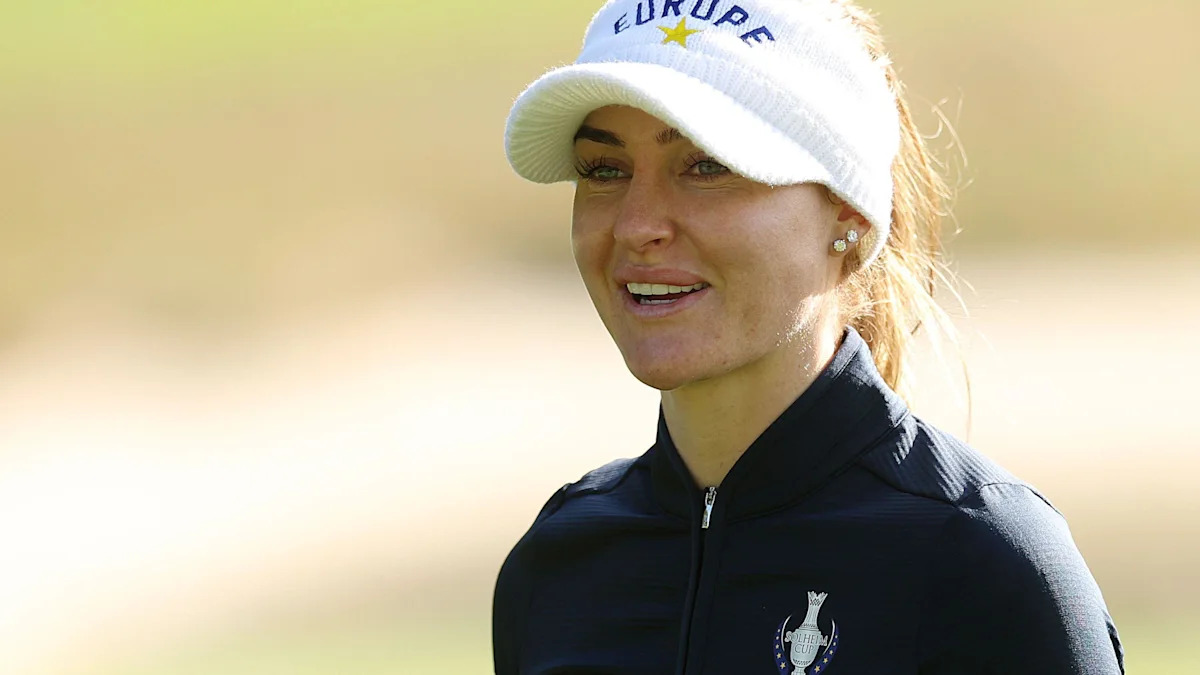
Recent history suggests this week’s Solheim Cup will be another epic clash to follow hot on the heels of Great Britain and Ireland’s dramatic victory over the United States in the Walker Cup.
The extraordinary climax at Lahinch last Sunday, where GB&I won with the last putt of the match, evoked memories of the past three Solheim Cups staged in Europe.
Advertisement
Three years ago in Spain the contest ended in a dramatic 14-14 tie to allow a delirious European team to hold on to the trophy, having initially wrestled it from US hands with a single point victory at Gleneagles in 2019.
Then it was Suzann Pettersen’s gut wrenching and ultimately successful putt on the final green at the Scottish course that decided the outcome.
And the previous Solheim Cup held on continental soil was a 2015 single point away win that capped an astonishing comeback by the United States in Germany.
So the past three matches in Europe have had no more than a point in them and the home team and the US are tied on aggregate at 42 points apiece.
Advertisement
“I think it just shows how important each game is,” said British number one Lottie Woad, who makes her debut for Europe this week.
“Even if you’re a couple down early, you can get it back and even just getting a half point could be vital. So I think you’ve just got to have that mentality that any half point or point helps.”
Woad’s compatriot and potential partner Charley Hull believes it can be tougher playing at home. “We get big crowds in both places, but obviously, it’s a little more pressure over here when it’s a home Solheim Cup,” she said.
“You’ve just got to deal with it, just stay focused, and be in the zone.”
Advertisement
Europe’s quartet of debutants
Lottie Woad is the top European player in the world rankings [Getty Images]
Woad is among four rookies in the European team joining fellow Englishwoman Mimi Rhodes, France’s Nastasia Nadaud and the big hitting Spaniard Julia Lopez Ramirez.
“I can’t wait for them to tee it up,” said European captain Anna Nordqvist. “It’s always easy to try to describe to the rookies what it’s like playing in the Solheim, but it’s something that you need to experience.
“And you have to get your own feel for it. But I can’t wait for them to feel what it’s like stepping up on that first tee.”
Players prepare for the intimidation of packed crowds in a huge grandstand around three sides of the opening tee, but of more significance will be the play as matches reach their climax down the closing stretch of holes.
Advertisement
And that will be amplified further if it is again close in the closing singles matches on Sunday. “Obviously it’s elevated,” said 2025 US Open winner Maja Stark.
“But you’re still just playing golf and you’re trying to do your best and you’re trying to beat one person. There’s not much more you can do.
“You can’t rely on team-mates on Sunday afternoon. You have got to go back and remember what’s important for me now.”
The three-day contest starts on Friday with four foursomes – alternate shot – matches, with four fourball matches to follow. That format is replicated on Saturday before the 12 singles matches on Sunday.
Advertisement
Form means little at Solheim


The Solheim Cup will begin with foursome matches on Friday [Getty Images]
American captain Angela Stanford is bullish about her line-up’s ability to handle the unique pressure of the Solheim Cup. “I think they’re very mentally tough,” she said.
“They don’t let things bother them. They let things kind of roll off their back if something doesn’t go the way they planned and they seem really focused.”
Ironically none of the 24 players are bringing stellar individual form into this match, not even Nelly Korda, the world number one who claimed her fourth title of the year by winning the US Women’s Open in June.
Advertisement
Korda has had only two top-10s since that major triumph at the start of the summer and finished in a lowly share of 50th place at the recent FM Championship.
Since Korda’s US Open victory there have been no LPGA wins for any of the Solheim players.
For Europe only Celine Boutier and Woad have claimed titles this season and American Lauren Coughlin is the sole other tour winner in 2026 on show.
But that backdrop will be forgotten when it comes to head-to-head matchplay. As the Walker Cup showed it goes to a rarified level when put into the team environment.
“You can lose or win any match regardless of rankings or how you’re playing at the moment,” said Linn Grant, Stark’s Swedish compatriot who has missed the cut in five of her past six events.
Advertisement
“When everyone shows up on Friday, you’re just going to bring your best game.
“It’s so different playing matchplay in this setting. It’s kind of like just everyone’s best game just shows up normally which makes it a lot more fun to play as well.”
Bernardus’ key holes
They are competing on a testing course at Bernardus Golf near Hertogenbosch in the Netherlands, which hosted the Dutch Open on the DP World Tour from 2021-23. It has a Surrey heathland feel, that can play like a seaside links in certain areas.
But that fast running aspect has been compromised by the storms that lashed the layout on Wednesday. “I think it’s a great course for matchplay,” said Stark.
Advertisement
“There are a lot of bunkers that you don’t really want to be in. You can have a lot of really long irons into par-four holes as well.”
The par threes are also likely to generate plenty of drama, especially the 15th where matches will reach a crucial stage. “It is my favourite hole both visually and strategically,” says Bernardus club professional Roel Verdonschot.
“It is built for drama. Players must decide whether to take the risk and attack the pin for a short birdie opportunity or play towards the middle of the green and accept a longer putt.
“The tee is sheltered, so the wind can be difficult to feel, even though it is still influencing the shot.”
Advertisement
And any match that goes the distance will involve an exceptionally tough 389-yard par-four closing hole. There is water from the left of the tee, while bunkers await players attempting to play safely towards the right.
And the green is tiny with a deep run-off to the left and water to the right. “The 18th is the most difficult playing hole at Bernardus,” said Verdonschot.
“You face a tee shot that you cannot afford to miss left, but you do not want to miss right either. If a close match reaches the 18th, there is a very good chance of drama.”
Which is completely in keeping with Solheim Cup matches, especially those staged in Europe.
Read the full article here


