





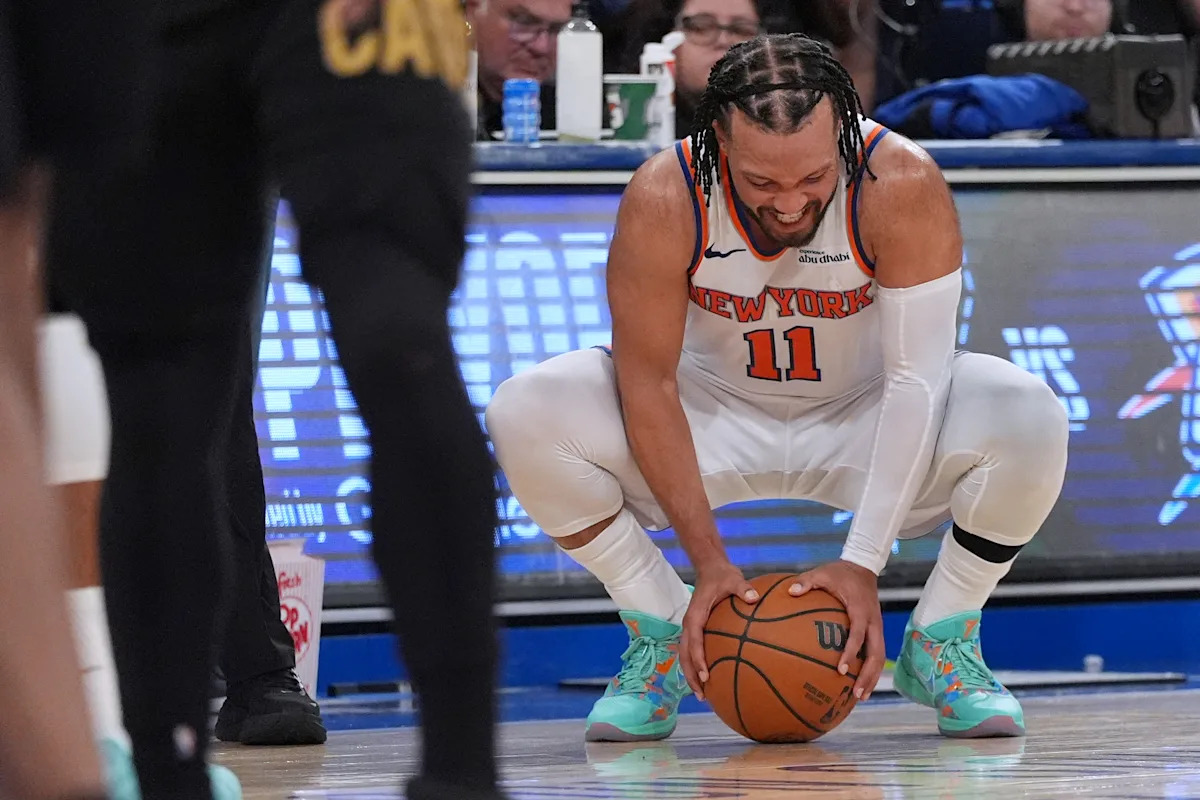
NEW YORK — Kenny Atkinson understood what Mike Brown was thinking.
Before Game 1 of the 2026 Eastern Conference finals, the Cleveland Cavaliers head coach fielded a question about a massive decision that his counterpart on the New York Knicks’ bench had made two rounds earlier — the choice to dramatically reorient his offense, shifting from a version predicated primarily on Jalen Brunson creating with the ball in his hands to the more motion-heavy approach that Brown had tried to install at the start of the season, with Karl-Anthony Towns acting as the playmaking hub at the top of the floor.
Advertisement
That tactical change revolutionized New York’s attack, sending the Knicks on a rampaging run to seven straight wins and a second straight conference finals, where that high-octane offense would now become Cleveland’s problem. So what did Atkinson think about the change? That necessity is the mother of invention.
“Down 2-1, we gotta change something, something’s not working — I get it,” Atkinson said before Game 1. “Atlanta’s got elite iso defenders.
“Sometimes, it’s like, you know, you have to be presented with that problem first, right? And then, you’re like, ‘Oh, man, we gotta make a change.’”
Atkinson’s Cavs pose a number of problems: Donovan Mitchell’s scoring, James Harden’s playmaking, Evan Mobley’s advancing versatility, Jarrett Allen’s increasing physicality on the boards, and credible shooters everywhere. One specific problem, though, presented itself to Brown early in the first quarter: Cleveland wasn’t going to gift-wrap the Knicks their preferred defensive matchups in this series. (Well, not yet, anyway.)
Why the Knicks got off to a slow start
Atkinson opened the series by cross-matching, slotting power forward Mobley onto Towns while center Allen slid over onto forward Josh Hart — an alignment we discussed in our series preview, and one that plenty of teams have deployed against the Knicks going back to Tim Thibodeau’s tenure, in an attempt to defang New York’s more dangerous offensive weapons by funneling shots to Hart, an at-times shaky shooter who shot 41.3% from 3-point range during the regular season, but entered the conference finals just 11-for-40 from deep in the 2026 playoffs.
Advertisement
“You know, Josh — we faced this coverage all year,” Brown said after Game 1. “And we played well throughout the course of the year, and we faced it in Atlanta.”
When they faced it against Cleveland in Game 1, though, the Knicks struggled out of the gate. New York went right to Towns as the high-post hub, but between Mobley’s ball pressure, the Cavs seamlessly switching off-ball screens to take away backdoor cuts and Allen sagging off Hart to park himself in permanent help position near the paint, the Knicks couldn’t find anything clean on their opening possession, settling for a contested late-clock pull-up 3-pointer by the returning OG Anunoby.
On its next possession, New York quickly dialed up a counter, putting the ball in Hart’s hands to draw Allen into the play and away from the paint while running an off-ball action with Brunson and Towns — a means of finding another entry point into the two-man game that wrecked the Hawks and 76ers. It got Towns a clean catch, but a strong closeout by Mobley (and, arguably, an uncalled foul) resulted in another missed 3-point try without a preceding paint touch.
Brown spun up another counter on the next trip, using Hart as the screener in an inverted pick-and-roll with Towns on the handle — a move aimed at drawing Allen into the action and away from the paint, and weaponizing Towns’ unusual ability to drive the ball for a man his size. But Mobley, last year’s Defensive Player of the Year, dug into Towns’ dribble, forcing him to lose possession with a live-ball turnover that got the Cavs out in transition.
Advertisement
A minute later, with Cleveland again gloving up all the Knicks’ off-ball activity while Towns surveyed from the top of the floor, New York wound up once again needing to settle for a late-clock 3 — this one, a dare-you attempt by Hart, with Allen nearly 10 feet away from him. It clanged clear.
When Mobley checked out with 6:42 to go in the opening frame, the 6-foot-5 Max Strus checked in — and promptly picked up the Towns assignment, sticking with the cross-match. On the Knicks’ next offensive trip, Towns aggressively drove at the smaller defender, going left, getting into the paint and getting to a runner … that Allen, who’d left Hart unattended in the far corner, calmly slid over and swatted clear, triggering another Cleveland fast break.
From Game 4 against Atlanta through the end of their sweep of Philadelphia, the Knicks had scored an average of 137.4 points per 100 possessions — an incendiary rate that would rank as the most efficient offense of all time. And yet, nearly halfway through the first quarter of a game against the NBA’s No. 15 regular-season defense, they’d scored just four points on 2-for-11 shooting.
Maybe the slow start was to be expected, given New York’s nine-day layoff between series.
Advertisement
“Yeah, I mean, to be real, there was definitely rust,” Towns said after Game 1. “You could see we were a team that hadn’t played a playoff game in a while.”
“We just started the game off 2-for-19 from the 3-point line,” Brown said. “And it wasn’t just Josh — we had some pretty good looks from the right people, and you know, if those go in, the mojo is a little bit different.”
Given the specific nature of the struggle, though, it sure seemed like maybe those long-standing problems with the Knicks’ starting lineup — and the offensive issues presented by Hart’s wax-and-wane shooting — were rearing their ugly head once again. They continued to do so throughout Game 1.
Despite Hart trying his level best to contribute in other areas — seven rebounds, four assists, a steal, aggressive on-ball defense, some sharp takes in transition — the downstream effects of how Cleveland exploited his presence effectively cratered New York’s overall offensive ecosystem. The Cavs dominated the middle quarters, building a 22-point lead largely on the strength of a defensive effort that held the Knicks starting lineup to just 80 points per 100 possessions in its 18 minutes, and the Knicks to a horrendous 68.8 points-per-100 with Hart on the floor in Game 1.
Advertisement
And then, in the fourth quarter, Brown played a card he’d been holding: Out went Hart, in went Landry Shamet.
It went well.
Landry Shamet, game-changer
It’s not just that Shamet made three 3-pointers in the historically remarkable 44-11 surge that delivered the Knicks a Game 1 victory (although those were nice). It’s that, with Shamet — a 38.6% career 3-point shooter who shot 39.2% during the regular season and had gone 10-for-23 from deep (43.5%) through the first two rounds of the playoffs — on the floor alongside Towns, Anunoby and Mikal Bridges, the Knicks fielded a lineup with five credible, dangerous shooters. That meant there was no weak link to exploit to enable Allen to load up defensively, and no safe place to hide a weaker defender. And that meant Brown had created the conditions for Brunson to go hunting again.
In Game 1, the five-man unit of Brunson, Towns, Bridges, Anunoby and Shamet scored 44 points in 12 minutes on 15-for-20 shooting — good for an offensive rating of 176, a level of efficiency that threatens to engulf your keyboard in flames when you type it.
Advertisement
“The game’s about adjustments,” Brown said after Game 1. “We made an adjustment down the stretch, and we were fortunate to be able to come back and get the win.”
Atkinson, for the record, doubled down on his post-Game 1 assertions that he both trusted Harden to hold up defensively and that he and his coaching staff did make some changes to their defensive coverages on Brunson pick-and-rolls. At Cleveland’s Wednesday walkthrough, he told reporters that the Cavs’ proprietary internal analytics graded New York’s fourth quarter shot quality “in the first percentile,” and that he viewed the choice between letting Brunson go one-on-one and sending a second defender at him as a “damned if you do, damned if you don’t” sort of proposition.
“We didn’t, like, stick with the analytical thing, where you’d say, ‘Live with it, live with it, live with it.’ We started double-teaming, and you know, we got hurt with the double-team. So if you’re on either side of the fence, you’re right,” Atkinson said with a laugh. “And you know, the coach, especially when you lose, you’re wrong, no matter what side you take.”
The Cavs presented Brown with a problem, and he made a change, and he was right. Two big questions leading into Thursday’s Game 2 (8 p.m. ET, ESPN): Assuming Brown keeps Hart in the starting lineup, will Cleveland stick to its script, even knowing that Brown has a ready-made adjustment in a five-out look with Shamet or Deuce McBride off the bench? And, if so, how quickly will Brown go to it if New York’s offense once again gets off to a slow start?
Advertisement
Hart, for his part, expects more of the same.
“I mean, probably the same game plan,” Hart told reporters at New York’s Wednesday practice session. “For them, this was the game plan that [put them] up 20 or whatever.”
He also, however, expects to handle it better.
“I shot shots, good shots, and I just didn’t make them — I’m working on that. Obviously, I would’ve liked to make them,” he said with a laugh. “But I’m going to continue to shoot. I’m working incredibly hard on my shot, so I’m going to keep shooting them with confidence. And then, if they don’t go in, then I’ve got to find a way to combat that, whether that’s getting guys in [dribble handoff] and quick actions while the big is in that drop, and get them open shots.”
Advertisement
If he doesn’t, though, Brown might find himself in a similar position to where his predecessor was in this round last season — needing to weigh the clear value Hart brings in all other areas of the game and as an emotional bellwether for this Knicks team against the need to not get off to slow offensive starts at a time of year when the margins between winning and losing, advancing and seeing your season end in heartbreak, can be razor-thin.
Last May, it took Thibodeau falling into a 2-0 hole with Games 3 and 4 coming on the road to make a change and send Hart to the bench. Brown went there three quarters into Game 1. He’s tended to be a little quicker on the draw with shake-ups and adjustments throughout his first season on the Knicks’ bench; if he decides that Hart needs to once again join him there (or if Hart, once again, calls for it himself), the veteran forward insists he’ll do what’s best for the team.
“Obviously, that’s always difficult, watching it on the bench — obviously, I want to be out there, I want to help my guys win,” Hart said Wednesday. “But at the end of the day, for me, I don’t have an ego to it. I approach this game with extreme humility, and that’s just how I approach it, man. I don’t have an ego.
“I said it last year, the last several years: I’m here to serve these guys. That’s the gift God’s given me: to serve these guys and make sure they’re in the best position to be successful, and I put the success of the team over the success of myself any day.”
Read the full article here