


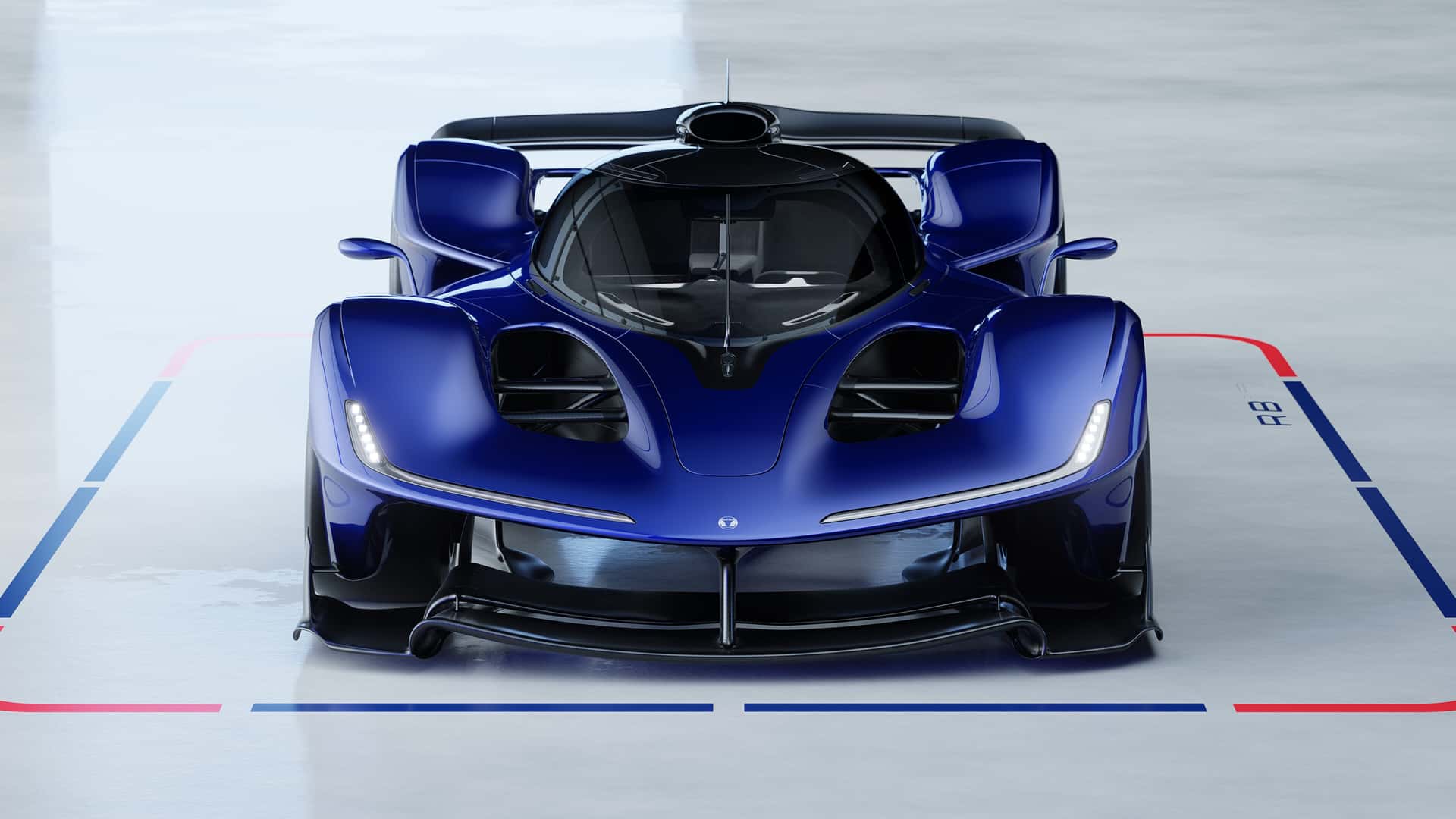
The Red Bull RB17 was never going to be just another hypercar. With the full force of Red Bull Advanced Technologies behind them, and without any pesky road-car regulations to get in their way, the engineering team saw an opportunity to build what they wanted, how they wanted. Restrictions be damned.
Now, nearly three years out from the concept’s original debut, Red Bull’s long-anticipated hypercar is almost ready for the road—er, track. Making its dynamic debut at the Goodwood Festival of Speed, we caught up with Cosworth’s Managing Director, Bruce Wood, to get a better idea of what makes this hypercar so special, and more importantly, why it has a V10.
To V10, Or Not To V10?
According to Wood, Cosworth and Red Bull looked at every possible engine option before settling on a naturally aspirated 4.5-liter V10. The custom-built Cosworth motor revs to 15,000 rpm, and puts down a ridiculous 1,200 horsepower and 811 pound-feet of torque. As Wood describes it:
‘It’s a clean-sheet design specifically for this car. When we normally do an engine, there’s something that grounds it in a certain direction. So there’s either some technical regulations for a race championship, or there are emissions regulations for a road car. The really unique thing about this is you’ve got none of those kinds of constraints.’
But believe it or not, that freedom made the decision surprisingly difficult, according to Wood.
‘[That freedom] was a little bit of a problem, because when you come to looking at the alternative engine configurations and the design, and how it integrates with the car, you don’t have anything to sort of crystallize ideas around.
We went through pretty much every single engine. We had V6 turbos, we had V12s… and the only way to really decide what’s best is to go into each configuration in a fair amount of detail in the analysis.’
Photo by: Red Bull Content Pool
After a bit of tinkering and a lot of testing, the team ultimately concluded that a naturally aspirated V10 offered the best balance of performance, responsiveness, and emotion. Especially emotion.
‘One of the big forks in the road is turbo or naturally aspirated. Given the nature of the car and what they wanted to achieve in terms of being a driver’s car, turbo engines… the torque delivery isn’t as instant.
You can achieve huge power, but if you want instant throttle response, that really drives you down the naturally aspirated route… We thought this was quite a nice balance between capacity [and] engine speed.
I think as well, the V10… the soundtrack you’ll get from a V10—you can’t really put that into a numerical assessment. Everybody still talks about that era [of Formula 1]. I think that was an important feature.’


Photo by: Red Bull Content Pool
From there, Cosworth’s engineering team really focused on nailing down the specifics: displacement, engine speed, etc. The result is one of the most extreme naturally aspirated engines the company has ever fitted to a production vehicle.
While Cosworth has experience building Formula 1 engines that revved beyond 20,000 rpm during the V10 era, designing an engine capable of reliably reaching 15,000 rpm in a customer-owned track car presented a very different challenge.
One key decision was the use of pneumatic valve springs, a technology long associated with Formula 1.
‘We knew we wanted to go over 15,000 with this, so that drove us toward air springs.’
Photo by: Red Bull Content Pool
Unlike an F1 engine (or even some of the RB17’s main rivals), Cosworth’s V10 doesn’t need a team of engineers just to fire it up. And that was an idea planned from the get-go. That meant they had to rethink specific details like piston clearances and cold-start behavior without sacrificing its sky-high rev limit.
‘Right from the outset, it was important that this was a car you could be spontaneous with—take it to a circuit and go use it. You didn’t need that army of people to run it.’
Cosworth also placed a strong emphasis on durability. Unlike old Formula 1 engines designed for just a few hundred miles, the RB17’s V10 is intended to last “many thousands of kilometers,” Wood notes, before needing any major overhauls.
Throughout development, Red Bull and Cosworth worked closely together, with the engine influencing everything from cooling systems to chassis packaging. Because so many components compete for the same space inside the car, collaboration was critical.
‘You’ve got to trust the people you’re working with. If Red Bull says, ‘We really need to put the air intake in this space,’ we know that’s the case. Every detail is a trade.’
Photo by: Red Bull Content Pool
Even with that complexity, though, Wood says the engineering team left very little on the table with this engine.
‘I’d be surprised if we didn’t leave much in the tank on this one. You choose the best materials. Weight is an enormously important target as well. It’s got everything in it.’
For enthusiasts, though, the RB17’s most defining characteristic won’t be found on a spec sheet—it’ll be on the track.
‘I would hope when we get some feedback from drivers, the thing they’re most impressed by is how drivable it is.’
Read the full article here