





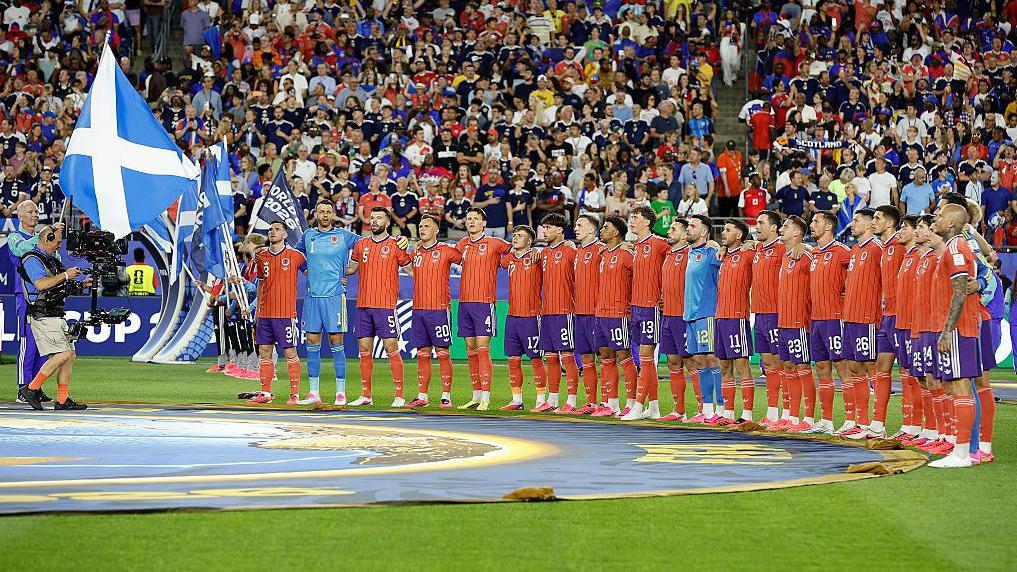
Scotland fans who had gone 28 years without seeing their team play at a World Cup probably didn’t begrudge a further two-and-a-half-minute delay before their game against Haiti got under way.
And after celebrating a 1-0 win – their first World Cup victory since Italia ’90 – the Tartan Army can reflect that good things do indeed come to those who wait.
Advertisement
But the delay to the Group C tie in Massachusetts continued a noticeable trend of tardiness at the 2026 tournament, with none of the first eight matches beginning on time.
In fact, those fixtures have started an average of three minutes after the scheduled kick-off time.
Thursday’s opening game between Mexico and South Africa was the biggest culprit, getting under way six minutes late, while Saturday’s match between Qatar and Switzerland was almost five minutes behind.
The only games to begin within a minute of the official start time were Australia against Turkey (40 seconds) and South Korea versus the Czech Republic (51 seconds).
Advertisement
What is behind late starts?
While a minute or two may not matter too much in the grand scheme of things, it will be identified as an area for improvement by Fifa, who meticulously plan every detail of the build-up to games.
Each match has its own dedicated running order, which is made available to the media, listing the exact timings of when – among other things – teams and match officials must assemble in the tunnel, when they enter the pitch and when national anthems are sung.
The information helps broadcasters, particularly those who play commercials, to ensure they don’t miss key pre-game moments.
Advertisement
For example, Haiti and Scotland were due to take to the field precisely eight minutes and 40 seconds before kick-off.
But at that point the Haitian players were not quite ready, with the match feed instead showing them being hurried along by a Fifa official.
By the time both sides eventually left the tunnel, they were already 90 seconds behind.
The other fixtures that have been significantly delayed also featured players entering the pitch late.
While the games involving co-hosts Mexico, Canada and the USA were all preceded by opening ceremonies, those had all concluded well before kick-off and shouldn’t have caused problems.
Advertisement
But one factor that may have contributed to the issue is Fifa’s decision to ramp up the pageantry immediately before matches start.
The entire squad, rather than just the starting line-up, now gathers in the centre circle for the anthems, with enormous flags displayed in each half.
World football’s governing body believes the ceremony provides a “moment of unity, pride and emotion”, but it is also more complex to stage.
As teams, officials and organisers grow more familiar with the routine, the process may become slicker – though it may also be that Fifa has slightly underestimated how long it takes.
Read the full article here