





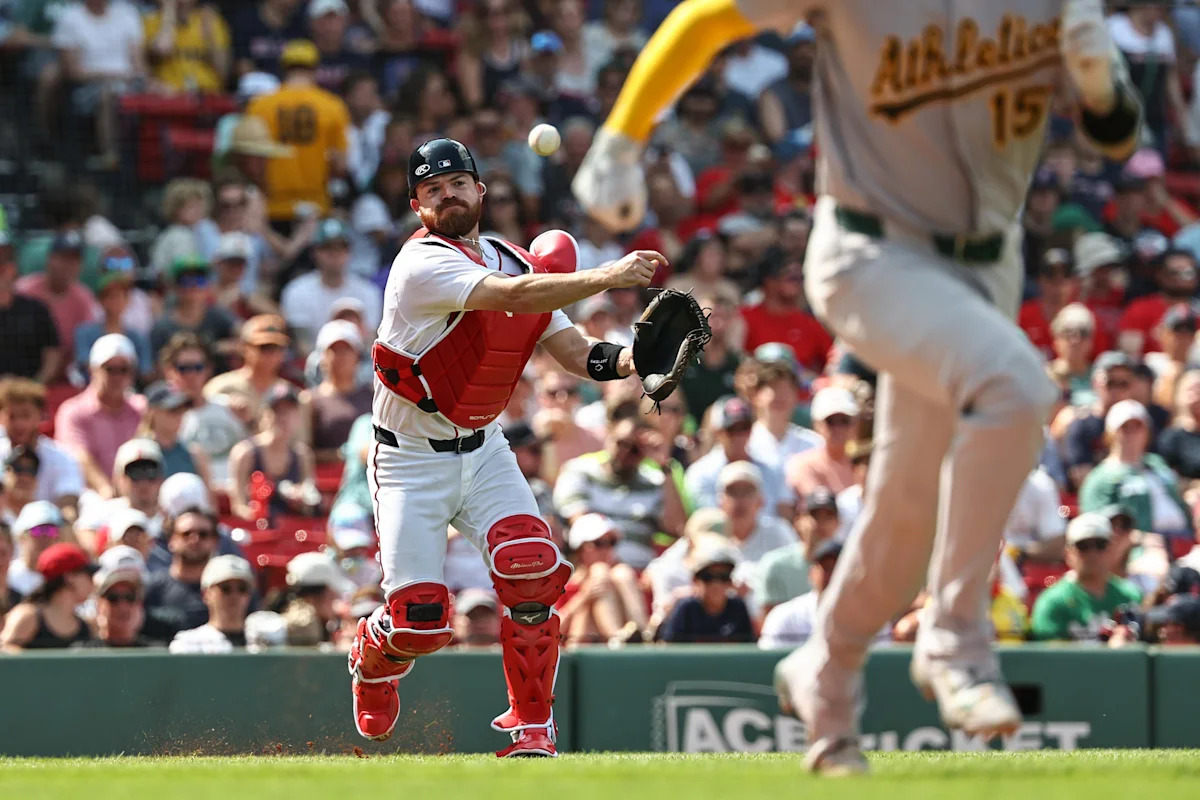
When the Red Sox acquired Adley Rutschman, the conversation immediately went to what he means for the offense, what it costs to get him, and whether this is the move that puts Boston over the top. There have been quite a few pieces on here doing a great job laying that out, from Tim Crowley’s playoff lineup theories, to Matt Gross’ fantastic analysis about Adley on the field and how it makes Craig Breslow look off the field. All fair. But buried underneath that discussion is a quieter question that’s going to matter a lot come October: who backs him up?
Carlos Narváez is gone—he went to Baltimore in the Rutschman trade. That leaves two names: Connor Wong, who’s been behind the plate for the Sox all season, and Jake Rogers, who landed here about a week ago and hasn’t stopped hitting since. This isn’t a clear-cut answer. Let’s go through it.
Advertisement
The Case for Connor Wong
Let’s start with the bat. Through 181 plate appearances, Wong is hitting .245/.333/.368 with a .701 OPS. That’s not a star line, but for a backup catcher it’s more than serviceable. He’s got 10 doubles. He gets on base at a .333 clip. When a backup catcher is getting 2-3 starts a week, you want a guy who can actually contribute offensively—and Wong can, sometimes.
The defensive numbers also favor him in ways that might surprise you. Wong’s catcher ERA this season is 3.24. That’s the ERA posted by Red Sox pitchers when Wong is behind the plate. For context, Rogers’ catcher ERA with his previous clubs is 3.52. Is that difference real or is it just the impact of Wong starting more games with a better pitching staff vs. Rogers—who has been with two very weirdly constructed and somewhat struggling staffs in Detroit and Baltimore? That’s for us to try and suss out.
View Link
Advertisement
The blocking numbers back it up, partially. Wong has allowed 10 wild pitches this season; Rogers has allowed 16. With a rotation built around guys with wipeout stuff—both elite fastballs and hard moving breaking balls landing in the dirt regularly—keeping the ball in front of you matters. One passed ball and a runner moving to third in an ALDS game can end your night.
And then there’s the familiarity argument, which is real even if it’s hard to quantify. Wong has multiple seasons learning how Crochet attacks lineups, how Tolle sequences his strikeout pitches, how every arm in that bullpen works. Rogers just got here. In October, when the margins shrink and every at-bat feels like a chess match, the catcher who knows the staff has an edge.
The Case for Jake Rogers
The arm. Full stop.
Advertisement
Rogers has thrown out 24.3% of base stealers this season. Wong is at 17.1%. That’s not a small gap—that’s the difference between a guy who neutralizes the running game and a guy opponents can exploit freely. When you have a guy with one of the best pop-time arms in baseball in Rutschman—who already showed out catching a runner stealing in his rehab assignment in Worcester—downgrading your arm at any given point is a real concern. In the regular season, stolen bases are one thing. In a playoff series, where managers are hunting every edge and one run can make all the difference, a catcher who lets the opponent run with impunity becomes a liability. Opposing base stealers are going to test whoever is behind the plate. The question is who’s going to make them pay for it.
Rogers also comes into this with a perfect fielding percentage on the season—1.000 in 39 games behind the plate. Zero errors. Zero throwing errors. Wong has two errors—both throwing errors. Again, not disqualifying, but in the context of a tight series where every mistake gets magnified, it’s worth noting.
And then there’s what he’s done since arriving in Boston, which has been genuinely hard to ignore. In his first three games as a Red Sox, Rogers is 3-for-6 with 2 RBI. He walked with the bases loaded in the August 6 marathon to drive in a run without even swinging. He went 2-for-3 with a walk while handling Payton Tolle’s 14-strikeout masterpiece on the 7th. He got a hit in yesterday’s loss. For a guy who just walked into a new clubhouse mid-pennant race, he hasn’t blinked once.
View Link
Advertisement
That small-sample line at .500 isn’t going to hold, and everyone knows it. But the .183 season average isn’t the whole story either—Rogers’ BABIP is .232, which is well below normal and suggests some bad luck is baked into that number. His contact quality and walk rate (16 BB in 125 PA) suggest a more functional hitter than the batting average alone implies. And if he keeps playing anything close to how he’s played since arriving, the offensive gap between him and Wong starts to close fast.
So Which Is It?
There’s no clean answer here, which is exactly why the conversation is worth having.
If you weigh the full season and trust the staff familiarity angle, Wong is your guy. The catcher ERA, the blocking, the OBP, the two months of organizational knowledge—it all points in his direction. You don’t bench a .333 on-base guy for a .290 guy because of a good first week.
Advertisement
If you weight the arm and the October context, Rogers makes a compelling case. A 7-point difference in caught stealing percentage sounds modest until it’s the seventh inning of a one-run game in an ALDS and someone just took second on a ball in the dirt. In a short series, the catcher who can shut down the running game has real value that doesn’t show up in OPS.
The honest answer is that Chad Tracy is going to have a real decision to make when Rutschman comes back. Wong has earned his roster spot all season, whether by default or by committee with Narváez. Rogers has earned a serious look in a single week. Both deserve to be in this conversation.
Let’s watch how Rogers plays over the next two weeks. That’s probably how this gets decided.
Read the full article here