



WASHINGTON – No, it’s not the Final Four. It just feels that way.
Between No. 1 Duke, No. 2 Connecticut, No. 3 Michigan State and No. 5 St. John’s, the East region foursome in Washington, D.C., would have enough star power to light up Indianapolis, host of this year’s national semifinals and final.
Advertisement
“This is like a Final Four, if you ask me,” said Michigan State coach Tom Izzo. “I think this is almost a chalk tournament. I’m just proud and excited to be part of it.”
Instead of playing for the national championship, the group will meet to decide which team advances out of this loaded region. The Blue Devils and Red Storm will get things started on Friday night, followed by the Huskies and Spartans.
Yet these are undoubtedly some of the biggest brands in the country. Each head coach brings glittering résumés into the Sweet 16, including a combined five national championships and 18 Final Four appearances. The four teams are led by a parade of All-America selections and future NBA draft picks.
On paper, it’s hard to find another regional bubble like this in recent tournament history.
Advertisement
“A ton of respect for each coach and their programs,” said Duke coach Jon Scheyer. “I think that’s what makes it exciting, right? It’s going to be an exciting atmosphere, high-level basketball, high-level coaching for sure.”
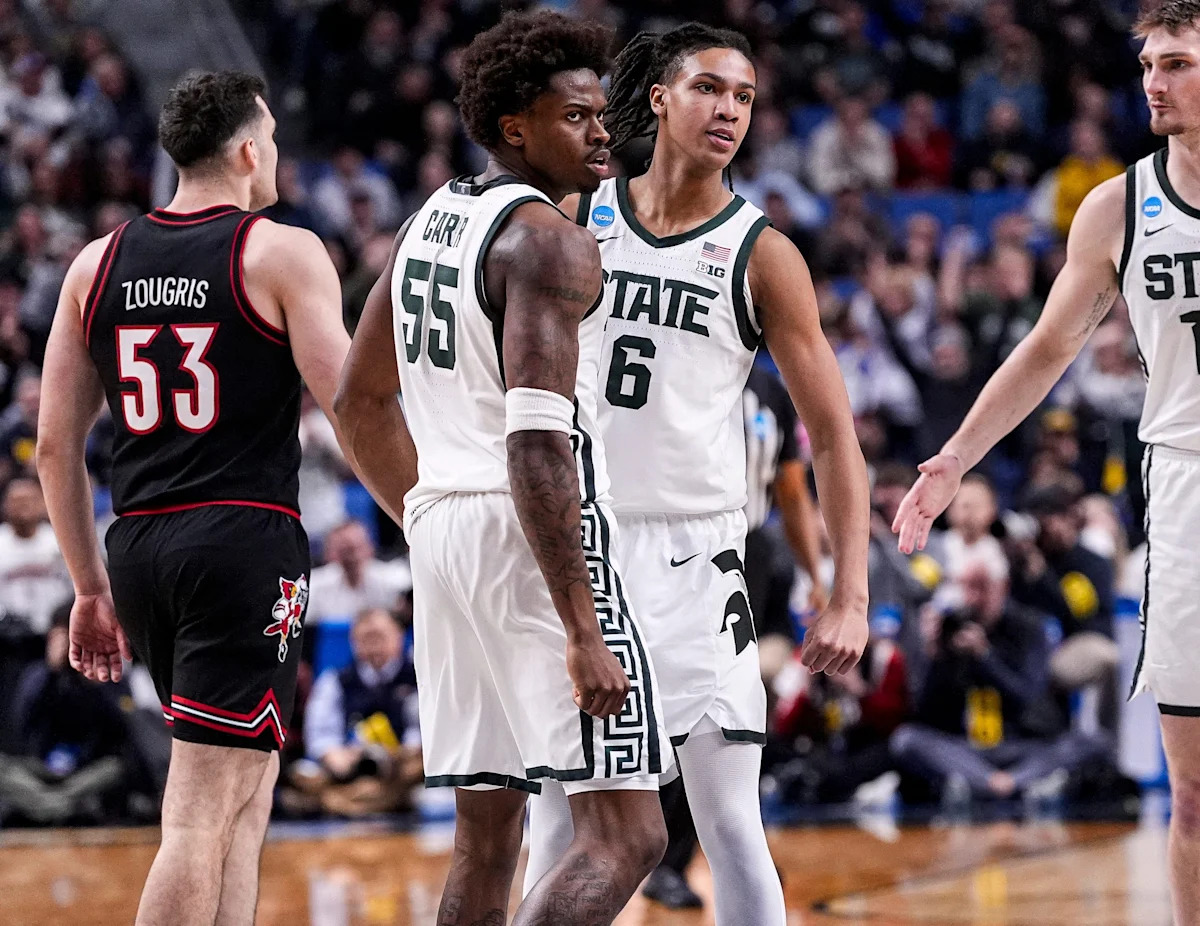
Michigan State forward Coen Carr (55) and forward Jordan Scott (6) celebrate a play against Louisville during the second round of the 2026 NCAA men’s tournament at KeyBank Center.
Elite programs, teams meet on an elite stage
Duke, UConn and Michigan State have combined for 13 national championships, with the Huskies most recently capturing back-to-back crowns in 2023 and 2024. They make up three of the nine programs to win multiple championships in the past 50 seasons.
The Blue Devils (34-2) won the ACC regular-season and tournament titles after losing just twice leading into March Madness by a combined four points. St. John’s (30-6) did the same in the Big East, though the Red Storm were given a No. 5 seed by the selection committee due to fewer Quad 1 wins that the other elite teams.
Advertisement
UConn (31-5) finished one game behind the Red Storm in the Big East and then dropped the conference championship game between the schools, giving St. John’s a 2-1 edge in the season series. Let’s put the rivalry aside for one night and root for each other to meet against in the Elite Eight, UConn coach Dan Hurley said.
“It’s probably a little bit early, but obviously, I think we’ve got to support each other,” said Hurley. “It’s pretty brutal on Twitter, I think, and socials between our fan bases, but I think we have to try to come together Friday night against our opponent so we can have a bloodbath on Sunday.”
And Michigan State (27-7) has rebounded from losses to Michigan and UCLA to end the regular season and conference tournament, respectively, to post impressive wins against No. 14 North Dakota State and No. 6 Louisville to reach the Sweet 16 for the second year in a row and the third time in four years.
“We want to make it as far as we can,” Michigan State forward Jaxon Kohler said. “Playing with all these guys is something that’s really special in my life, honestly.”
Advertisement
East region features four of college basketball’s best coaches
Here’s the best way to describe four head coaches still standing in the East region: Scheyer is the least accomplished of the bunch.
That’s a telling statement given how capably Scheyer has stepped into Mike Krzyzewski’s shoes since being promoted from associate head coach in 2022.
All he’s done in his four seasons is go 123-24 overall and 65-13 in the ACC, reaching the Elite Eight in 2024 and the Final Four last season, though the Blue Devils’ season ended with a heartbreaking collapse against Houston in the national semifinals. Given the difficulties of replacing a legend, Scheyer has become the poster child for seamless caching transitions.
Advertisement
Izzo followed similar path as an assistant to title-winning coach Jud Heathcote before assuming the job in 1995 at the age of 40 – five years older than Scheyer was when he replaced Coach K.
The résumés speak for themselves of the three veterans speak for themselves.
Izzo has gone 764-308 with 11 Big Ten regular-season titles, six Big Ten tournament titles, 17 trips to the Sweet 16, eight appearances in the Final Four and one national championship, in 2000.
“I don’t know how Coach Izzo has done it,” Hurley said. “I don’t.”
Hurley is one of eight coaches to win back-to-back national titles, joining Krzyzewski, Billy Donovan (Florida), Henry Iba (Oklahoma State), Ed Jucker (Cincinnati), Adolph Rupp (Kentucky), John Wooden (UCLA) and Phil Woolpert (San Francisco).
Advertisement
Now in his third season with the Red Storm, Pitino is already the only coach to reach the Sweet 16 in five separate decades, the only coach to win national championships at two schools — Kentucky in 1996 and Louisville in 2013, though the second was later vacated by the NCAA — and one of two to lead three different teams to the Final Four (Providence, Kentucky and Louisville), along with current Arkansas coach John Calipari.










Breaking down the East region Sweet 16 matchups
There’s one very interesting quirk to the Blue Devils’ matchup with the Red Storm. Duke beat St. John’s in each of the program’s five national-championship seasons (1991, 1992, 2001, 2010 and 2015), including a 78-61 win in the 1991 Elite Eight.
Duke is preparing for a battle against the Red Storm’s physical, end-to-end style, which paced a 67-65 win against No. 4 Kansas in the second round.
Advertisement
“I think that’s part of our identity, too, is being a physical team,” Duke freshman Nikolas Khamenia said. “I think we’ve played a lot of teams that have been physical, which is obviously going to help prepare us for tomorrow.”
St. John’s will have to contend with Duke forward Cameron Boozer, a favorite for national player of the year while leading the team with 22.4 points, 10.3 rebounds and 4.2 assists per game.
“You have to be really hungry and believe,” Pitino said. “If you don’t, usually you go home. So we just want to get after it. We know we’re playing a great team. There’s no question about that. They haven’t lost very much. But we want to foster that type of belief, that we’re going to win this game.”
Like Duke and St. John’s, the matchup between Michigan State and UConn should have a high-intensity feel driven by two of the top defenses remaining in the tournament.
Advertisement
According to the analytics site KenPom.com, the UConn defense ranks 11th nationally in adjusted defensive efficiency and the Spartans rank 13th. And both offenses look to get into transition but will focus on frontcourt play in the halfcourt set, with the Huskies led by center Tarris Reed Jr. (41 points and 40 rebounds through two tournament games) and Michigan State centered on Kohler, center Carson Cooper and junior forward Coen Carr.
While the two teams didn’t face off during the regular season, they did meet in a charity exhibition game in late October, with the Huskies pulling out a 76-69 win.
“You remember the physicality they play with, the rebounding, how fast they play, the pace they play at,” said UConn forward Alex Karaban.
This article originally appeared on USA TODAY: East Region in March Mandes resembles Final Four with its quality
Read the full article here