




Matches at the World Cup could face long weather delays if thunderstorms strike in close proximity to the stadiums in use.
The tournament – co-hosted by the United States, Canada and Mexico – is being held in the peak of storm season in parts of the countries, with strict rules in place for lightning in the US particularly.
Advertisement
The weather, including the threat of lightning, already played a role in preparation for the tournament, with England’s friendly with Costa Rica delayed by an hour after heavy rain and the prospect of lightning in the Orlando area.
While a scorching New York City, with temperatures in the mid-30s during the opening days of the tournament, experienced heavy rainfall, thunder and lightning less than 24 hours before Brazil face Morocco in New Jersey.
With Fifa adhering to rules set by local authorities during the tournament, the National Oceanic and Atmospheric Administration (NOAA) says that if any lightning strike is detected within eight miles of a stadium the game has to be stopped.
That was a scenario seen several times during last year’s Club World Cup in the US, with six matches halted due to electrical storms.
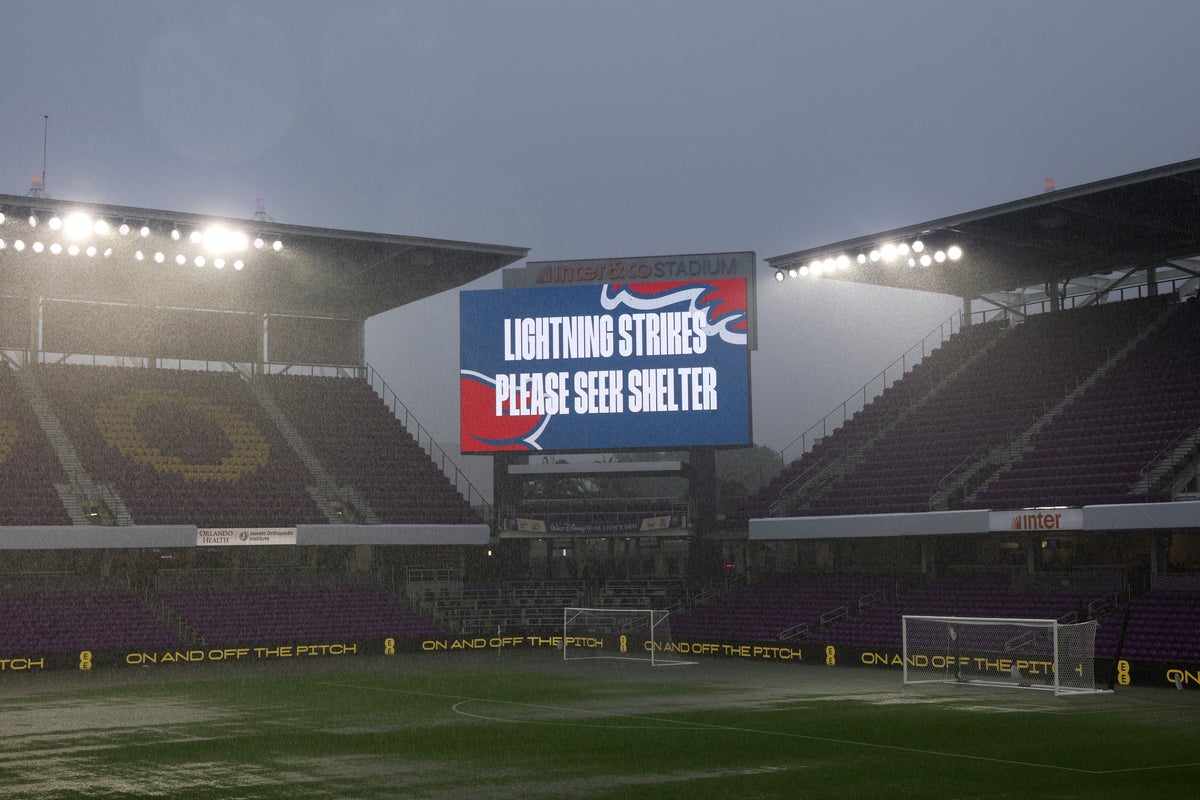
A warning for lightning strikes appears on the big screen as heavy rain falls prior to the International Friendly match between England and Costa Rica at Inter&Co Stadium (The FA via Getty Images)
That included an encounter between Chelsea and Benfica which kicked off at 4.38pm local time and eventually finished four hours and 38 minutes after it had begun.
Advertisement
Stadiums in the Gulf Coast area and south east of the United States are likeliest to come under threat from thunderstorms, with Fifa addressing each match on a case-by-case basis if play is halted.
If lightning strikes within eight miles, a half-hour countdown begins before play is permitted to resume. Any subsequent strike would reset that clock, potentially leading to length delays like the kind seen in that Chelsea-Benfica game in Charlotte, North Carolina.
Issues could potentially arise if storms hit during the final round of group-stage games. The kick-off times of the two games in each group are synchronised to avoid affording an advantage to any nation by knowing what they need to do, although that may be unavoidable under such circumstances as a weather delay.
Were conditions sufficiently dangerous to force an abandonment, World Cup regulations state that the game would be played on a future date, restarting in the same minute as it was paused, with the remaining minutes played.
Read the full article here


