





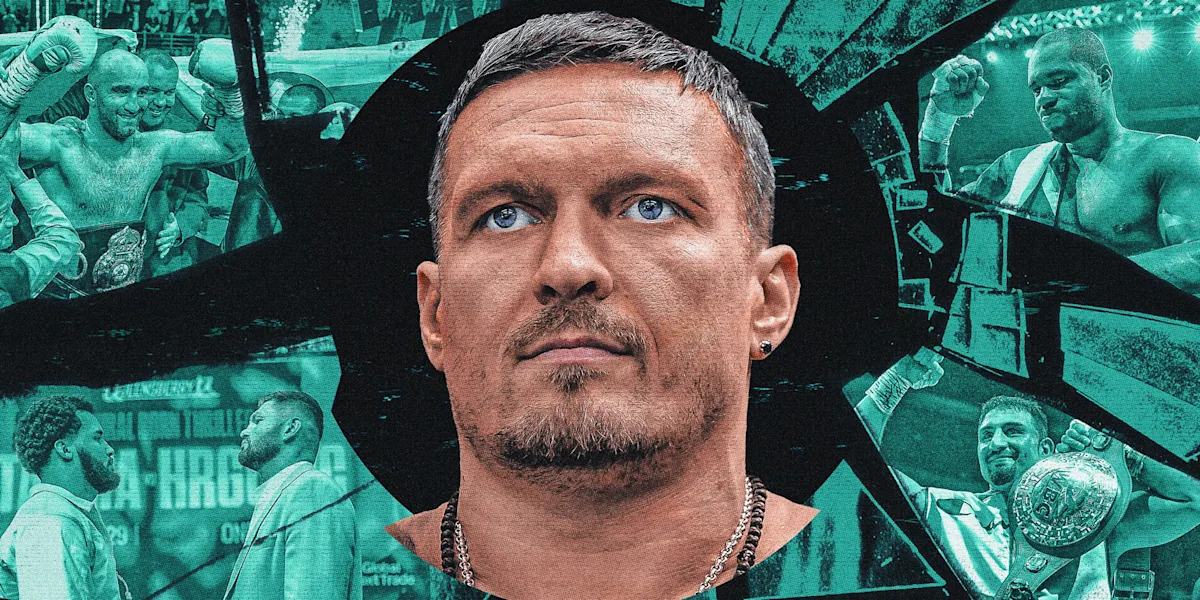
Sometimes greed makes a belt suddenly pointless. Eat too much at a buffet, for example, and one finds that a bloated stomach will now pick up the slack, rendering one’s belt unnecessary. The choice then becomes a simple one: either the belt is loosened a few notches or it is deemed an inconvenience and removed entirely. Either way, on account of one’s gluttony, both its function and value has now changed.
For reasons of safety, belts are also removed in prisons and most airports, before later being returned. Meanwhile, in a boxing ring, where no one is safe, a belt is an item both won and lost. It is lifted and worn. It is vacated and stripped. It is, depending on the fighter wearing it, by turns meaningful and meaningless.
Advertisement
In the old days, back when the meaning was clearer, the belts of boxers were pretty things coveted by all. They were quite rare, too, with fewer bodies wearing them and fewer sanctioning bodies demanding fees for the privilege. Being so rare, it meant something whenever you saw one. They told a story. They signified success. They carried a certain gravitas.
Then something changed; a change in fashion, perhaps, or in consumption habits. Now all we hear is that there are too many belts in boxing and that the proliferation of them has diluted what it means to be seen wearing one. Now there is even talk of boxing’s belts being removed altogether, fueled by a growing belief that it is the fighter — or better yet, the fight — that matters most when attracting an audience.
If that were to happen, one former fighter who wouldn’t mourn the loss is Terence Crawford. In December, Crawford, a world champion at three weights, was stripped of his WBC (World Boxing Council) super middleweight title just 81 days after winning it, all because he had failed to pay sanctioning fees for his previous two fights (against Saúl “Canelo” Álvarez in September 2025 and Israil Madrimov in August 2024).
Not long ago, Terence Crawford had quite the belt collection.
(Harry How via Getty Images)
“Champion Crawford allegedly earned $50 million [for] that fight [vs. Álvarez],” Mauricio Sulaiman, the WBC President, said at the time. “Appreciating the magnitude of that event and the magnitude of those monies, the WBC modifies rules to limit the boxer’s bout fees to 0.6% [$300,000] instead of the 3% [$1.5 million], which the rules required.
Advertisement
“The WBC put champion Crawford on notice of his failure to comply with express mandates of the WBC rules and regulations. Specifically, non-payment of the boxer’s bout fees for his last two fights.
“The WBC had no choice but to act, considering champion Crawford had received ample notification and multiple opportunities to address and resolve the situation.”
Ultimately, it hardly mattered to Crawford. He retired no sooner than that statement had been issued and nobody, not a single soul, will remember him being stripped of, or even wearing, the WBC super middleweight title when it’s time to assess his legacy in the sport.
Besides, in a situation like that one, is a fighter ever wrong to decide what a belt means to them? Certainly, when it comes to a battle between fighter and sanctioning body, it’s hard for a sanctioning body to take a stand, or the moral high ground, while at the same time behaving in a way that undermines its own point. Indeed, one need only look at the number of titles the WBC is presently dishing out to understand why Crawford, their erstwhile super middleweight champion, might have approached the idea of paying to wear their belt without any enthusiasm or pride. In fact, just cast your eye over the latest WBC rankings and you will see there are currently eight boxers across their 18 weight classes in possession of “interim” titles. This means that in each of those eight weight classes, there is not one but two world champions. In short, it means what was once meaningful has now become almost meaningless.
Advertisement
It’s not just the WBC, either. All of the other major sanctioning bodies have been equally guilty of exploiting boxers’ desire to have a belt around their waist. Hence, we today have a deluge of international belts, and intercontinental belts, and super belts, and regular belts, and diamond belts, and silver belts. It’s also why the World Boxing Association (WBA) have, at present, a total of three world champions in their light heavyweight division: Dmitry Bivol, who is the “super” champion, David Benavidez, who is the “regular” champion, and Albert Ramírez, who is the “interim” champion.

David Benavidez is one of three current WBA world light heavyweight champions. Confused yet?
(Cris Esqueda/Golden Boy via Getty Images)
All in all, it’s a messy state of affairs, this business of belts. It’s messy for the champion robbed of experiencing the thrill of calling himself the world champion, and it’s messy for any fan still foolish enough to try to keep track. And yet, perhaps because of the iconography, or simply the history, we stick with it, fans and fighters alike. Try as we might, we struggle to imagine the sport without them and we find it impossible to picture our all-time favorite fighters without seeing around their waist, or slung over their shoulder, the very same world titles that have been devalued in recent years.
For the fighters, especially, the appeal of holding a world title of any description will never die. After all, though money is often the driving force when a boxer turns professional, equal to this, particularly in those formative years, is the hunger to carry a belt.
Advertisement
“It needs to be a part of boxing,” said “Canelo” Álvarez on Uncrowned’s “The Ariel Helwani Show” in July. “Those belts have a lot of history. I think they need to be in boxing, those belts. For me, if my boy [his son] turned into a fighter, he would want to be a world champion like his dad. He would want to be fighting for those belts like his dad.”
Chances are, for as long as there is money to be made from them, and indeed the demand for them, there will always be belts of some description in boxing. Whether they stick around in their current guise, or mutate into something else, is another question, but, if only for reasons of hierarchy and marketing, they will surely have a place. In the eyes of the public, a world title fight is a world title fight, regardless of its merits in the eyes of those who maybe know better. Nothing, in fact, has the capacity to deceive quite like those three words: world title fight. It is something promoters have used to sell faulty products for decades and it is something television networks have frequently looked for when tempted to invest in a specific event. It could even be argued that the value of a world title fight, or a world title belt, is considerably greater at the negotiating table than it is in the ring nowadays.
Zuffa Boxing, the new promoter in town, clearly knows the value of belts. In the world of mixed martial arts (MMA), from which Dana White and Zuffa Boxing have arrived, the UFC title is for many fighters the title to win. There are only eight of them for men, spread across eight weight classes, and to win one typically means that you are the No. 1 fighter at that weight, at least among fighters signed with and ranked by the UFC.

Canelo Álvarez, Dana White and Turki Alalshikh all have different views on boxing’s belt obsession.
(David Becker via Getty Images)
Now, having formed Zuffa Boxing with Saudi co-founder Turki Alalshikh, White’s intention is to create a similar structure in boxing. The aim, we are told, is to recognize only eight of the sport’s 18 weight classes and, in terms of world titles, recognize only Zuffa’s own. However, one can’t help but question the feasibility of this plan when so many of the existing belts are synonymous with success in a sport much older than MMA.
Advertisement
In March, Jai Opetaia, the former IBF cruiserweight champion, received the inaugural Zuffa cruiserweight title for beating Brandon Glanton, yet appeared, in the fight’s aftermath, to still be grieving what had been sacrificed to acquire what was shiny and new. In the ring he wore three belts, but it was the positioning of these three belts that proved telling. You had over his right shoulder the IBF cruiserweight title, which was not on the line against Glanton and was soon stripped from Opetaia, and then over his left shoulder you had the The Ring magazine belt, which should mean more than it does. The third belt, meanwhile, the Zuffa belt, was in the end wrapped around Opetaia’s waist by White, who’d approached the Australian from behind. That belt, unlike the other two, was not one gathered by Opetaia himself, yet it now had pride of place on his body. Now it was exactly where the audience would expect to see a belt worn by a world champion.
“You are the recognized Ring magazine champ and you’re now the first-ever Zuffa cruiserweight champion of the world,” Max Kellerman, the post-fight interviewer, was quick to remind Opetaia in the ring. “Who would you like to make your first title defense against?” He then paused. “Zuffa title defense.”
“Man, I’m chasing the belts,” Opetaia said. “I know there’s been a lot of white noise and stuff, and a lot of stuff on social media, but I’m hoping we can get it worked out and I can chase that goal. I have not lost track of it. I never have. I’ve been stripped once before and I’ve been stripped again. I’ll be getting the belt back and will become undisputed.”
“I think you are undisputed, you just don’t know that yet,” said Kellerman, again on hand to remind Opetaia of all he was forgetting. “In the eyes of most boxing fans you already are undisputed, in spite of whatever the belts have to say.” He then asked Opetaia if he fancied fighting Gilberto Ramirez, the then-WBA and WBO cruiserweight (World Boxing Organization) champion, to which Opetaia replied: “WBC, WBO, WBA, whatever. I’ve been chasing these unification fights for such a long time. I made it very clear. Now I’m holding the most belts. I’ve got three belts; he’s [Ramirez] got two. Let’s get it on.”
Advertisement
Confused? You’re not alone.

Jai Opetaia is today beltless … at least in the eyes of boxing’s four major sanctioning bodies.
(Chris Hyde via Getty Images)
Three months after Jai Opetaia became not a new world champion but a different world champion, Oleksandr Usyk decided that he quite liked the idea of being a former world champion, despite still being the best heavyweight in the world.
“It’s a good day to say that I want to vacate all the belts I currently hold,” announced Usyk, a two-time owner of the WBC, WBA, IBF and WBO heavyweight titles, in June. “I want to make them available so the guys who are next in line can fight for them.
“I’m leaving the belts, but I’m not leaving the sport because I still have my last dance.”
Advertisement
Some have suggested that Usyk, who dethroned Anthony Joshua in 2021, will now select Deontay Wilder, the former WBC heavyweight champion, for his so-called “last dance” and that will be that. His ability to do so is of course now strengthened by the fact he is no longer beholden to any particular sanctioning body. He can instead for once wield the power of a world heavyweight champion — the true world heavyweight champion — and do exactly what he wants. There has even been talk of Usyk and Wilder meeting for the inaugural Zuffa heavyweight title, though that has yet to be substantiated.
Regardless, the audacity of Usyk to dump the belts is a testament to his power as a champion; confirmation if ever it was required that some fighters can indeed transcend the belts that once defined them. In Usyk’s case, there is no need to follow the rules of a sanctioning body anymore. Nor is there any time to waste. His last fight, a farcical one against kickboxer Rico Verhoeven, was an early indication that the 39-year-old was starting to go rogue and have a bit of fun. This suspicion was then confirmed when, in June, he effectively said to the next generation, “It’s your turn now. My work here is done.”

Oleksandr Usyk said goodbye to his belt collection after becoming a two-time undisputed heavyweight champion.
(Ed Mulholland via Getty Images)
As for what happens in the future, that’s anyone’s guess. All I know is that the last time a great Ukrainian’s heavyweight reign came to an abrupt end — this time not of his own volition — I was in Düsseldorf, Germany watching Tyson Fury do the unthinkable to Wladimir Klitschko, firmly of the belief it would benefit the division.
Advertisement
As great as he was, Klitschko — a champion for nine years — it was time for a revamp, most felt. By then, in 2015, his methodical, jab-and-grab style had run its course and was becoming a threat to the entertainment value and therefore health of boxing’s most valuable weight class. For that reason alone, Fury’s dull disarming of Klitschko that November had the same effect as a thunderstorm that follows a prolonged period of suffocating heat. It broke something, in other words, and the rain, both sudden and biblical, was for one night welcomed. Not only that, it was invigorating, medicinal. People left their homes and took to the streets just to dance in it. “The king is dead,” they yelled, “long live the king!”
In truth, Fury, the new king, didn’t last very long. Within a few months, in fact, he had declared himself injured ahead of a contracted rematch with Klitschko and then, not long after that, we learned that he had tested positive for the performance-enhancing drug nandrolone. Now the division really was free. Now, with Fury stripped of the world titles he had snatched from Klitschko, the ducks at heavyweight were not only in line but about to be fed.
That meant Charles Martin got one (the IBF title), it meant Joseph Parker got one (the WBO title), and it also meant Lucas Browne got one (the WBA “regular” title). It wasn’t until Anthony Joshua then emerged and dethroned both Martin and Parker with relative ease that a semblance of quality control was restored.
Meanwhile, rocking the WBC title around that time was Deontay Wilder, whose inability to beat a returning Fury was what ultimately allowed Fury back into contention after serving his drug ban and losing a load of weight. Now you had Joshua and Fury, two Brits, seemingly on a collision course to tie the whole thing together, only for Usyk, the world’s undisputed cruiserweight champion, to rise up and return to Ukraine what has for most of the past two decades been theirs anyway.

Usyk’s decision has kicked off a new belt revolution in the heavyweight division.
(Bradley Collyer – PA Images via Getty Images)
Which brings us all back to square one.
Advertisement
“It’s bittersweet in a sense,” said Fabio Wardley, another British heavyweight, when handed Usyk’s WBO belt following his decision to vacate. “It’s a fantastic thing to happen to me but, and not to sound arrogant, I wanted it all. I wanted it to be picture-perfect. Anyone who gets into boxing dreams of becoming world champion, so for me to turn my nose up at it and say, ‘It wasn’t exactly how I wanted it to be,’ almost feels ridiculously arrogant. I love to fight, I love to box, but I also love to earn it as well.”
As it happened, Wardley soon surrendered that WBO belt when Daniel Dubois, his countryman and a former IBF and WBA “regular” titleholder, stopped him in the 11th round of a classic in May. Since then, Usyk’s other belts have been allocated to men who would have been just as conflicted as Wardley was upon receiving his; proud on the one hand, yet perhaps embarrassed by the ease with which they had “won” something traditionally hard-earned. So far, Usyk’s WBC belt has gone to Germany’s Agit Kabayel, while his WBA belt now belongs to Murat Gassiev of Russia. Then you have the IBF title, which will, on Aug. 29 — this Saturdaay — be at stake when Britain’s Moses Itauma, considered the division’s Next Big Thing, fights Filip Hrgovic, a capable Croatian whose single loss as a professional came against Dubois.
It’s all moving, then — only, in what direction? Are we going forward, or are we going backward? That is the question. Moreover, despite the prospect of motion and change, can it not be argued that the proliferation of champions, much like the proliferation of belts, serves only to confuse and make things all the messier? Will we soon pine for the days when the Klitschko brothers, Wladimir and Vitali, took turns putting the division in a headlock? Will Usyk’s recent reign, brief though it was, represent the last time we will see a truly dominant heavyweight establish themselves as the division’s number one?
Advertisement
Or, as many old-timers claim, is the heavyweight championship of the world now simply a belt whose meaning and prominence has been killed by the sport’s inability to stop eating? “I can walk into a restaurant in Philadelphia with 200 people in there and not one of them could tell me the name of the current heavyweight champion of the world,” Hall of Fame promoter J. Russell Peltz told me in June. “I could then go to a baseball game or a football game, where there are 30,000 people in the audience, and I would still be surprised if a single American could tell me the name of the current heavyweight champion of the world.”
In the 1930s, it was reported that a black inmate on death row in a Southern state was in the process of being asphyxiated in a gas chamber when he said, as his dying words, “Save me, Joe Louis.” That might have been true, or it instead might have been fabricated, yet the enduring nature of the tale forever speaks to both the power and presence of the heavyweight champion of the world in those times.
Now, almost a century later, boxing fans seek a savior for a much simpler task: the task of keeping the heavyweight championship of the world alive. “Save us, Moses Itauma,” they might soon cry, aware it’s not a new belt the sport needs but new blood.
Read the full article here