





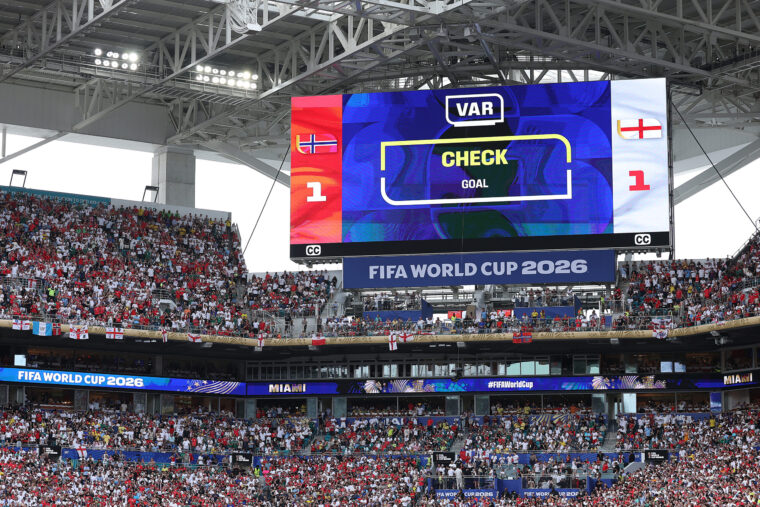
UEFA has decided not to fully adopt one of the most talked-about VAR changes introduced at the 2026 FIFA World Cup, according to talkSPORT.
During the World Cup, updated laws approved by the International Football Association Board (IFAB) allowed VAR to become more involved in incidents involving simulation.
Advertisement
The change meant VAR could step in if a referee had booked or sent off the wrong player, helping officials correct cases of mistaken identity linked to diving.
The new protocol was used in several high-profile matches and attracted praise from many supporters who believed it could help reduce simulation in football.
However, it was at the centre of one of the biggest controversies at the World Cup when it was used during Argentina’s World Cup quarter-final victory over Switzerland.
With the match finely balanced, Swiss forward Breel Embolo was initially involved in an incident that saw Argentina’s Leandro Paredes booked for what appeared to be a reckless challenge.
Advertisement
After reviewing the footage, VAR concluded that Embolo had actually initiated the contact.
Since the Swiss striker had already received a yellow card earlier in the game, he was shown a second booking and sent off.
Argentina eventually capitalised on their numerical advantage to secure a 3-1 victory after extra time.
A similar situation unfolded in the United States’ clash with Paraguay. USA captain Tim Ream was first booked for a challenge on Miguel Almiron before VAR determined that Almiron had simulated the foul.
Ream’s yellow card was cancelled, while Almiron was instead cautioned for diving.
Despite the positive reaction from many fans, UEFA has informed its VAR officials that the new law should only be used to correct clear cases of mistaken identity.
Advertisement
The governing body believes those situations involve factual errors that can easily be fixed without expanding VAR’s role further.
Officials will still be able to intervene if an incorrect second yellow card has been issued, meaning players judged to have dived can still face punishment when appropriate.
UEFA has also confirmed it will continue reviewing incorrect corner-kick decisions based only on who last touched the ball, rather than checking for possible offsides in the build-up.
Read the full article here