




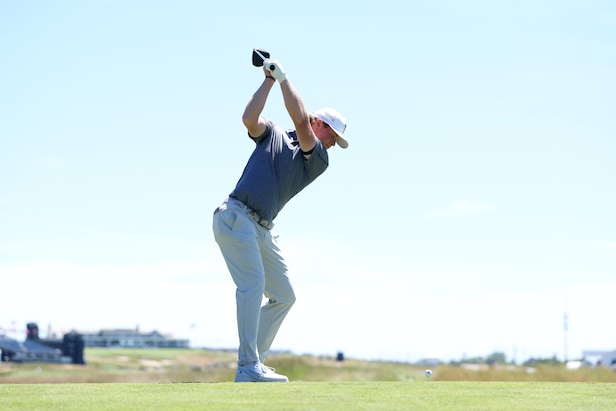
SOUTHAMPTON, N.Y. — When Jake Amos first saw Arni Sveinsson, it was in the spring, and the high school junior was coming off a long Icelandic winter. Amos was the head coach at East Tennessee State University then, and although he’d never coached anyone from the small island nation, a few Icelandic alumni had vouched for the high school junior—he was a serious, motivated player.
The two met in Miami, at one of Sveinsson’s first outdoor events following a winter of practicing indoors. Amos’ verdict?
Advertisement
“He looked terrible.”
But Amos, who would soon land the head coaching job at LSU and take Sveinsson with him, has been doing this a long time, and he saw something that went beyond the poor performance.
“His base fundamentals were great,” he said. “It was how he walked, how he went into his shots, how he reacted to a bad shot, and the way he conducted and carried himself. It was all the little details that looked elite, which you can’t teach. And the stuff that didn’t look good, I thought there was a solution for it.”
Once they were both at LSU, his instincts were borne out quickly. Within a couple weeks, under the guidance of the coaching staff, Sveinsson had improved to a shocking degree. Part of it was his natural ability, but a bigger part was that he was smart, and he listened, and he asked the right questions, and he worked and worked and worked.
2279279141
Arni Sveinsson earlier this month playing for the LSU Tigers at the NCAA Division I Men’s Golf Championship at Omni Resort in California.
Advertisement
Ryan Sirius Sun
By the end of his first year, he had a tournament win at the Blessings Intercollegiate, was chosen as a third-team All-American, compiled the third-best single-season scoring average in LSU history and was, Amos thought, the best freshman in the country. His success continued this past year, where as a sophomore he played in his second Arnold Palmer Cup and won again, at the Fallen Oak Collegiate Invitational. By that point, Amos already considered him to be one of the best iron players he had ever coached. And then, two weeks ago at Lakes Golf & Country Club in Ohio, he made his bid to qualify for the U.S. Open.
Amos drove him to the airport for that trip, and Sveinsson’s father flew in to caddie for him. The year before, he had been in position after his first 18, but had stopped chasing, and lost his aggression. This time, he shot a 33 on the back nine of his second round, survived a four-for-three playoff, and became the first Icelandic player to make the U.S. Open.
* * * * *
Advertisement
What explains this trajectory, and how a player from a country that has plenty of courses, but isn’t considered a hotbed of golf talent, could rise so high so quickly?
On Tuesday afternoon at Shinnecock, after playing a nine-hole practice round, I watched him finish his day with some work on the putting green. He had quite a team with him for an amateur—not only were his parents in town to watch, but also Amos, his Danish agent, his caddie, his physio, a stats guy, a mental coach, and Josh Gregory, a performance coach who has begun working with him.
It’s remarkable for a college sophomore to have such an extensive team, even if they’re only gathered for one week, and it’s a result of what Amos called “national federation mindset.” In other words, along with the support of his parents—when asked what they do for work, Sveinsson said “some computer business stuff … I couldn’t really tell you”—the Icelandic national golf structure provides material support.
Sveinsson, 20, stands 6-feet tall, and the first thing you notice is his red hair and the red freckles covering his face. The second thing you notice is his demeanor. He’s not humorless—in a short press conference, when the moderator noted that he was the first Icelandic player to appear in both the U.S. Amateur and the U.S. Open, he jokes that he hopes he’s not the first to play in the U.S. Senior Open—but he comes off as a very serious person, which jibes with Amos’ description that he’s an obsessed “golf nerd” whose focus is absolute.
Advertisement
“Mentally he lives his life in a way that not many sophomores in college do,” Amos said. “He’s like a 45-year-old man.”
Sveinsson grew up in a town of 20,000 people called Garðabær in the capital region near Reykjavík. He played soccer and basketball as a kid, and it wasn’t until he was 12 years old that he watched the Masters with his father—a former recreational golfer who had stopped when Arni and his brother were born but had reached a scratch handicap—and spontaneously decided to try it out. He went to the course with his grandparents and was hooked immediately.
“I didn’t really leave the course from then on,” he said.
He joined the junior program at the Golf Club of Kópavogur and Garðabær, and, in what became a theme, things happened quickly. He played constantly, even if that meant playing indoors in the long Icelandic winters and annoying his parents by chipping indoors. By 15, he was breaking par consistently and competing with older players, and in his own serious way, became enamored to the point of dedicating everything to the sport.
Advertisement
“I fell in love with the grind of it,” he said. “You’re always chasing perfection, but it’s not there.”

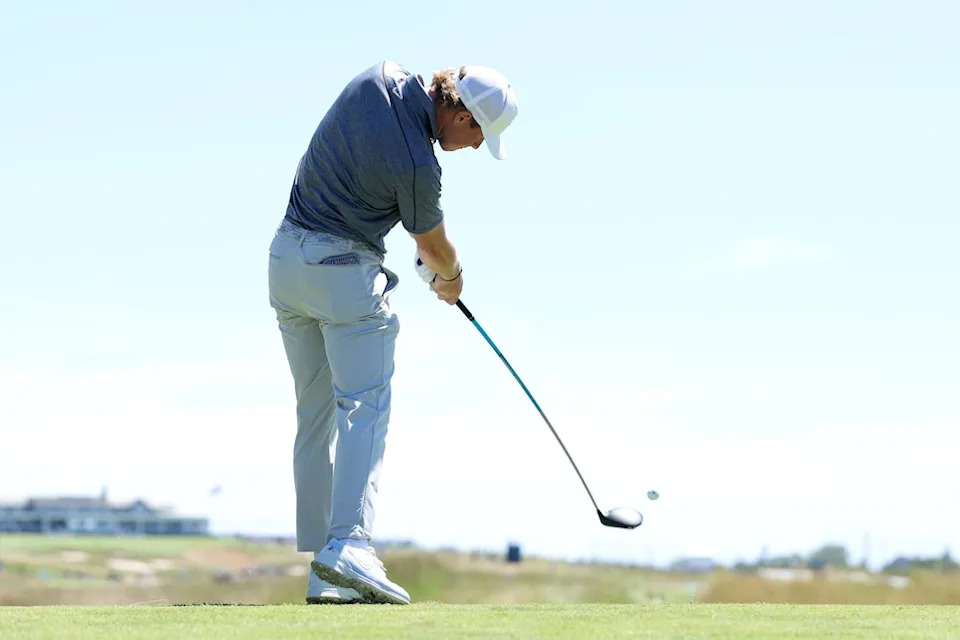
2281936843
Christian Petersen
He started playing across Europe and everywhere he could, with the specific idea of getting attention from college coaches. He sent emails to coaches, including Amos, and now he has a specific biographical detail that he shares with Rory McIlroy—both committed to East Tennessee State, and neither went there.
Unlike McIlroy, though, he wasn’t an obvious star.
“I didn’t really do anything special in junior golf,” he said, “and that’s why I’m very grateful for my coach for taking the chance on me. There were a lot of kids way better than me at the time, but I he saw something deeper than that.”
Advertisement
By his own reckoning, Sveinsson’s best attribute is his work ethic and preparation, and the mental fortitude to absorb the blows that golf inevitably delivers; he knows he’s not going to be perfect, and he knows he won’t always succeed, but more importantly, he knows that he needs to learn every time he fails.
As far as his country, he’s become used to fielding questions from people who raise an eyebrow at the novelty. He’ll happily say it’s a “huge honor” to achieve the milestones, and he has a strong sense of his place in Icelandic golf.
“I try to carry that torch further,” he said, “so the talent that’s coming up now can look at this and hopefully do better than me in the future.”
Still, golf is an individual sport, and Sveinsson is smart and striving enough that he’s hyper-focused on his own destiny. Shinnecock, he knows, is significant as a debut, but perhaps less so in the long run of the story he’s writing. He told me he’s dialing in his swing this week, and he feels slightly out of sync between travel and the unrelenting wind at Shinnecock. He’ll practice with Sam Burns, another LSU alum, on Wednesday, and his expectations feel very much in check—”I want to take whatever this week gives me and then move on.”
Advertisement
Longer term, though, his ambitions are expansive, and he’s not afraid to speak them aloud.
“It’s a big process that you’re living in,” he said, “and I want to achieve big things in this game.”
It’s been an exceptional start, and his unique origin means that even in the early days of his journey, he’s carved out a place for himself in golf history.
Read the full article here


