





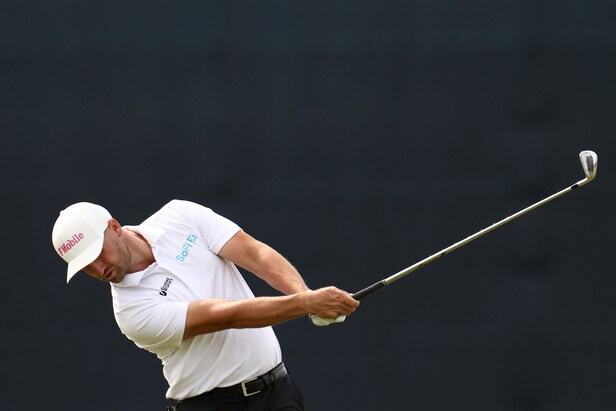
SOUTHAMPTON, N.Y. — On Friday afternoon, it appeared very likely that someone would narrow the four-shot lead Wyndham Clark (seven under) held over Xander Schauffele and Matt Fitzpatrick (three under), all of whom finished in the morning wave. Sam Stevens, Sam Burns, Rory McIlroy, and even Tom Kim hovered at or near three under for hours, but none could reach four under. And in the end, only Kim even matched Schauffele or Fitzpatrick at three under. Which means that after 36 holes, Clark’s lead remains four strokes.
Does that mean it’s over?
Advertisement
Obviously, the answer is no—we’ve seen leads of that size vanish in a single round—but let’s get down to the spirit of the question and take a deep dive into major championship history to see how other players with the same lead at the 36-hole juncture have fared. Maybe, in the process, we can learn something about Clark’s chances to prevail at Shinnecock.
(Before we get there, though, let’s give a massive shout-out to Morgan Johnson at the PGA Tour, who came through with these stats on short notice.)
Here’s the headline: In the history of 72-hole major championships, there have been exactly 30 times when a player held a lead of exactly four shots, of which Clark is the most recent. Of the 29 players who came before him …
*drum roll, please*
Advertisement
… only 11 have won, for a pretty unimpressive winning mark of 38 percent. In other words, if you trust these stats, right now you’d be wise to pick the field over Clark.
There have been larger midway-point leads in the majors, but somewhat surprisingly, the last time four- stroke margin in the U.S. Open was all the way back in 2018, when Dustin Johnson held a four-shot lead on this very course. Ominously for Clark, D.J. shot a 77 on Saturday and finished T-3.
Even more surprising, this four-shot lead after 36 had only happened three times previously in the U.S. Open, and you have to go back pretty far to find them—James Barnes in 1921 (he won), and Tom McNamara in 1909 (second place).
Despite being the youngest major, the Masters has seen the most four-shot leads after 36 holes, with 11 in its (relatively) short history. Only four of those leaders have won, including Arnold Palmer in 1964 and Seve Ballesteros in 1980, and among the losers is perhaps the most notorious major collapse of all—Greg Norman in ’96.
Advertisement
At the PGA, there seems to be a “four-shot lead curse”—none of the five players who held that lead won the event, and in 1967 Tommy Aaron turned in a 76-78 weekend to finish T-20—the worst of any player in this category.
Finally, at the Open Championship, we have some success, with six of 10 players going from a four-shot lead after 36 to hoisting the claret jug, including Rory McIlroy in 2014, the most recent player in any major to win with this specific lead.
So, does all this mean that Wyndham Clark has exactly a 38 percent chance to win? Probably not. In fact, there’s a strange little statistical anomaly that throws it all into further confusion—according to Johnson, since 1934 there have been 24 instances of players with a lead of three shots after 36 holes, and 12 of those 24 have gone on to win.
Which means, of course, that it’s better to have a three-shot lead on Friday night than a four-shot lead, and that Clark made a serious mistake by making birdie on 18, when he should have taken a modest par and enjoyed the smaller, but safer lead. Where was his stats team???
Advertisement
Or … maybe that’s an idiotic take, and it’s just a statistical anomaly.
We can say this, though—a five-shot lead would have been so much better. In major history, 10 of 12 players holding a five-shot lead through 36 holes have gone on to win, including Brian Harman at the ’23 Open and Scottie Scheffler at the ’22 Masters. Yes, we’re dealing with small sample sizes here, but there does seem to be a huge drop-off from five strokes to four.
What about leads higher than five? Well, Abe Mitchell holds the unfortunate distinction of being the only player with a massive 36-hole margin who didn’t win. He led by six shots at the 1920 Open but shot a disastrous 84 in the third round and finished fourth. The players who have won with six-shot leads are McIlroy (2011 U.S. Open, 2026 Masters), Tiger Woods (2000 U.S. Open) and Martin Kaymer (2014 U.S. Open). Brooks Koepka prevailed when he led by seven shots at the 2019 PGA. Henry Cotton holds the 36-hole record with a nine-shot lead that he converted at the ’34 Open Championship … though he played with fire by shooting a final round 79.
So, what’s the conclusion? Basically, that the 2026 U.S. Open is still anyone’s game. Clark is more likely to win than any other player, of course, but historically not more likely than every other player. His insecurity may be especially pronounced at a course like Shinnecock, where things can go south in a hurry and where the weekend weather promises tougher conditions than we’ve seen so far.
Advertisement
Finally, for kicks, here’s a complete list of the 29 players before Clark who held a four-shot lead, and how they finished in the end.
Masters
Henry Picard – 1935 – 4th
Ed Dudley – 1938 – t-6
Jim Ferrier – 1950 – 2nd
Cary Middlecoff – 1955 – win
Ken Venturi – 1956 – 2nd
Arnold Palmer – 1964 – win
Seve Ballesteros – 1980 – win
Jack Nicklaus – 1981 – 2nd
Greg Norman – 1996 – 2nd
Mike Weir – 2003 – win
Chris DiMarco – 2005 – 2nd
PGA Championship
Tommy Aaron – 1967 – T-20
Gil Morgan – 1976 – T-8
Tom Watson – 1978 – T-2
Greg Norman – 1986 – 2nd
Tiger Woods – 2009 – 2nd
U.S. Open
Tom McNamara – 1909 – 2nd
James Barnes – 1921 – win
Dustin Johnson – 2018 – 3rd
Advertisement
Open Championship
J.H. Taylor – 1900 – win
Harry Vardon – 1902 – T-2
Harry Vardon – 1903 – win
George Duncan – 1911 – 8th
Fred Daly – 1947 – win
Henry Cotton – 1948 – win
Fred Daly – 1952 – 4th
Billy Casper – 1968 – 4th
Tiger Woods – 2005 – win
Rory McIlroy – 2014 – win
MORE GOLF DIGEST U.S. OPEN COVERAGE
U.S. Open 101: Answering all your frequently asked questions
How to watch the 2026 U.S. Open
Power Rankings: Every player in the U.S. Open field, ranked
Here’s the record prize money payout for each golfer at the U.S. Open
Video: Every hole at Shinnecock Hills
Why can’t the USGA get Shinnecock Hills right? Our interactive guide explains
Advertisement
What’s a ‘good’ shot at Shinnecock? The difference between our editos and tour average
Breaking down Scottie Scheffler’s chances to complete the career Grand Slam
Every chip shot you’ll see at Shinnecock Hills, explained
Read the full article here