




The NFL is constantly cycling. What’s en vogue gets copied around the league, the other side of the ball adjusts, we reach a (short) state of equilibrium, and then a new (or refurbished) change happens to adjust for the adjustment, and the cosmic ballet goes on.
One of my favorite aspects of doing my job is looking forward, and predicting and anticipating what the trends for the upcoming season might be. Last summer, I looked at how new kickoff rules and increased coaching aggression will change how third downs are treated in terms of running the ball, how teams will look to run the ball more to take advantage of the changing size of defenders (which they did: NFL teams ran the ball at the highest rate since 2008 and had their highest leaguewide rushing success rate on running back runs since 2004), and how there might be an increased frequency of personnel groupings featuring two or more tight ends; it’s a prediction that not only came to fruition in terms of usage and success (see: Los Angeles Rams), but also continued to be a talking point (one that’s been exhaustively covered) throughout the offseason with free agency and especially the draft.
Advertisement
Looking back in football is necessary, whether it’s for film review or for a player archetypes in scouting. Looking back should also be used to look forward. A head coach stewing on hot trends can leave them in the dust as the league quickly adapts and finds the next way to gain or stop an extra yard. The old saying is that the NFL stands for “Not For Long,” and that applies in a lot of ways, including staying on the bleeding edge of where the NFL, and football in general, are going.
Play 2026 Soccer Pick ‘Em with FOX One and make your picks for the world’s biggest soccer tournament
And while there are a few scheme and play-related gizmos I want to touch on in this piece, there’s one aspect with NFL offenses that has caught my attention that I am going to be keeping an eye on throughout this season.
Yes, it has to do with the Rams.
Advertisement
No, it does not have anything to do with their bevy of tight ends.
That one thing is speed. Not player speed, but the speed between plays. In 2025, NFL offenses played at the slowest pace in years.
Kliff Kingsbury is taking his no-huddle heavy concepts to the Rams, pairing with head coach Sean McVay. (Photo by Perry Knotts/Getty Images)
(Perry Knotts via Getty Images)
Motion takes time, slowing the game down. How are defenses reacting?
In terms of time of possession, NFL offenses took an average of 29.6 seconds between plays in 2025. That’s the longest since at least 2000, which is as far back as TruMedia’s data goes.
NFL offenses were playing at this pace even with Kliff Kingsbury and Chip Kelly calling plays (well, for part of the season at least), two thrill seekers masquerading as play-callers. In 2020, that number was 28.1 seconds and in 2015 it was 28.2 seconds. But it cracked 29 seconds for the first time in 2024. In average play clock terms, NFL offenses snapped the football with 9 seconds left on the dial. A full second and a half lower than the marks of 10.5 the prior two years, which was the prior low going back to 2019. Why?
Advertisement
Well, offenses are varying up personnel groupings, using motion, and they have to sort through what were once called “exotic” defensive looks that are looking more domesticated by the year. Motion, naturally, takes time. The play-call verbiage to get to motion, or multiple motions, or multiple plays with motion or multiple motions, can be verbose.
The motion talking point is a little trite in 2026, but it really is notable when you look at the numbers. NFL offenses used motion on 46.2% of their snaps in 2018, per NextGenStats. That number was 63.3% in 2025. Motion at the snap has more than doubled from 16.8% in 2018 to 36% in 2025. Plays with multiple motion have steadily risen as well. People moving from spot A to spot B takes seconds off the clock. The vocabulary needed to get everyone aligned takes seconds off the clock.
The Shanahan coaching tree, among others in the NFL, has recognized not only the benefits of using motion to change the picture for defenses (again look at those motion at the snap numbers), but just the simple need of doing so to combat what defenses are doing. And what are defenses doing? They’re playing more zone coverage, particularly Cover 2, and they’re disguising it as much as possible, even with the constant pre-snap shenanigans offenses are throwing at them. Defenses have reacted and adapted to what offenses have been throwing at them by putting a lid on their entire operation. Changing up looks, flooding passing lanes and getting quarterbacks to hold onto the ball for one of their looping pass rush plans to get home.
Defenses are pushing deeper in coverages and are allowing more space on throws underneath, and they are tackling better than ever. Leaguewide missed tackle rates have dropped from 14.1% in 2018 to 12.6% in 2025, which is the lowest rate in NextGenStats’ database. Group tackle opportunities have shot up, a beneficial byproduct of playing more zone coverage: NFL defenses combined for 80.9 group tackle opportunities per game in 2018. That number was 98 in 2025.
Advertisement
With more eyeballs on the football, it can limit the damage a player can do with multiple defenders keying on them instead of just one player losing, leading to a big offensive play. Yards after catch has dropped from 5.9 yards in 2018 to 5.4 in 2025. It’s not just on pass plays as explosive runs (gains of 12 yards or more) on designed plays reached an all-time low of 7% in 2025. With safeties, or some defender because of all of the inverting and disguising defenses do now, playing deeper, there is a natural tendency for quarterbacks to throw shorter, and they are about a half yard shorter relative to the first-down marker than a decade ago, and if in a quarters coverage call having the safety being a part of the run fit, then there is a clamp put on run plays, too.
Offense’s evolving weapons: Floods, sails and no-huddle concepts
So, what do I think offenses can do? Quarterbacks have to be more comfortable pushing the football downfield. And if defenses are allowing offenses to throw the ball underneath, then trying to do something to add some venom to those concepts as well. The easy buttons of before don’t work as often as they used to. One example is a swing checkdown that’s being paired with a player chip blocking and then releasing as a lead blocker; turning what is usually a rally and tackle situation into a solo screen that can turn into something much more than a simple 3-yard gain while defenders hold up their fists to signal fourth down.
They can flood coverage areas with passing concepts that have multiple routes working in one direction. Like the appropriately named “Flood” concept featuring three outbreaking routes that I broke down the Bears running here:
Advertisement
They can continue to use motion in an attempt to gain that angle or extra step on the ever intelligent defenders and defensive play-callers. Quarterbacks and play-callers become more comfortable attacking deeper with longer developing concepts (a strain on the offensive line, which is why you often see teams pair play action with those concepts in an attempt to alleviate some of that stress). Or, if defenses want to disguise and move around as much as offenses are in today’s game, instead of reinventing the wheel, they can just use the wheel. Or more appropriately, use the wheel and spin it really fast.
The use of no-huddle for stretches of game or even basing an entire offense out of not huddling is not new at any level of football. Think the Bills with the K-Gun offense to Peyton Manning with the Colts, to even just last year with the Washington Commanders with Kingsbury as play-caller. Offenses go fast, or threaten to go fast, to keep defenses simplistic. Or at the very least limited in what they can call.
What does this have to do with the Rams? Well, their new assistant head coach happens to be Kliff Kingsbury. And while Kingsbury is labeled as an “Air Raid” coach, one of his better qualities was the ability to get to a pretty varied gameplan menu while not huddling the offense for nearly two-thirds of his offense’s plays.
I am truly trying to avoid going full galaxy brain here. I do think teams will try to keep defenses out of their perfect play-call and into something more static and basic but speeding up the game on them. I mean, they can’t go any slower than they were last year, can they?
Advertisement
There were other teams that used tempo out of 2-minute situations to effectiveness last year, too. The Saints under Kellen Moore would sprinkle in a couple of drives every game to keep defenses simplistic for his inexperienced quarterbacks. And it’s not just an old coaching adage that defenses become more simple when sped up: on early-down plays outside two minutes of each half, defenses blitzed on dropbacks 20.4% of the time when in a no-huddle situation. That number was 27.1% when huddled.
And even if an offense isn’t exactly majoring in no-huddle, being able to base a fairly large menu out of it can be a nice change-up to throw at the league’s better defenses. Especially against a defense like, say, the Seahawks, who feature a bunch of high-end communicators on with hyperspecific gameplans from head coach Mike Macdonald. Snapping the ball before a defense can recognize the play it scouted and practiced against that week can lead to one key blown assignment or missed tackle, or not allow the group to rally for a tackle, leading to a big play for the offense. I have described Macdonald’s scheme as “kaleidoscopic” because of its ever changing picture for quarterbacks and offensive lines. But, in just snaps I watched when the Seahawks were playing against an unexpected no-huddle situation, that coverage call was pretty consistently one of two calls (which was probably one call that adjusts based on offensive formation). And offenses were able to hit explosive plays at a higher clip against the Seahawks, too. Speeding up the snap also can catch defenses attempting to do something tricky. Simulated and creeper pressures will drop a defender from the line of scrimmage and blitz another, but who goes where can be based off of the offensive look. Or even if a defense gets to a more extravagant play-call and pressure, the ball snapped early can catch the defender far away from the line of scrimmage with too much room to cover to do any real damage on the play.
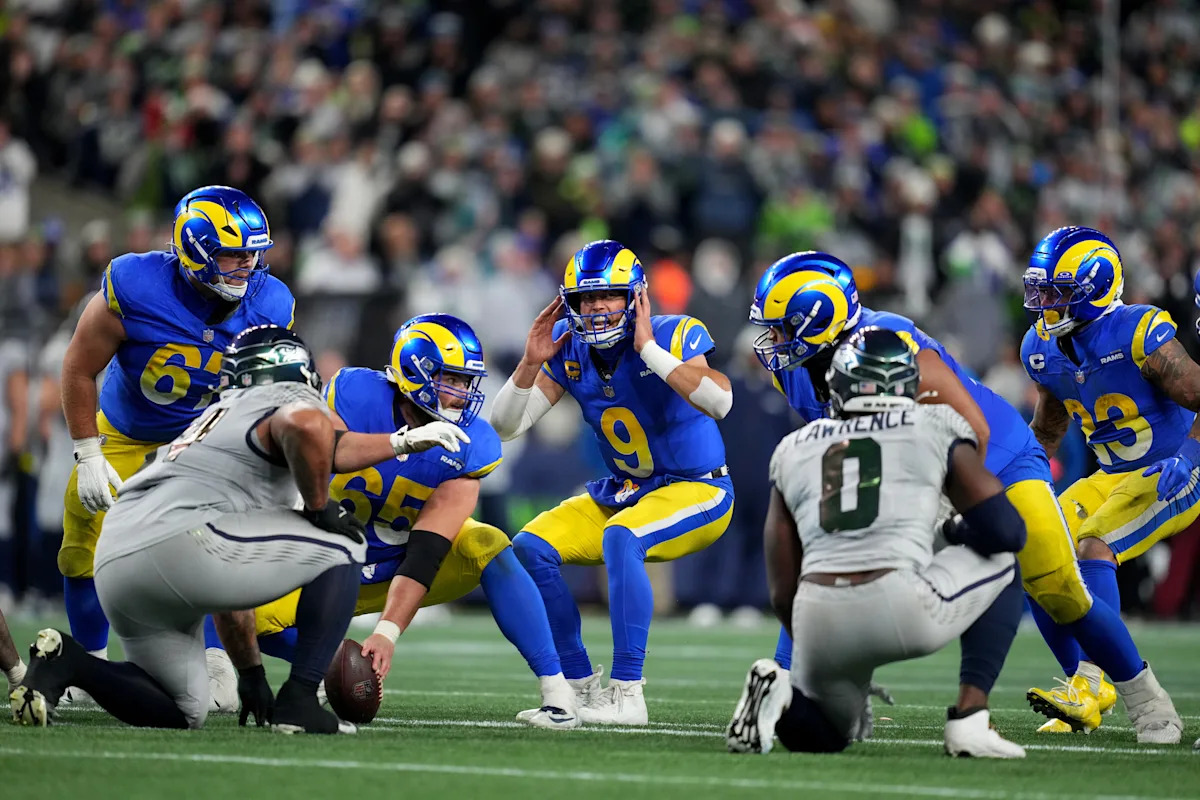
Back to the Rams. And I know they’ve been in the news a bunch lately with the Myles Garrett trade, but I promise I was working on this piece beforehand. The Rams huddled on 5.4% of the time outside 2 minutes of each half in 2025. It was the lowest mark in a steady decline of no-huddle rates under Sean McVay that once topped out at 17.1% in 2018. This was a part of McVay’s offensive philosophy early in Los Angeles: constantly using the same 11 (1 RB, 1 TE, 3 WRs) personnel grouping with the same five skill players on the field. Not giving defenses any tendency to go off that might tip the upcoming play’s intent. Another feature of those Rams offenses was their use of no-huddle and changing tempos on defenses.
The Rams would constantly take advantage of defensive personnel caught in bad situations by quickly getting to the line of scrimmage after a big play. They would also get to the line of scrimmage quickly, use a motion, fake a snap, and then have McVay bark a play-call to then-quarterback Jared Goff over the headset before the play clock reached 15 seconds (when the communication shuts off in quarterbacks’ helmets). Goff would then communicate the final concept to the rest of the Rams. To great effect, too. Defenses had to stay on their toes with the threat of the ball getting snapped quickly. And because McVay based so much of the offenses out of just a few formations and motion looks. It cleaned up the look for McVay to get to his preferred play-call and also the coverage for Goff to diagnose after the snap.
Advertisement
Offenses aren’t in any dire place right now, but defenses have clapped back hard on the popular offensive concepts of the past decade or so. They’ve adapted to all the types of motions that offenses have been throwing at them. They are getting quarterbacks to throw the ball shorter, they are rallying to tackle and making the stop at a higher clip than ever before (and a lower average depth of yardage, too). They are making outdated protection schemes, like the one the Patriots “used” in the Super Bowl against the Seahawks, look silly.
Protection is another aspect in the NFL that I will be keeping tabs on throughout this season. As defenses have gotten smarter with the protection rules that NFL offenses use, I’ll be watching to see if offensive line coaches and play-callers continue to vary and modernize their protection schemes this season, too. This is one way play action helps. It can change the angles of blockers and even add to the number count by pulling linemen, tight ends and even wide receivers. Throwing a bolo punch, like dropping back from under center without any play action on early downs can also be a nice way to keep defenses with highly detailed opponent scouting guessing.
Advertisement
NFL teams will look everywhere to score and stop points. These are just a few threads that I pulled on. Some ramblings of a mad man. What unfolds throughout a season often leads to some of the biggest, or at least some of the most interesting, plot points and storylines. I have no doubt play-callers will come up with fresh, or refurbished, ideas in 2026 to do the very same thing.
Read the full article here


