




Thomas L. Friedman is an opinion columnist who writes about foreign affairs, globalization and technology for The New York Times. Tom Friedman, a well-traveled single-figure handicapper, is a contributing editor for Golf Digest. They’re the same person. Long before Friedman won three Pulitzer Prizes for his reporting and column writing from around the world, he caddied for Chi-Chi Rodriguez in the 1970 U.S. Open. You could say he’s prepared his whole life for this moment in time. The multiple club senior champion is uniquely qualified to juggle the Israel-Lebanon ceasefire, the Iran War, Ukraine-Russia, the future of A.I. and the shuttering of LIV Golf. No one else has his perspective on our game in the context of world events, so we asked Tom to answer some pressing questions about this week’s news. For the last five years, Saudi Arabia’s Public Investment Fund spent $5 billion disrupting professional golf by investing in the upstart LIV Golf Tour, but multiple outlets are reporting it will discontinue funding the golf league after this year. To understand what just happened, Friedman was as good a place to start as any.—Jerry Tarde
How would you characterize the Saudis’ original goal for LIV Golf and how it fit into the larger PIF strategy?
Friedman: I had a brief conversation with a very senior Saudi leader at the time. He was under the impression that it would increase the play of golf in Saudi Arabia, which was part of Crown Prince Mohammed bin Salman’s larger strategy of attracting tourists, particularly sports tourism, to Saudi Arabia. MBS himself was not a golfer, although his brother Khalid, the defense minister, is. I explained to them that the way to attract golf to Saudi Arabia was not by funding a rival tour to the PGA Tour, made up largely by professional golfers on the back nine of their careers, but instead by dedicating 20 miles of Saudi Arabia’s massive coastline and inviting the world’s top five golf architects to build five links courses there. That is what would bring golf tourists—not this LIV tour.
Advertisement
Was it at all successful?
I can only speak for myself. I am a golf enthusiast. I even watch women’s college golf—which I love because their game is slightly closer to mine!—on the Golf Channel. I never once watched a LIV event on TV or in person and I never once looked up who won a tournament, let alone which team won. It struck me as a cross between an exhibition event and a weekly giant corporate outing. I would pay to see Chi-Chi Rodriquez do an exhibition and spin golf balls on his wedge or hit a 250-yard drive from his knees before I would pay for LIV.
One of the consistent objections to LIV Golf was the Saudi regime’s human rights record, and its potential role in anti-American attacks — i.e., the so-called “blood money.” Yet it’s also true many American corporations benefit from Saudi business and funding. What is the truth?
I have complicated views on this subject that you don’t have space for. Saudi Arabia lost its way after the takeover of the Grand Mosque in Mecca in 1979. It made a giant, puritanical right turn that was terrible for Saudi Arabia and for the whole Arab-Muslim world, of which it is the titular leader. That right turn contributed to 9/11. MBS’s whole agenda was to reverse 1979—let women drive, open up Saudi Arabia to tourism, take the religious police off the streets, soften Saudi Islam, bring in a film festival and comedy festival. It is one of the biggest, fastest social transformations in the world—and it has had a huge effect inside. They now have a professional women’s basketball league!
Advertisement
At the same time, it is still an absolute monarchy and that absolute monarch was complicit in the murder of Saudi journalist and reformer Jamal Khashoggi, one of the most despicable things I have ever seen. Saudi Arabia, the region and the whole Muslim world is vastly better off for MBS’s reforms and he never will or should escape responsibility for the Khashoggi murder. If you can’t hold two contradictory thoughts in your head at the same time, don’t come to the Middle East for either golf or a war in the Gulf.
To borrow one of my favorite movie lines: “Forget it, Jake. It’s Chinatown…’’
Assuming LIV Golf shuts down, what does that signal about Saudi Arabia’s broader strategy of using sport for global influence? In other words, what’s the future of “sportswashing”?
You know, there is an old saying that a camel is a horse designed by a committee. I don’t want to get personal, so I will just say that LIV was a bad idea from the start, hatched by some people with too much money and too little judgment, seeking influence in and over the game of professional golf for many different motives—none of them good. They could have paid Steph Curry and LeBron James $1 billion each to play H-O-R-S-E once a month and ruined the NBA, but they were obsessed with golf…. I never thought this was about some strategic decision by the ruling family to clean up the Khashoggi tragedy, by starting a golf tour with Greg Norman and Phil Mickelson. It only made it worse, bringing it from the news pages to the sports pages and back.
1242269410
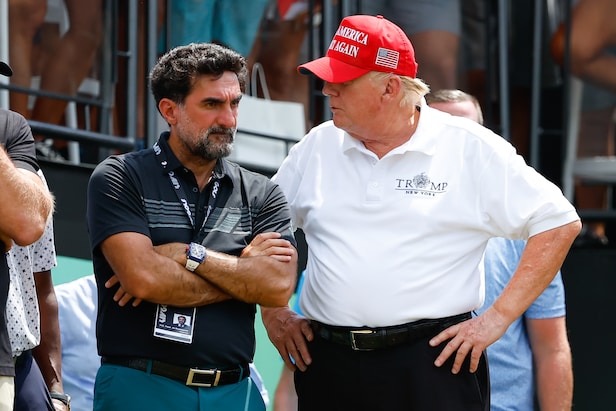
President Donald Trump and Yasir Al-Rumayyan, Governor of the Public Investment Fund (PIF) the Sovereign wealth fund of the Kingdom of Saudi Arabia at the LIV Golf Invitational Series Bedminster.
Advertisement
Icon Sportswire
What has changed in the five years since LIV’s debut?
Since I never watched a single putt on LIV, I couldn’t say how it has changed. Obviously, purses have increased on the PGA Tour, so I am happy for those players who stayed.
To what extent has the Iran war and the current Middle East climate played a role in the Saudis’ potentially pulling back on LIV?
It exacerbated a problem that was already there. Even before the war, the Saudis were cancelling or slowing down a lot of domestic building projects. They were trying to do too much at once, recognized that, and so they began cutting back buildings and projects that were seen as too expensive or too unnecessary. LIV fell into that bucket, and the Iran war just exacerbated that trend. While the price of oil per barrel has gone up, and that is good for an oil-producing state, the Saudi oil industry suffered some real, costly damage from Iranian attacks and, in the future, they are going to have to spend billions more on their defense. I think this is when MBS realized that this golf tour was not bringing a single new tourist to Saudi Arabia—it was only a money drain—and an easy one to sunset.
If you can’t hold two contradictory thoughts in your head at the same time, don’t come to the Middle East for either golf or a war in the Gulf.
Thomas L. Friedman
Advertisement
Yasir Al-Rumayyan is both PIF governor and LIV Golf chairman. He was out in front with golf, known as an avid golfer and defender of LIV. Is this just one investment that didn’t pay off or will there be bigger implications for him?
I just don’t know. What I do know is this: PIF is very different from other major sovereign wealth funds. Most of them invest in pretty liquid cash, stocks, bonds and commodities all over the world. So, in times of economic slowdown, they have lots of cash available to inject into their economies. PIF was always different. Its mandate was largely, but not exclusively, to invest in construction projects building a new Saudi Arabia. It may seem bizarre to many people, but PIF today is short on cash. The Wall Street Journal recently noted that in 2024, PIF reported a return that was “close to zero.’’ That was in a year that the S&P was up 25%. It is rich on paper, but it is not rolling in dough – and then you add the Iran war costs on top of that. Suddenly LIV starts to look like not just a frivolous hobby by a golf-obsessed Saudi running PIF, but another totally unnecessary cash drain.Saudi Arabia is still hosting the 2034 World Cup, and is still invested in F1, boxing, Newcastle United, the LIV-adjacent SURJ Sports Investment entity. Why do you think golf got sacrificed?
Again, bringing professional sports to Saudi Arabia, a very young country, where both women and men are now participating in professional sports leagues, makes sense to me. Funding Sergio Garcia’s retirement, not so much – especially in the new economic environment. I can’t imagine any Saudi citizen will miss LIV.
More on LIV Golf

LIV Golf LIV Golf CEO asserts league has money for rest of season, but says that’s ‘not the way the world works’ in regard to future funding

LIV Golf Is LIV Golf finished? What recent funding reports mean, landing spots for Bryson DeChambeau and Jon Rahm, where golf goes from here


liv golf LIV Golf’s telecast opens by scolding media, then quickly is hit with lengthy technical issues
Advertisement
You’re a golfer who cares deeply about the game and the PGA Tour. Understanding the international implications, if you were Brian Rolapp, how would you now handle a re-entry of LIV Golf stars like Jon Rahm, Bryson DeChambeau and Cam Smith? Feel differently about Phil Mickelson?
That’s a hard one. I am a golf devotee. I love to see the best play the best. But there are a lot of PGA Tour pros in the top 50 who turned down a lot of money to preserve the integrity and future of the PGA Tour, instead of jumping to LIV for the money. Tough call. Whatever they do they should do it fast, heal the breach and move on. Professional golf needs to be healed. Speaking personally, though, whoever comes back, if one of them is tied with Rory or Justin Rose on Sunday in the U.S. Open, I won’t be rooting for them.
If this is it for LIV, would you expect Saudi Arabia to be done with professional golf, or do you see them as potential investors in the for-profit PGA Tour or sponsors of events on the DP World Tour?
I have done no reporting on that. I would be shocked if they rushed back into anything like this with golf. As I said, this is part of a wider economically driven retrenchment.
Advertisement
Looking back at the last five years, all the turmoil, broken friendships and bad blood in professional golf, what are the lessons we should take away?
That true golf fans like me care about traditions, care about the integrity of the sport. And while we understand that it is a business—and certainly believe that professional golfers, like other professional athletes, deserve to be well compensated for their excellence—when you cast all the history, charitable values and records of the PGA Tour aside and make it only about money, you lose a lot of us. It is not that I don’t think professional golf should not be about money, it is that its appeal to me all these years was that it was not only about money.
I would continue to write a column for the New York Times if they paid me nothing. It’s that much of a privilege. I bet a lot of golfers would play in the Masters if all they got was a trophy. There are things that money can’t buy—and when you sacrifice all those things, in whatever endeavor you are engaged in, you are left with something hollow.
What does LIV reveal about America’s ability to set the rules in global sports? Is it a microcosm of shifting geopolitical power where capital, not morals or traditions, dictate outcomes?
I would not read too much into it. It was a solar-lunar eclipse—the wrong people at the wrong time—with too much money, too few of the right values and too little good judgment. I don’t see it as a trend. May it rest in peace—or at least rest.
Read the full article here


