






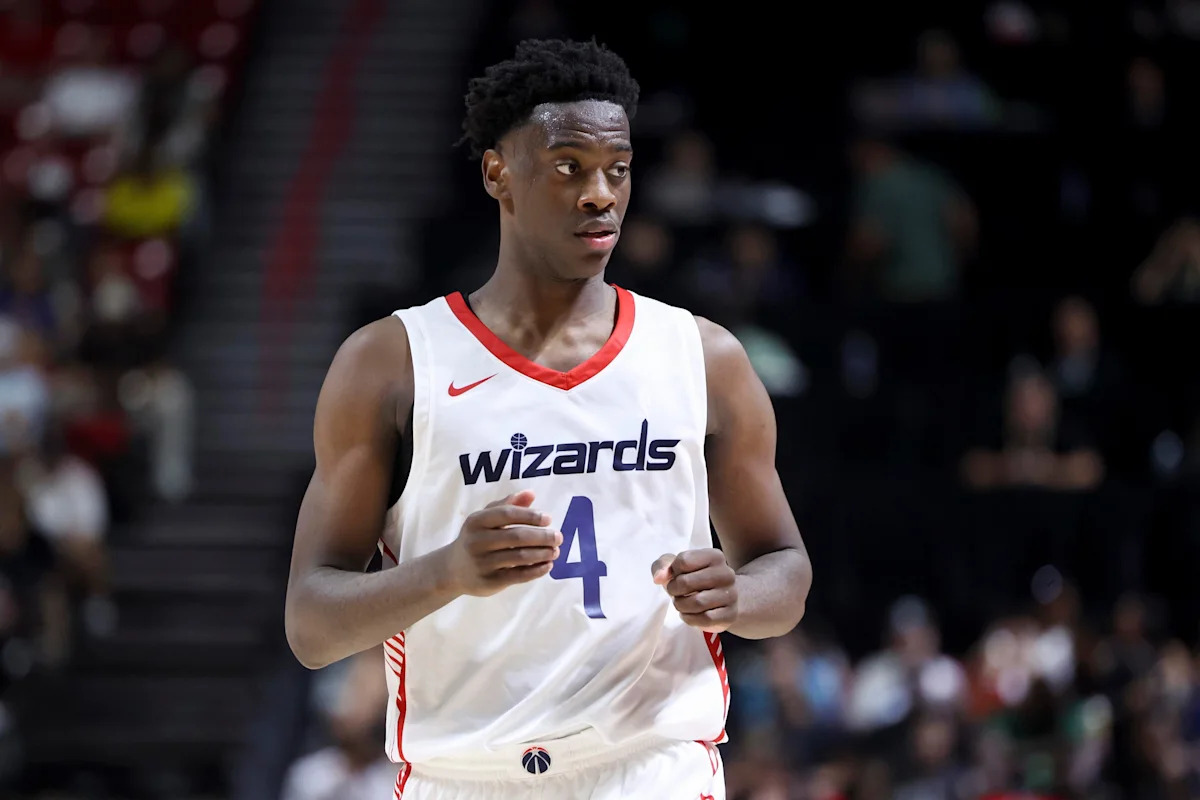
The last time the Washington Wizards carried a playoff pulse, they were led, in part, by Russell Westbrook, who suited up for four other teams and pulled down the curtain on his NBA career in the half a decade since calling the nation’s capital home.
Over those five post-Westbrook years, Washington’s won 35, 35, 15, 18 and 17 games. That’s 120 total victories, 12 fewer than the Oklahoma City Thunder racked up the past two seasons alone.
Advertisement
Two campaigns of rudderless basketball succeeded by a trio of purposeful rebuilding seasons has led the Wizards into 2026-27, a year crucial in determining their long-term outlook. For their meager win totals across 2024-26, they’ve netted a cast of eyebrow-raising youngsters, including a pair of top-two picks in Alex Sarr (second in 2024) and AJ Dybantsa (first in 2026).
Flanking them are a few other under-23 young players still worth giving a damn about: Kyshawn George (22), Bilal Coulibaly (22), Tre Johnson (20) and Will Riley (20). Last winter, aware of free agency as a dying ember for most teams to land talent, the Wizards utilized their bountiful cap space by trading for Trae Young and Anthony Davis, two former All-NBAers experiencing downswings in their respective careers with, in Washington’s eyes, hopefully the requisite juice left to rediscover stardom and accelerate its aspirations for winning.
Much like the Utah Jazz out West, the Wizards do not have to summit the mountain of their rebuild in 2026-27. But they cannot remain at base camp and promise tomorrow, once they’re a little more energized and inherited another vibrant prospect, is the day they start climbing. This imminent season will answer plenty of questions to clarify whether the past three years can ignite a prosperous future or if their high-stakes moves will soon force another reset.
Sarr and George authored encouraging sophomore seasons. Can they build upon that promise, fill in a few more colors of their respective rainbows and become highly impactful players moving forward? This is precisely the time to punt away training wheels and less often apply the “young” caveat to analysis of their quality as players. The Wizards are hoping they’re ready for that responsibility.
Advertisement
What does Dybantsa’s NBA debut look like? Will he indicate the towering offensive upside that prompted Washington to take him first overall in June? How does he mesh alongside the fellow bedrocks in Young, Davis, Sarr and George?
Through three seasons, Coulibaly’s hinted at being the sort of sprawling, defensive-minded wing every playoff contender desires yet struggled with health, consistency and offensive viability. Can an elevated offensive environment, headlined by Young’s wondrous facilitating, and greater surrounding talent allow him to connect the dots as he approaches restricted free agency next summer?
How does Johnson improve as an interior operator to amplify his sparkling long-range game and snappy passing? Can Riley parlay his post-All-Star Break surge and impressive Summer League stint to garner a rotation spot amid Washington’s crowded forward room?
Despite an injury riddled, underwhelming 2025-26, Young received a four-year, $212 million extension (player option final year) this offseason. Will his generational court vision amplify play-finishers such as Davis, Sarr, George, Johnson and Coulibaly? I’m optimistic it will; there’s a good mix of rim-rattlers and long-range explorers for Young to feed and establish a cohesive shot diet.
Advertisement
Washington’s finished 23rd (2025-26) and 28th (2024-25) in effective field goal percentage the last two years, beset by wide-eyed and/or underqualified initiators orchestrating possessions. It simply needs to put the ball in the hoop more routinely.
Young should help achieve that.
Here’s how he impacted the Atlanta Hawks’ effective field goal percentage when he was on the floor over his first seven seasons (last year’s 15-game sample not included), per Cleaning the Glass:
Both he and Dybantsa are optimized on the ball. Can Young score effectively enough to warrant the majority of on-ball touches? He’s averaged 31.6 points per 100 possessions the past two seasons following a four-year run of 37.3. If he continues being a less lethal scorer — which absolutely alters his offensive footprint and the way defenses approach him — will this finally be the season he embraces some off-ball work in favor of creation reps for Dybantsa and Johnson? If the scoring perks back up, how does Washington manage his talents while still prioritizing Dybantsa’s game?
Advertisement
Now 33, Davis is extension eligible and has two years, $121 million remaining on his deal (player option for 2027-28). Following last season’s trade, he did not appear in a game for Washington and has played only 71 times the past two years, in addition to his already-mercurial availability.
He shares a position with Sarr. Both take threes, neither makes them. They are best served as rollers and cutters focused on the interior. Sarr’s spike in efficiency between years one and two (48.2 percent vs. 54.4 percent true shooting) was rooted in swapping triples (38 percent 3-point rate down to 21 percent) for shots inside (28 percent rim frequency up to 39 percent). How do those two coexist offensively and what approach does Washington take to allocating their minutes? Does it want to foster Sarr as a 4-man or keep letting him grow at center?
If Davis re-establishes himself as a premier defender, that front-court tandem is quite rangy and imposing, especially with the progress Sarr exhibited in 2025-26. Davis can also alleviate some of Sarr’s glaring defensive rebounding woes, which have stunted his impact on that side of the ball.
Can Davis stay healthy (a rarity since departing Los Angeles), return to his All-Star heights, synergize with Washington’s youthful core and prove worth keeping around for a few more seasons? That’s the reality the Wizards seek and from which they stand to benefit most.
Advertisement
So little about Washington feels bankable. Its prospects are unproven. Its veteran stars are, at least lately, unreliable. But the foundation to compete exists. In seven months, the Wizards will understand vastly more about the hierarchy of their young core and where it could propel them, and the early-ish dividends on their aggressive 2026 trade deadline.
While that information is not guaranteed as satisfactory, it will outline a necessary route ahead. They’ll hope the route is one featuring many of the same players helping shape whatever 2026-27 looks like. If it does, their playoff signature should soon no longer be most recently penned by Russell Westbrook, a cornerstone from a different, distant era of Wizards basketball.
Read the full article here


