





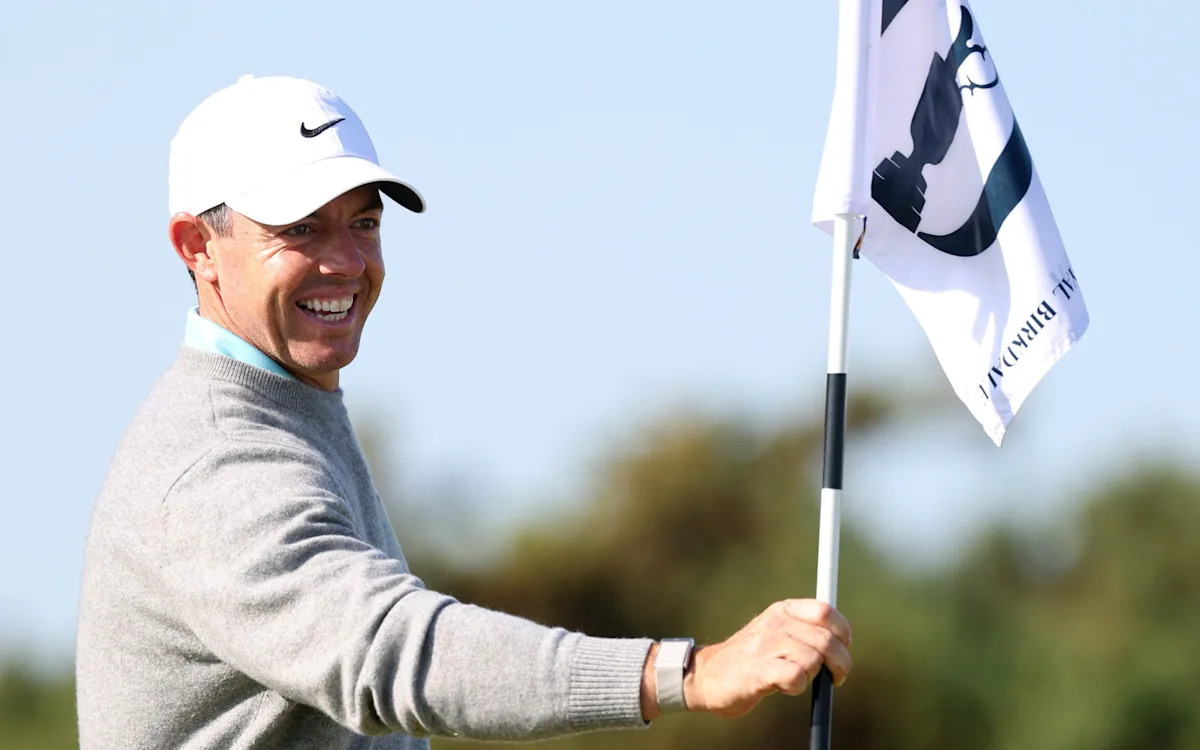
With day after day of sun still forecast, they are already calling it ‘Royal Burntdale’ and the burnished colours should be welcome hues for Rory McIlroy.
The world No 2 has assured everyone that his preference is now for fast and firm conditions and that he is no longer the mud-baller from the early years of the last decade who squelched his way to four majors in record quick time. This is his chance to prove it.
Advertisement
“I’ve really started to enjoy that side of golf much more over the past few years since I’ve started to have a little more understanding of the game in general: golf course architecture, equipment stuff and becoming a student of the game again,” McIlroy said.
“And honestly, it’s a challenge to me because I know I’ve had that reputation as, ‘oh well he won when things were soft’. I’d love to win a major championship or major championships where it was firm and fast. I prefer that style of golf now.”
McIlroy should enjoy the conditions in Southport – Stuart Kerr/Getty Images
McIlroy partly fulfilled this ambition when he won the Masters in April. Augusta was faster and firmer than anyone could remember. But in relative terms, compared to tests such as this and other Opens such as St Andrews in 2022, Carnoustie in 2018 and Hoylake in 2006, it still had lush characteristics. The US Open has also been more solid underfoot, especially at Chambers Bay in 2015. That was a big moment for McIlroy as he missed the cut in Seattle.
Advertisement
“I remember walking off the green at Chambers Bay thinking to myself: ‘Thank God I’ve won one of these [in 2011] because I don’t know if I’ll ever really have a chance again’,” he said. “It’s wild to think about where my mind was at that stage of my career. Now I’d love to go play Chambers Bay again because that’s the sort of golf that I want to play.”
McIlroy is not just talking a good links game. The results back him up and in American golf-speak he is “trending” on the challenges that have sun-baked turf where the competitors must rely on the ground game.
In 2018 at Carnoustie, McIlroy was second, after finishing fifth and fourth in the previous two Opens. Afterwards, he declared: “I’ve developed and I’ve grown as a links player.” And his biggest critics could not have disagreed.
Granted, he won the Open at Hoylake in 2014, but the Liverpool layout was so saturated that it resembled a lake by the end. His performance in the previous year’s British major at a concrete-like Muirfield summed up his form on the links, as he missed the cut. As did his attitude: “I just felt brain dead out there.”
There was the pervading sense back then that McIlroy was simply a splat-track bully, who loved playing on soaked layouts where, as one of the longest hitters and best drivers in the game, he could adopt an aggressive game plan. The softer greens allowed his high-soaring long irons to stop dead next to the pin. He was irresistible at the Congressional in the 2011 US Open, at Kiawah Island in the 2011 US PGA and, after Hoylake, at Valhalla in the 2014 US PGA.
Advertisement
Of course, those of us who had been watching him for years knew that he was not so one-dimensional. After all, he shot a 61 at Royal Portrush in elite amateur competition as a 16-year-old. McIlroy could cope around tough courses. He talked himself out of doing so, as his infamous majorless drought stretched past the 10-year mark. McIlroy needed a reset and this was why the 2018 US Open at Shinnecock Hills was such an important milestone in his journey. He shot 80 and missed the cut in America’s national championship for the third time in a row.
“I played those two days in 2018, and then I got to the Travelers Championship the next week and I remember feeling so much in my comfort zone going to TPC River Highlands and thinking to myself, ‘I’ve got this backwards. I should be in my comfort zone at Shinnecock and not here’,” he said.
“I remember flying back from Dubai at the end of 2018, and I would keep a journal. I wrote in it that from 2019 going forward, I’m going to build my game to compete at the major championships and excel at the toughest tests that we have. Again, working on the things that you need to do well to excel at these, which is flighting the ball, hitting your numbers, wedge play, short game, putting, which is all the stuff that I feel like I’ve improved.”
McIlroy is a second Claret Jug waiting to happen and a first in conditions like this. He was third, and probably should have won, at the 2022 Open at St Andrews when the Old Course was cooked and then finished second at the 2023 at LA Country Club when the ball was again running.
Advertisement
McGinley: Rory is now the complete player
He won that year’s Scottish Open at Renaissance when the ground was bouncing and enjoyed three fine rounds on the same links last week in a tie for seventh. McIlroy has the pedigree for Birkdale and the class for the rock-hard environs. Paul McGinley is sure of it.
“If you look at the winners at this place it reads like a hall of fame – [Arnold] Palmer, [Tom] Watson [Lee] Trevino, [Peter] Thompson, Padraig [Harrington], [Jordan] Spieth,” McGinley said. “And then look at the Open winners when it has been fast and firm. Cam [Smith] was at the top of his game in ‘22, Francesco [Molinari] in ‘18, Tiger [Woods] in ‘06, Watson in 1977. Rory is now the complete player and would be perfectly at home on those lists.”
Indeed he would, just as he would fit in among the male legends who have managed to win multiple majors in different seasons. Jack Nicklaus, Woods, Ben Hogan, Walter Hagen, Gary Player… The game’s greats beckon the man from Holywood, Belfast once again.
Try full access to The Telegraph free today. Unlock their award-winning website and essential news app, plus useful tools and expert guides for your money, health and holidays.
Read the full article here