





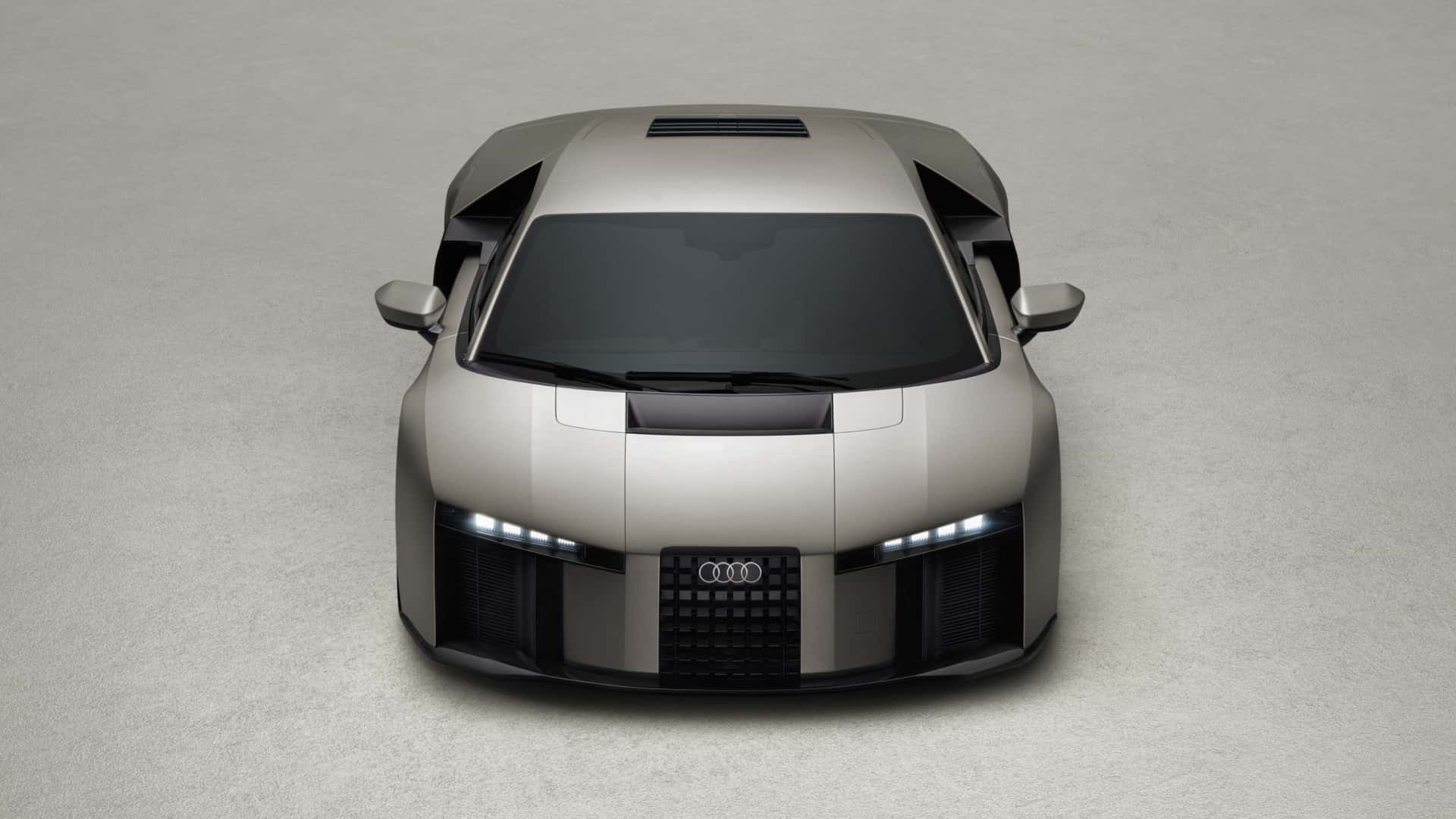
- The Audi Nuvolari combines a twin-turbo 4.0-liter V8 engine with three electric motors.
- With a top speed of over 217 mph, it’s the fastest Audi ever.
- Production is limited to 499 units.
- The name honors a legendary Italian race car driver and was previously used on a 2003 concept.
It’s been a little over two years since Audi called time on the R8 by ending production of its iconic mid-engine performance machine. The German luxury brand has since refuted reports about bringing it back for a third generation, yet there’s now a new supercar that fulfills a similar role. It doesn’t revive the R8 moniker; instead, it adopts another nameplate with a historical reference.
Nuvolari takes its name from the legendary Italian driver Tazio Nuvolari, who won races in the late 1930s for Auto Union, a forerunner of what is now Audi. Ingolstadt is now honoring his legacy with a flagship model that ushers in the company’s new design language initially previewed by the Concept C last year. The new supercar is not only going into production but will also reach the market before the targa-topped electric sports car.
At the heart of the Nuvolari is a plug-in hybrid powertrain based around a twin-turbo 4.0-liter V8. The combustion engine revs to 10,000 rpm and works with three axial-flux electric motors for a combined output of 987 horsepower. Coincidentally, that’s the same figure as the original Bugatti Veyron when it launched in 2005.
Photo by: Audi
Familiar Technical Specifications
Although Audi predictably doesn’t mention the Temerario, it’s easy to connect the dots between the new Nuvolari and Lamborghini’s entry-level supercar. After all, Audi owns Lamborghini, and both generations of the R8 were based on models bearing the raging bull: the Gallardo and the Huracan. Aside from the screaming 10,000-rpm redline, the combustion engine’s output of 789 hp and 538 lb-ft (730 Nm) matches that of the Temerario’s V8.
But here’s the kicker. The Nuvolari’s combined power of 987 hp outpunches the Temerario by 80 hp and takes the crown as the most powerful Audi ever, a title previously held by the RS e-tron GT Performance. It’s also the fastest street-legal model to wear the Four Rings, topping out at more than 217 mph (350 km/h). At the same time, it’s among the quickest, reaching 62 mph (100 km/h) in 2.6 seconds, or one-tenth quicker than the Temerario. From a standstill to 124 mph (200 km/h), it completes the run in just 6.8 seconds.
With a gross capacity of 7.3 kWh, the Nuvolari’s battery has nearly twice the energy of the Temerario’s 3.8 kWh pack and does enable purely electric driving over short distances. You obviously won’t go very far before the combustion engine kicks in, especially since the Lamborghini can run in EV mode for approximately five miles before the V8 takes over.
We asked Audi about any potential ties to the Temerario, and the official statement confirms there is a relationship between the two cars and they share the V8, but with an Audi touch for the Nuvolari:
‘The Nuvolari clearly embodies the Audi DNA – with Formula 1–inspired technology, a distinctive design, and uncompromising performance. By leveraging synergies across the Group, the best technologies have been combined and precisely tailored to Audi-specific values, where it is meaningful and efficient. For example, while the combustion engine architecture remains unchanged, its character is distinctly shaped through an Audi-specific application.’

Photo by: Audi
Nuvolari Brings A Couple Of Audi Firsts
Much like the R8 before it, the Nuvolari benefits from Audi Space Frame aluminum-intensive construction, but for the first time it has been combined with a body made mostly of carbon-fiber-reinforced polymer. Lessons learned from F1 helped engineers optimize the CFRP to keep weight in check, although an exact figure has not been released. For reference, the Temerario tips the scales at 3,726 pounds (1,690 kilograms) before fluids.
Nuvolari is Audi’s first model to use forged center-lock wheels, combined with carbon-ceramic brakes featuring ten-piston front calipers clamping 420×40 mm discs and four-piston rear calipers paired with 410×32 mm discs. These are slightly larger than the Temerario’s setup and are also claimed to have engineering roots in F1.
The F1 connection doesn’t end there. Audi claims the active aerodynamics, including an adaptive rear wing, take inspiration from the pinnacle of motorsport. The aero element has three stages (Closed, Low Downforce, High Downforce) and automatically adjusts depending on the drive mode. Alternatively, the driver can modify the settings using a rotary control on the steering wheel. This can be done in all driving modes except E-Hybrid, where fully electric driving is prioritized.
19
Source: Audi
Traction Control Off Mode And An F1-Derived DRS
As for the other four modes, there’s Balanced, Dynamic, Dynamic+, and Track, with the latter allowing traction control to be fully disabled. There’s even an F1-like drag reduction system (DRS) that the driver can manually deploy at the touch of a button on the steering wheel to increase top speed.
To further tie in with its F1 efforts, Audi uses a Titanium color also seen on the Concept C. The similarities to the electric targa sports car continue inside, where the Nuvolari combines physical controls with screens and uses color accents as a nod to Auto Union’s Type C race car of the 1930s.
Audi has pledged a return to its former self in terms of high-quality materials, and the Nuvolari aims to pave the way for improved cabins, with the Concept C to follow next year. Hopefully, this will then trickle down to volume models in the “A” and “Q” series.
While Lamborghini will build as many Temerario supercars as demand allows, Audi is limiting Nuvolari production to just 499 units. Deliveries are scheduled to begin in the first half of 2027. The Concept C mentioned earlier will also evolve into a production model next year as well.
The 2003 Audi Nuvolari quattro Concept
10
Source: Audi
This isn’t the first time Audi has paid tribute to Tazio Nuvolari. At the 2003 Geneva Motor Show, the Nuvolari quattro with a twin-turbo V10 engine previewed a design language later used on models such as the first-generation A5 launched in 2007. The 600-horsepower styling exercise commemorated 50 years since the Italian driver’s death.
Later, in 2014, the third and final generation TT received a Nuvolari special edition in the legendary driver’s homeland, Italy.
Motor1’s Take: Audi has been adamant that there wouldn’t be a follow-up to the R8, so this comes as a nice surprise. While pricing isn’t mentioned, the Nuvolari will almost certainly sit deep in six-figure territory, considering the Temerario starts at just under $300,000. Nevertheless, finding 499 buyers shouldn’t be difficult given the performance and styling.
Although a supercar is, by definition, for one-percenters, it also serves as a reset button for Audi after a few so-so years. It offers a glimpse of what’s to come in terms of exterior design and interior quality for future volume-oriented models launching after the Nuvolari and the Concept C.
At the same time, these two sports cars help address a gap in the lineup by bringing back the sleek two-door shape we’ve been missing for a while.
Read the full article here