





CROMWELL, Conn. — Anxiety is a fascinating human emotion.
I laugh often when I consider that my body is the product of thousands of years of human evolution — a painstaking process of selectivity that has given me the ability to think rationally, to act intentionally, and, most impressively, to feel. I laugh because that process has manifested in my modern experience of anxiety, where my body feels the same imminent danger my ancestors once felt while outrunning lions and cheetahs, but feels that danger because I am about to hear the commissioner of the PGA Tour outline changes to the competitive structure of a made-up game.
Advertisement
But anxiety is not only fascinating in its origin, it is also fascinating in its contagiousness. It is incredible how one person’s discomfort can spread throughout a room without the utterance of a single word. It is also incredible how our brains are hyper-attuned to such shifts in the energy, feeling these things even though they are not spoken.
As it turns out, nobody is immune to feeling the discomfort — not even the greatest golfer of the last three decades, who appeared visibly restless to speak for the first time before the assembled media on Tuesday morning at the Travelers Championship.
The source of Tiger Woods’ discomfort might have been manifold. He has not spoken publicly since entering a rehab facility following a DWI charge in March. He was also not speaking about his typical subject of public commentary about golf: himself. But it is possible that the source of at least some of his discomfort was the pulse of the room gathered at TPC River Highlands — a room of golf dignitaries, of big wigs and Very Important People who were so on edge about the day’s proceedings that they collectively looked one bad coffee order away from a viral TikTok.
Any good therapist would have asked the room to name their fears out loud. To explain why their anxiety was so high. And if any of them was being honest, they would have told us the real reason: The changes they were about to announce weren’t really about golf.
Advertisement
It can feel trite to talk about the importance of TV in sports. To suggest that TV is important to sports is to suggest that the sun is important to the existence of life on earth. In short, you get it already.
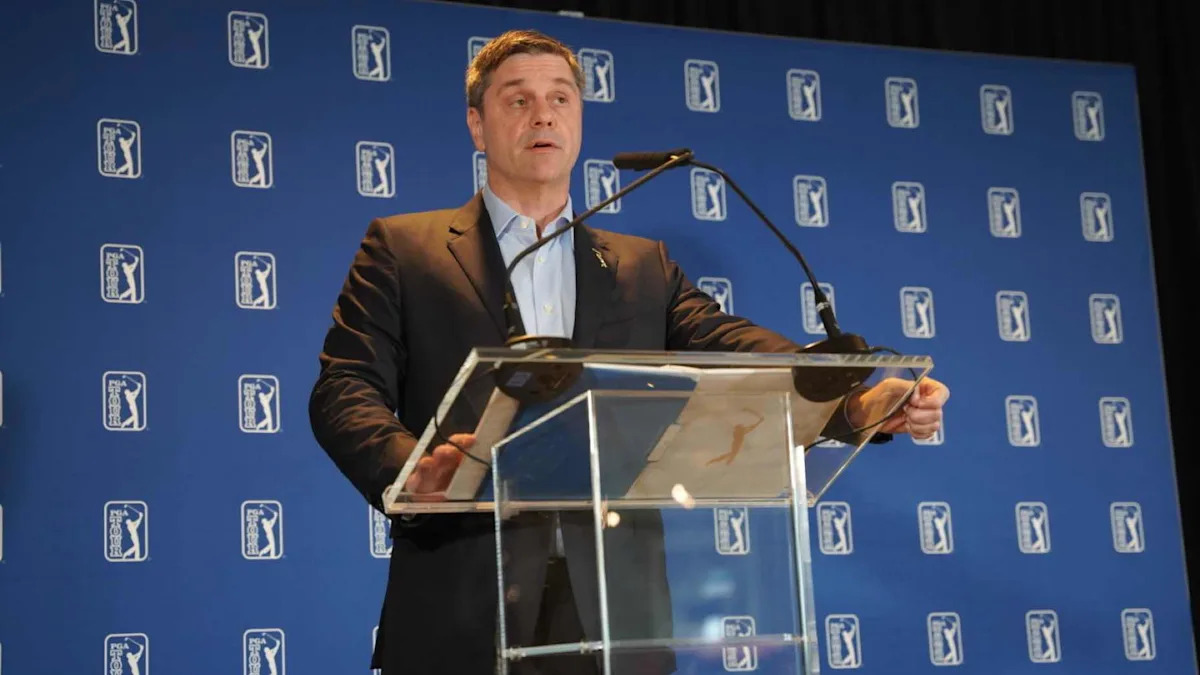
And yet here it is important to address TV in sports. It was TV that caused the PGA Tour to announce a sweeping set of changes on Tuesday, including two new “series” aimed at providing a more coherent vision to the world, among many other tweaks. It was TV that encouraged the PGA Tour to hire Brian Rolapp to oversee those changes, navigating no shortage of backroom wheeling and dealing over 12 painstaking months of negotiations with players. And it was TV that encouraged them to happen so quickly — they were announced on Rolapp’s one-year anniversary as PGA Tour CEO — bucking golf’s traditionally Senatorial bent towards gridlock.
Rolapp is still getting his sea legs in golf, but he is well versed in the dark arts of TV viewership. His previous role at the NFL involved years at the forefront of the media rights business that turned from a monolith into a black hole — swallowing up billions in revenue from TV partners and steadily increasing to such a significant chunk of the overall TV business that some believe it will eventually consume it whole.
Rolapp’s ex-employers at the NFL are in the first stages of their own negotiations right now involving the future of their media rights, and the expectation is that the deals will more or less blow our socks off. Early reports are that NFL negotiations with CBS, the first of the networks stepping into the thunderdome, are beginning at twice their previous rates — rates which were themselves believed to be an extraordinary overpay.
Advertisement
The reason for the NFL’s posture is because they hold all the cards. They are the biggest enterprise in pro sports, and they control more attention than any non-social media platform in the United States. TV networks need the NFL just to keep the lights on; streamers want the league because it is a path to viability.
The result of this posture is that the rest of the pro sports leagues are suddenly facing the real prospect of a nuclear winter. Should the NFL bite off as much as it intends to chew when these next deals are signed in the next 18 or so months, there could be fewer TV dollars for everybody else, and if there are fewer TV dollars for everyone else, we could find ourselves rapidly approaching the end of a three-decade upward spiral in the value of professional sports. TV networks could owe so much to the NFL that they literally run out of money to pay their rights fees, and other leagues could be forced to take lesser deals in their place, or none at all.
In other words, Tuesday’s announcement from the Tour wasn’t necessarily a victory party, it was an acknowledgment of a simple fact — winter is coming — and it was an effort to reinforce the insulation.
“I think the demand for live sports programming is still at an all-time high, but not all live sports programming is the same. You need to compete,” Rolapp said Tuesday, acknowledging the quiet part out loud. “The distribution options and the financial backing or rights fees available are not limitless, so you need to innovate and be the best you can.”
Advertisement
For Rolapp’s PGA Tour, the innovations are considerable. Professional golf is expected to be cleaner and simpler and smarter and better. It is also expected to be more profitable and more exciting and more “commercially viable” (the Tour is said to have more sponsors willing to pay for its $20 million championship series than events for sale). It will have promotion and relegation for the first time, and it may welcome an elite new tier of golf courses to its tournament venues.
News
PGA Tour ratifies sweeping changes that will change pro golf as we know it
PGA Tour ratifies sweeping changes that will change pro golf as we know it
By: Sean Zak
New ideas with big announcements always “sound” good. The proof comes in the competition, and this is the Tour’s biggest risk. Pro golf is a sport of traditionalists, and those people did not see obvious problems with the Tour’s functions in the way Rolapp did. Should pro golf alienate its traditionalists with its new format, its gains in coherence and simplicity and intelligence will be for nought.
Advertisement
And yet there is at least one good reason to believe the Tour is not as at-risk as it might appear: You can name plenty of questionable additions to the Tour under Rolapp’s new plan, but at the current juncture, you can name very few questionable subtractions. The goal isn’t for the Tour to rid itself of tradition, only to broaden the pool of people who might decide they want to care about it.
“I think the reason for change has been pretty clear,” Rolapp said. “I think if you talk to our fans, if you talk to our partners, they are all looking for improvement. I think we looked around and we saw what we need to do to increase fans’ attention and create more value for our partners and felt this was necessary.”
For Rolapp, the biggest changes will not have to do with golf — but rather, with competition. If you’re a golf tour used to being a golf tour, that’s a scary proposition. It’s a bet that could fail.
On Tuesday at the Travelers, we saw for the first time how it looks. Mostly, though, we saw how it felt — and the lesson was clear.
Advertisement
Hold on tight.
You can reach the author at [email protected].
The post The most consequential PGA Tour change has nothing to do with golf appeared first on Golf.
Read the full article here