




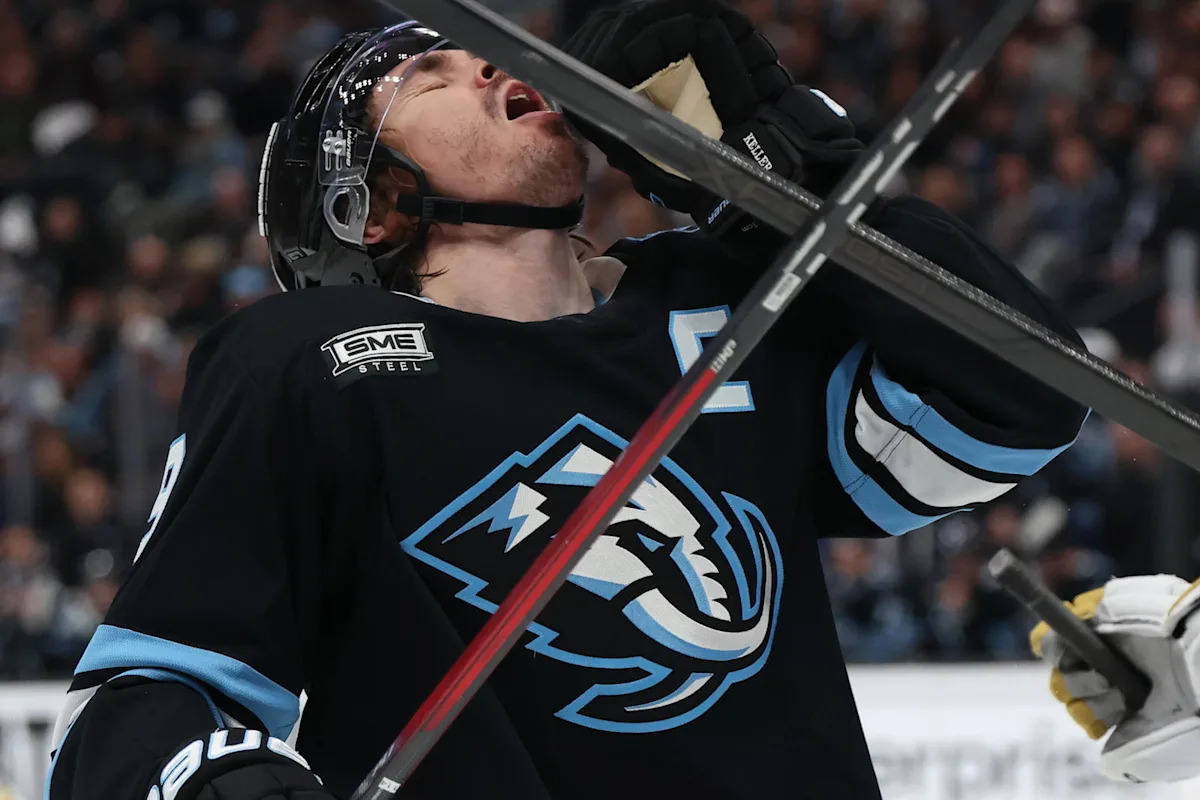
One postseason appearance changed everything, and now the Utah Mammoth face the kind of offseason that could determine whether they’re simply an exciting young team—or the NHL’s next legitimate powerhouse.
Expectations surrounding Utah entering the 2025-26 season were modest at best.
Advertisement
The foundation was certainly intriguing. Clayton Keller remained the offensive catalyst, Logan Cooley and Dylan Guenther continued developing into stars, Nick Schmaltz provided veteran production, and Mikhail Sergachev anchored the blue line. But with the Central Division loaded from top to bottom and several young players still finding their footing, most believed another year of growth would be necessary before playoff hockey became realistic.
Instead, the Mammoth accelerated the timeline.
General manager Bill Armstrong aggressively strengthened the roster, acquiring J.J. Peterka from the Buffalo Sabres and adding veteran defenseman Mackenzie Weegar from the Calgary Flames without sacrificing a first-round pick in either deal. Those moves transformed Utah into one of the league’s biggest surprises, finishing 43-33-6 and punching a ticket to the Stanley Cup Playoffs.
The opportunity was there for an even deeper run.
Advertisement
After grabbing a 2-1 series lead over the Vegas Golden Knights, Utah looked poised for an upset before consecutive overtime defeats completely shifted the momentum. The Mammoth ultimately exited in six games, but the series proved something important: this team is much closer than many expected.
Now comes the difficult part—deciding whether it’s time to push all of the chips to the middle.
Few organizations possess the type of high-end prospect depth Utah currently enjoys.
Tij Iginla appears ready to make the jump after dominating the WHL with the Kelowna Rockets. The sixth overall selection from the 2024 NHL Draft exploded for 41 goals and 90 points in just 48 games while finishing with an eye-popping plus-47 rating. His offensive instincts are obvious, but his commitment away from the puck may be what earns him NHL minutes immediately.
Advertisement
Caleb Desnoyers isn’t far behind.
The fourth overall pick in 2025 produced 22 goals and 78 points across 45 games, showcasing the creativity and hockey IQ that made him one of the premier prospects in his draft class. At 173 pounds, additional strength would certainly benefit him, but his talent is difficult to ignore.
Utah suddenly finds itself with an enviable problem.
If one—or both—young centers prove capable of sticking in training camp, the organization could dramatically reshape its lineup while injecting another wave of speed and skill into an already dangerous forward group.
Cap space provides flexibility, but difficult choices still await.
Advertisement
With roughly $14.2 million available, Armstrong must determine which pending unrestricted free agents remain part of the organization’s long-term vision.
Kailer Yamamoto made a compelling late-season case. After settling into a top-six role, he recorded nine points over his final 13 games, including the playoffs, bringing energy and secondary scoring exactly when Utah needed it most. A projected contract near $1.8 million makes a reunion financially appealing, assuming the organization believes his late surge is sustainable.
Kevin Stenlund offers value in different ways.
His offensive totals won’t dominate headlines, but a 54.2 percent faceoff success rate and league-leading shorthanded ice time made him one of Utah’s most trusted defensive forwards. With projections placing his next contract around $1.4 million, retaining him would preserve an important piece of the penalty kill.
Advertisement
Alex Kerfoot presents a more complicated decision.
Limited to just 34 games because of injuries, the versatile forward produced only 13 points and is expected to command more than $3.3 million annually. His ability to play multiple positions remains valuable, but with organizational depth growing down the middle, Utah must determine whether that price fits its long-term blueprint.
Perhaps no player presents a more fascinating offseason decision than Barrett Hayton.
When healthy, the center consistently impacts games with relentless forechecking, responsible defensive play, and dependable two-way effort. The problem has been availability. Since 2021-22, his career has alternated between mostly healthy campaigns and seasons interrupted by lengthy absences.
Advertisement
Now arbitration eligible, Hayton is projected by AFP Analytics to earn north of $5.3 million annually on his next contract.
That’s where the conversation becomes interesting.
With Iginla and Desnoyers pushing toward NHL jobs and Utah already possessing significant depth down the middle, Hayton could emerge as one of the organization’s most valuable trade assets. His age, defensive reliability, and untapped offensive upside would undoubtedly attract interest across the league.
Whether Armstrong chooses continuity or leverages that value to strengthen the wings could become one of the defining decisions of Utah’s offseason.
Advertisement
After exceeding expectations and announcing themselves as a legitimate playoff team, the Mammoth are no longer chasing relevance—they’re trying to build a roster capable of contending for the Stanley Cup every single year.
Image
Read the full article here


