





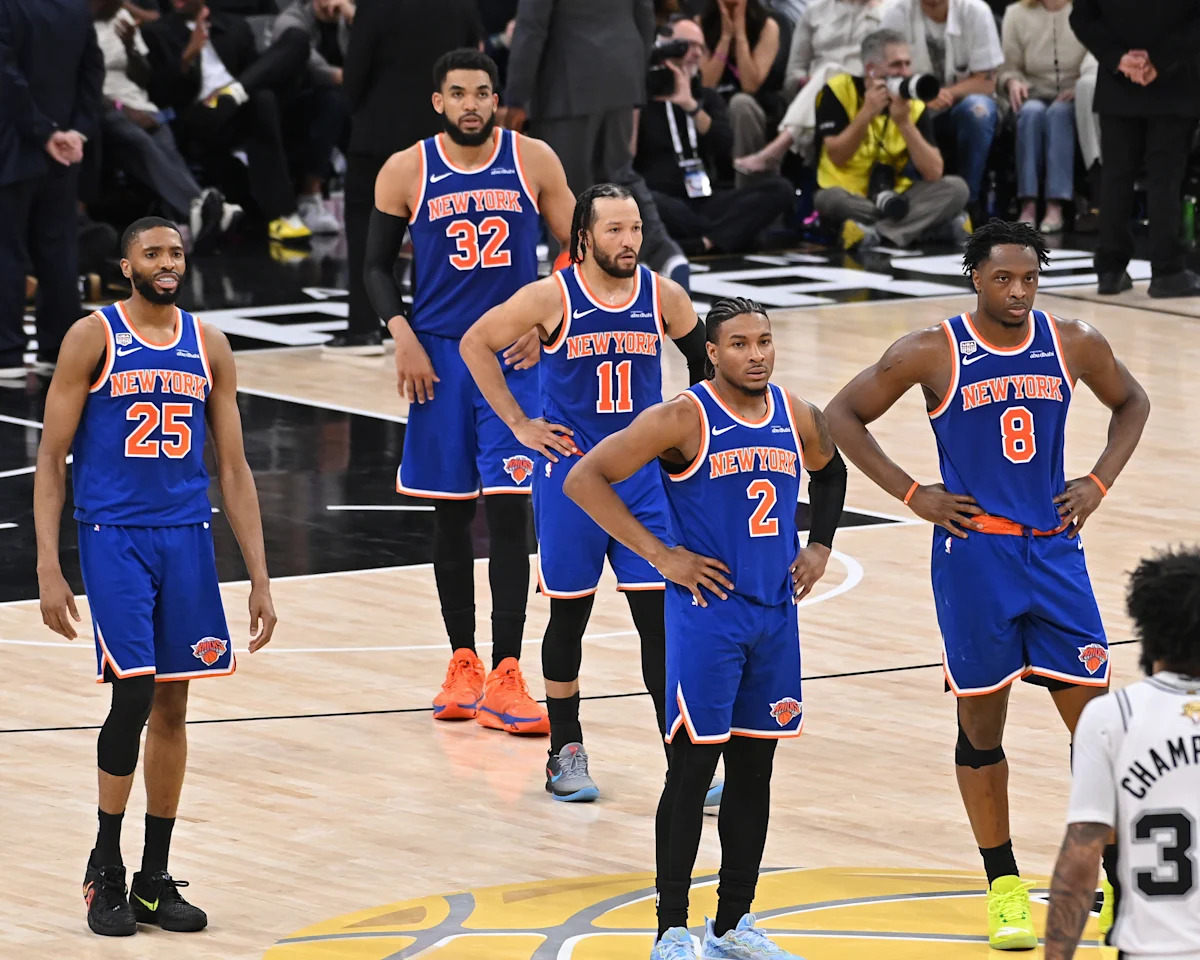
NEW YORK — That the New York Knicks, who just won the 2026 NBA championship, are not favored to win the 2027 NBA championship, is no great surprise.
For one thing, the NBA hasn’t seen a repeat champion since the 2017 and 2018 Golden State Warriors. A decade into Adam Silver’s “parity of opportunity” era, picking the field over the champs seems like a reasonable decision.
Advertisement
For another, it’s hard to blame the oddsmakers for dispassionately favoring a larger 82-game sample over a smaller 19-game one (even if those 19 games constituted some of the best basketball any team has played in recent memory). Heading into the 2026 NBA playoffs, both win-loss record and most advanced metrics pegged the Knicks as something like the fourth- or fifth-best team in the NBA, behind the Oklahoma City Thunder, San Antonio Spurs, Boston Celtics and arguably Detroit Pistons. Heading into the new season with the fourth-best odds of once again hoisting the Larry O’Brien championship trophy, behind OKC, San Antonio and Boston, is understandable, from a removed, quantitative view.
Beyond that … I mean, of course the Knicks aren’t considered the favorites to win next season. They weren’t considered the favorites to win this season. Not until roughly one minute after The Right Hand of God made first contact.
Championship runs don’t always work this way. Sometimes, the favorite heading into the season winds up atop of the mountain come mid-June, and everyone’s just sort of like, “Yep. That sounds about right.” (In the last decade alone, the 2016 Cavaliers, 2017 and 2018 Warriors, and 2024 Celtics all pulled that off.)
Advertisement
A lot of them, however, do unfold like this. Something that first appeared to be little more than an optimistic trick of the light somehow instantiates into tangible, three-dimensional reality; the impossible suddenly shifts into inevitability.
So much had to go right for New York to end its 53-year NBA title drought and turn in one of the greatest postseasons in the history of the sport. That can make it difficult to extract grand takeaways from the Knicks’ road to the top. All paths to glory differ, but this one …
-
Find an undervalued player overshadowed by a higher-wattage face of the franchise
-
Who also has layers-deep family ties to your organization dating back to his literal infancy
-
Who will then decide to forsake more than $100 million in immediate earnings so that you can make more moves around the margins
-
Bring in a bunch of his old college buddies, who all fit brilliantly and are perfectly additive to the culture you’re creating
-
Trade for an All-NBA unicorn who also used to be represented by your team president, back when he was one of the biggest power agents in the sport
-
And when you suffer a devastating, high-profile loss in the playoffs, resist the urge to blow things up
-
Instead, just fire the coach who delivered the most success your franchise had seen in a quarter-century
-
And go find a perfect replacement (but only after like six unsuccessful attempts to hire someone else)
… feels particularly hard to replicate.
To the extent that there is a lesson to be learned from the Knicks’ yearslong rise to the top of the heap, maybe it’s this: The astonishing can happen. Everything can line up just right. You can go from 17 wins to an NBA championship. But the magic, like the man says, is in the work — years upon years of hunting wins on the margins in every scouting profile, every transaction, every signing, every analytical study, every tactical adjustment, every investment in player health and injury prevention.
Advertisement
It’s the organizational version of the way the Knicks offense put defenses in the blender, with each small advantage leading to another, and another, and another, until eventually the edge is too large to overcome. The result of what team president Leon Rose and his staff have built is a kind of a roster-building miracle — from one red paperclip to an immaculate house of cards, a friggin’ Sagrada Familia of cards, all stacked precisely enough to be able to not only stand firm in the storm of the playoffs, but somehow reach all the way to heaven.
It’s a miracle borne of a leadership team that exercised patience at the right moments. Not using on Donovan Mitchell what would become the key pieces in the OG Anunoby trade. Doing the OG deal without surrendering any first-round picks, allowing them to become the ballast for Mikal Bridges.
Not using those picks for a big man like frequently rumored targets Joel Embiid or Giannis Antetokounmpo, who would have necessitated a more fundamental reorientation of how the offense would operate than either the chameleonic (sometimes to a fault) Bridges or the floor-spacing and more geometrically resonant Karl-Anthony Towns. Not overreacting to last spring’s Eastern Conference finals loss to the Indiana Pacers or this January’s post-NBA Cup swoon by damning the torpedoes and going all-in for Giannis. Continuing to believe in the collected talent, the underlying fundamentals, the bones of the house.
Advertisement
It’s also a miracle borne of an understanding for when to hit the gas. Moving to build the whole thing around Jalen Brunson after he’d shown that he was, definitively, the goods. Moving RJ Barrett and Immanuel Quickley at arguably the peak of their values for Anunoby at what might’ve been the nadir of his, with a giant new contract looming.
Putting five first-round picks on the table for Bridges; recognizing the need to both raise the offense’s floor and replace the likely-outgoing Isaiah Hartenstein, and doing both with the KAT trade, even at the cost of culture-setters Julius Randle and Donte DiVincenzo. Cutting bait on Tom Thibodeau just three days after he brought you to your first Eastern Conference finals in 25 years, in favor of a coach in Mike Brown who you believed could get more out of this collection of talent — and who proved you 100% right.
It’s not one created, as the 2019 Toronto Raptors were, without any lottery picks. The highest-drafted player on the Knicks’ championship roster, obviously, was Towns, the No. 1 pick in the 2015 NBA Draft, who sacrificed and sublimated himself within the ecosystem for these Knicks, and who played the best basketball of his life over the past two months. New York’s roster features two other lottery picks: Mikal Bridges, picked 10th overall in 2018, and Jeremy Sochan, chosen ninth overall in 2022.
The highest-drafted player actually drafted by the Knicks, though? Second-year forward Pacôme Dadiet, whom New York selected with the 25th pick in the 2024 NBA Draft, and who played a grand total of 176 minutes this season.
Advertisement
The entire rest of the roster consists of late-first-round picks (OG Anunoby, 23rd; Landry Shamet, 26th; Dillon Jones, 26th; Josh Hart, 30th), second-rounders (Jalen Brunson, 33rd; Tyler Kolek, 34th; Mitchell Robinson, 36th; Miles McBride, 36th; Jordan Clarkson, 46th; Mohamed Diawara, 51st; Ariel Hukporti; 58th, Kevin McCullar, 58th) and undrafted free agents (Jose Alvarado, Trey Jemison).
Yes, some entered the league with pedigree: The Villanova guys had all won national championships, Alvarado had been named ACC Defensive Player of the Year, Kolek and Jones had won Player of the Year honors in their respective college conferences, etc. And sure, Anunoby likely would’ve been a mid-to-high lottery pick had he not torn the ACL in his right knee during his sophomore season at Indiana. But all of these players — even No. 1 pick Towns and lottery selections Bridges and Sochan — have been in some way passed over, undervalued and questioned, and have had to answer those questions and push through those doubts to get where they are today.
“I think everybody to a certain degree at some point in life is overlooked, you know?” coach Mike Brown — who, for the record, was fired from four different head coaching jobs before winning it all in New York — said after the Knicks’ miraculous Game 4 win. “I mean, I’ve had people in my own family who, I see more potential in them than maybe what the world sees. And you know, just to have the ability to stay with it, stay with it, stay with it, stay with it, especially when you get knocked down — to me, that defines who you are. Even if you don’t have the ‘ultimate success’ that you think you deserve, if you get knocked down in life, and you’re able to get back up and keep fighting, that’s a freaking win.”
That shared willingness to keep fighting, a character trait that Rose and Co. clearly seemed to prioritize in building this roster, paid dividends for the Knicks throughout the treacherous climb to the summit. Hart saw and felt it firsthand after missing a fast-break layup that could’ve given the Knicks the lead late in Game 4 against the San Antonio Spurs — a moment where he felt as low as he could imagine … only for his teammates to sprint over and immediately pick him up.
“When you have a team that has that kind of togetherness in the most adverse situations, that breeds championship habits and a championship team,” Hart said. “I feel like we can go down the line of every guy in that locker room that has had moments like that during the season, and everyone has been there to pick each other up. When you have a team that can do that, no matter what happens in a game, you feel like you can get through it.”
Advertisement
While the Knicks aren’t built around high-profile in-house draft picks of their own, that’s not to say that their drafting and player development work didn’t have any role in assembling this title roster. Far from it.
Robinson, their longest-tenured player, has grown from a scratch-off ticket full of athletic tools in 2018’s second round into a fundamentally different player — less live-wire jumping out of the gym to block 3-pointers, more grounded interior defense and offensive-rebounding dominance. That evolution proved massively important to the Knicks’ overarching approach — hammer the offensive glass, limit turnovers, create turnovers, win the possession battle — and found its greatest expression with 26.1 seconds left in Game 5, when he bulldozed through Victor Wembanyama to grab Hart’s missed free throw, kick the ball out to Shamet, and force the Spurs to foul Anunoby, who made it a two-possession game.
While Robinson was on the floor to put his fingerprints on the victory, his fellow former Knicks draftees weren’t.
Advertisement
Barrett, the last first-round pick of the previous regime, didn’t reach the All-Star/All-NBA heights of the two players picked before him in the 2019 NBA Draft (Zion Williamson, Ja Morant). But he turned into a dependable-enough, counting-stats-productive near-star to merit being the first first-round pick to receive a contract extension from the Knicks since Charlie Ward in 1999. Quickley, the second first-round pick of Rose’s tenure — and one that, according to reporting at the time, senior basketball advisor William Wesley, a.k.a. “World Wide Wes,” essentially pounded the table to select — developed into an ace reserve, finishing second in Sixth Man of the Year voting in 2023 and routinely juicing New York’s efficiency on both ends of the floor when he checked into the game.
After playing key roles on the Knicks teams that went to the playoffs in 2021 and 2023, Barrett and Quickley wound up being the trade package that delivered Anunoby — the central casting 3-and-D big wing whom the Raptors likely wouldn’t have been able to re-sign in unrestricted free agency that summer, and whose arrival transformed the Knicks into a team that could seriously harbor bona fide dreams of contention. Since joining the team midway through the 2023-24 season, the Knicks have gone 141-68 with Anunoby in the lineup across all competitions — a .675 winning percentage, a 55-win pace — and have outscored opponents by 1,192 points with him on the floor, the second-highest figure on the team, behind only Brunson.
Also part of that package heading to Toronto? A 2024 second-round pick that the Knicks originally got from the Clippers in a 2021 draft-night deal that sent Keon Johnson to L.A. in exchange for Quentin Grimes — who wound up being a starting 2-guard on a Knicks team that made the second round of the 2023 playoffs, and who was later dealt to Detroit in a trade that brought back Bojan Bogdanovic and Alec Burks, both of whom contributed to another second-round appearance in 2024. All the pieces matter.
The Knicks, somewhat infamously, didn’t send any first-round picks to Toronto for Anunoby. They have, however, turned what seemed like fairly limited draft capital into cornerstone players in a number of other deals.
Advertisement
Rose and Co. turned New York’s 2023 first-round pick, along with Cam Reddish and Ryan Arcidiacono, into Hart, the Jay to Brunson’s Silent Bob, and the emotional and energetic centerpiece of the roster.
(Being willing to move off Reddish, whom he’d imported ahead of the 2022 trade deadline, after just 35 underwhelming games highlights another strength of Rose’s tenure: the ability to recognize when something he thought would work wasn’t working, and to pivot quickly. See: The Kemba Walker and Evan Fournier era.)
They entered the 2022 NBA Draft holding the No. 11 pick, and wound up, through a series of draft-night deals, turning that into three (protected) future first-round picks and enough cap space to sign Brunson — part of a multi-year pattern of trading down in the draft to accumulate more future draft capital and bring in players at slightly lower salary slots than a higher pick would command.
Advertisement
That includes the aforementioned Dadiet, the 25th pick in 2024, who played a surprisingly pivotal role on this title team that belied those scant 176 minutes. As Fred Katz of The Athletic detailed at the time, his willingness to sign for 80% of his rookie-scale slot — a break of about $900,000 from what he could have gotten — was critical in the Knicks’ efforts to crowbar open just enough salary cap space to be able to swing the eve-of-training-camp blockbuster for Towns back in 2024 while fitting his supermax contract underneath the second apron. (They were able to get that close to fitting in the mega-deal thanks in part to Brunson and Robinson both being on descending contracts — another “win every negotiation” hallmark of a transactional era overseen by cap strategist Brock Aller.)
New York was hard-capped at the second apron at that point due to their previous summer blockbuster for Bridges, which saw them send out five first-round picks for a player they believed profiled as a perfect complementary wing next to Brunson, Anunoby and Hart. (One of those picks, by the way? The Milwaukee Bucks’ 2025 first, which the Knicks got from the Detroit Pistons as part of that 2022 draft-night wheeling and dealing to create the cap space to sign Brunson. All the pieces matter.)
The full freight the picks they sent to the Brooklyn Nets — New York’s unprotected 2025, 2027, 2029 and 2031 firsts, plus an unprotected 2028 pick swap — have, at times, been a millstone around Bridges’ neck, an easy talking point for frustrated fans to hammer when his shot went cold and he appeared to float through games. But after he bounced back from a dire start to the 2026 playoffs to turn in the best month of his career as the Knicks ascended to a new plane of postseason existence, capped by a monster performance in Game 2 against San Antonio and 14 points with four assists in the Game 5 closeout, nobody seemed to be particularly concerned about all that draft capital.
Nor is anyone hemming and hawing over the 2025 first that the Knicks sent Minnesota along with Julius Randle and Donte DiVincenzo for Towns — a pick that, again, originally came from Detroit before being redirected through Houston (for Christian Wood!) and Oklahoma City (for Alperen Şengün) and eventually landing in New York as part of the aforementioned 2022 Brunson-aimed draft-night arbitrage that landed Ousmane Dieng in OKC.
Advertisement
Even with the draft picks added to the kitty, though, the Knicks needed to get creative on the margins to grease the skids on the Bridges and Towns deals. As Katz detailed, they had to guarantee the contracts of Mamadi Diakite and Shake Milton in sign-and-trade deals to add them to the Nets package to make the math work for Bridges while avoiding the hard cap. Then, they had to redirect Keita Bates-Diop (whom they received from Brooklyn in the Bridges deal) and the similarly signed-and-traded Charlie Brown Jr., Duane Washington Jr. and DaQuan Jeffries along with Randle and DiVincenzo in what wound up being a three-team deal to get Towns.
Every roster spot, every player and pick under team control, every cent of extra cash a team can send in a deal — all the pieces matter. That includes hitting on the margins in the players you do keep.
It’s Rose immediately signing McBride to a three-year, $13 million contract extension after flipping Barrett and Quickley to Toronto in the Anunoby deal, locking in what was about to become an extremely important two-way rotation piece for what soon became an extreme value contract. It’s creating attractive enough conditions for mid-career veterans that you can land guys like Shamet and Clarkson, both of whom had vital moments during New York’s season and run to the Larry O’B, for the minimum. It’s turning a swing-and-a-miss on Guerschon Yabusele into a quick-pivot correction — first, sending him (and cash) to Chicago for wing Dalen Terry, and then flipping Terry (and cash) to New Orleans for Alvarado — that returned a better-fitting player who played a huge role in the Game 4 comeback against San Antonio … while actually saving a million bucks on the balance sheet.
Advertisement
The most important savings, of course, came courtesy of Brunson. His decision to sign a four-year, $156.5 million contract extension in the summer of 2024 rather than waiting a year to sign a five-year deal that could have netted him an additional $113 million (or, really, an additional $37 million, if you’re getting technical about it) created the financial conditions that allowed the Knicks to conduct all the big business that followed — re-signing Anunoby, fitting in Towns’ supermax, extending Bridges, being able to use the taxpayer midlevel exception on Yabusele, which later turned into Alvarado — without going into the second apron and being subject to the myriad restrictions on trades and signings that come with it.
We can hold two thoughts simultaneously. On one hand, players shouldn’t be put in the position of needing to take less than the top dollar they can make, in a system that artificially caps their earnings as it is, in order to facilitate the construction of the best roster possible. On the other, though, Brunson — from the day he got to Manhattan, a partner in this family business — seems exceedingly pleased with what giving up that up-front money wound up getting him on the back end.
Brunson gave something up to get something in return, and now he has everything he could ever want.
Advertisement
Well, maybe not everything.
“He’s happy he won this m**********r,” an, um, excited Bridges said during an Instagram Live stream on Monday. “He’s very happy. I know he is. But if you don’t think that [he’s] not ready for another run? Then y’all don’t know JB.”
It’s unlikely that the Knicks will become the first team since the Kevin Durant-era Warriors to go back-to-back; there’s a reason the oddsmakers set the lines the way they do, after all. Surviving one 100-game season, coming back and doing it all over again … well, it’d take a miracle, wouldn’t it?
Read the full article here