




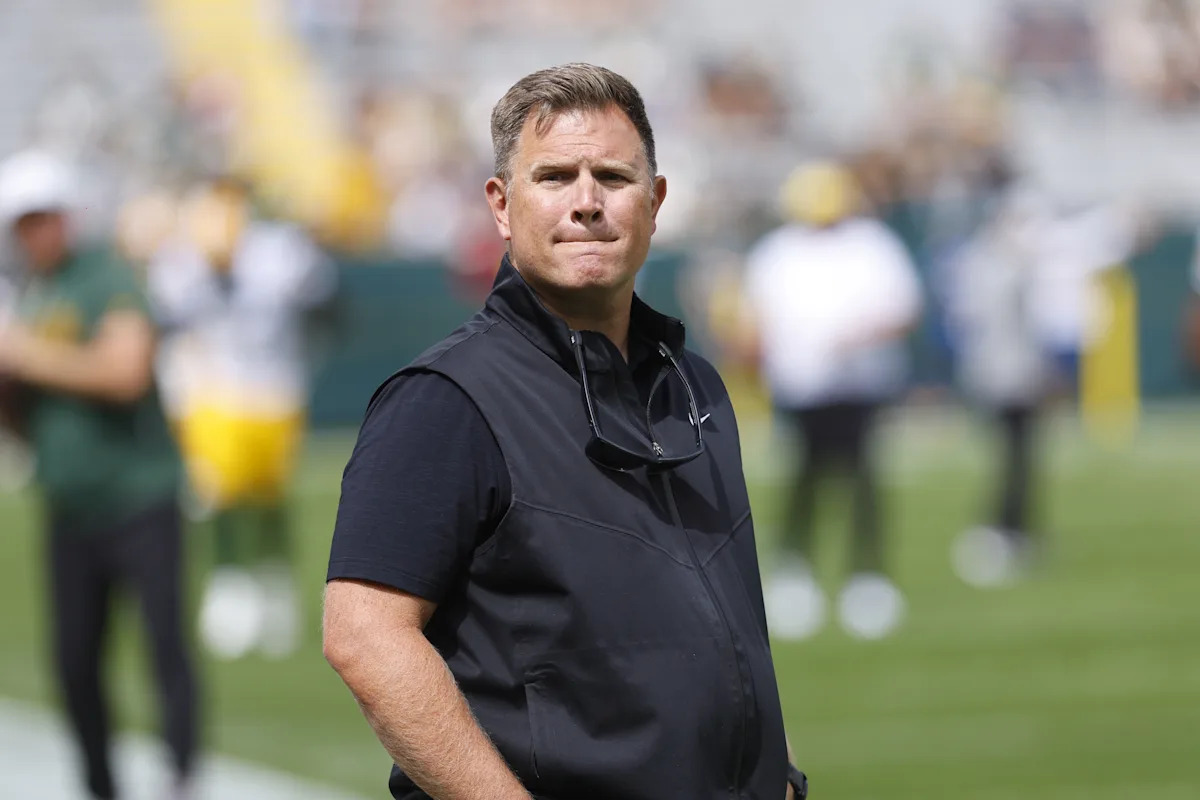
Last week, when Green Bay Packers general manager Brian Gutekunst spoke to the media for the first time since the 2025 regular season kicked off, he stated, “If opportunities present themselves, we’re never not able to do those things,” in reference to the team’s cap situation. Frankly, he’s right in that the Packers can push cap hit forward, if they want to, but they are not unique in this respect.
How much can Green Bay clear in cap space with simple restructures, which just turn salaries or roster bonuses into signing bonuses that can stretch over the lifetime of a player’s current contract? $52 million. That sounds like a lot on paper, but it also ranks 25th in the NFL, according to Over the Cap’s data.
At this point, basically every team can leverage the cap, with the exception being the Philadelphia Eagles, who went into overdrive over the past couple of seasons. For example, the Detroit Lions can actually create $128 million in extra cap space this year, without releasing a player, if they really wanted to.
Advertisement
The short story of the NFL right now is that everyone has more cap space and flexibility than they can use, which is why there have been few quality free agents that have hit the open market in recent years. ESPN’s Adam Schefter even mentioned this in passing this week, stating that he believes that more teams will be involved in trades this offseason because of a weak free agent and draft class.
Everyone can just borrow cap space from the future and pay the money now, hoping that the $25 million per year cap space increases inflate out the pain of the cost, as long as a club’s owner is willing to spend the money. Some owners, at least according to Roger Goodell’s comments last offseason, question him on the integrity of the salary cap.
Prior to the Covid season of 2020, the NFL’s cash spending on players was essentially equal to the collective salary cap. Since Covid, cash spend on players is about 10 percent higher than the salary cap, despite the cap jumping from $182.5 million in 2021 to $279.2 million in 2025. That 10 percent number is holding year to year, too, and isn’t going down the further we get away from the Covid season, when the salary cap actually regressed.
Advertisement
In practice, there’s much more cap flexibility out there than there are smart options for how to spend that money. That’s why the biggest gains in the market over the last two seasons have come for average starters coming off their second contracts, not star players. When it costs $20 million per year for an average (or below average) tackle, $15 million for an off-ball linebacker and $13 million for a nickelback, things start to stack up.
If nothing else, this new era of cap management is showing us which ownership groups really want to push the limit (or don’t have any impulse control, depending on your perspective). For example, the Cleveland Browns have spent about $362 million more in cash on players than the Pittsburgh Steelers have since just 2020 alone. For perspective, that’s roughly twice the team-level salary cap of the 2021 season. That’s just the Browns’ player spend on top of what the Steelers have spent, and Pittsburgh has spent more over the combined 2020-2025 seasons than the salary cap. In the previous era, their player spend relative to the cap would have been above average. Now, they’re the second-lowest spending team in the league.
Results, though, haven’t been correlated to wins, in part because the open market has been dry of top-end talent. The Browns are just 27th in dollars per win since 2020, despite spending all that money. For what it’s worth, the Packers are a relatively average spend team (ranked 14th since 2020, about $10.4 million more than the average team over this time and they have spent 11 percent more cash than the NFL salary cap in this period) that ranks sixth in dollars per win, behind just the Kansas City Chiefs, Buffalo Bills, Pittsburgh Steelers, Los Angeles Rams and Seattle Seahawks.
It’s going to be interesting to see how teams spend their money this offseason. My prediction? The price for average players will rise again because they’re the ones who will be available in free agency. This will continue to shorten the gap between average starters coming off rookie deals and star players.
Read the full article here


