





Under Kirby Smart the University of Georgia transformed from a sleeping giant into the winningest program in college football. The program produced back-to-back national championships, a dynasty-level run of NFL Draft talent, and a roster depth that most programs could only dream about. The question is a tantalizing one for any Bulldogs fan: if you could pluck one former Georgia player from the Smart era and drop him magically back onto the 2026 roster, who would have the biggest impact?
To be clear, this is not simply a question of who was the “best” player. Impact at the college level is shaped by position value, scheme fit, the current state of the team’s roster, and the degree to which a single player can elevate the players around him. With those factors in mind, here are the five strongest candidates — and a verdict on who wins the argument.
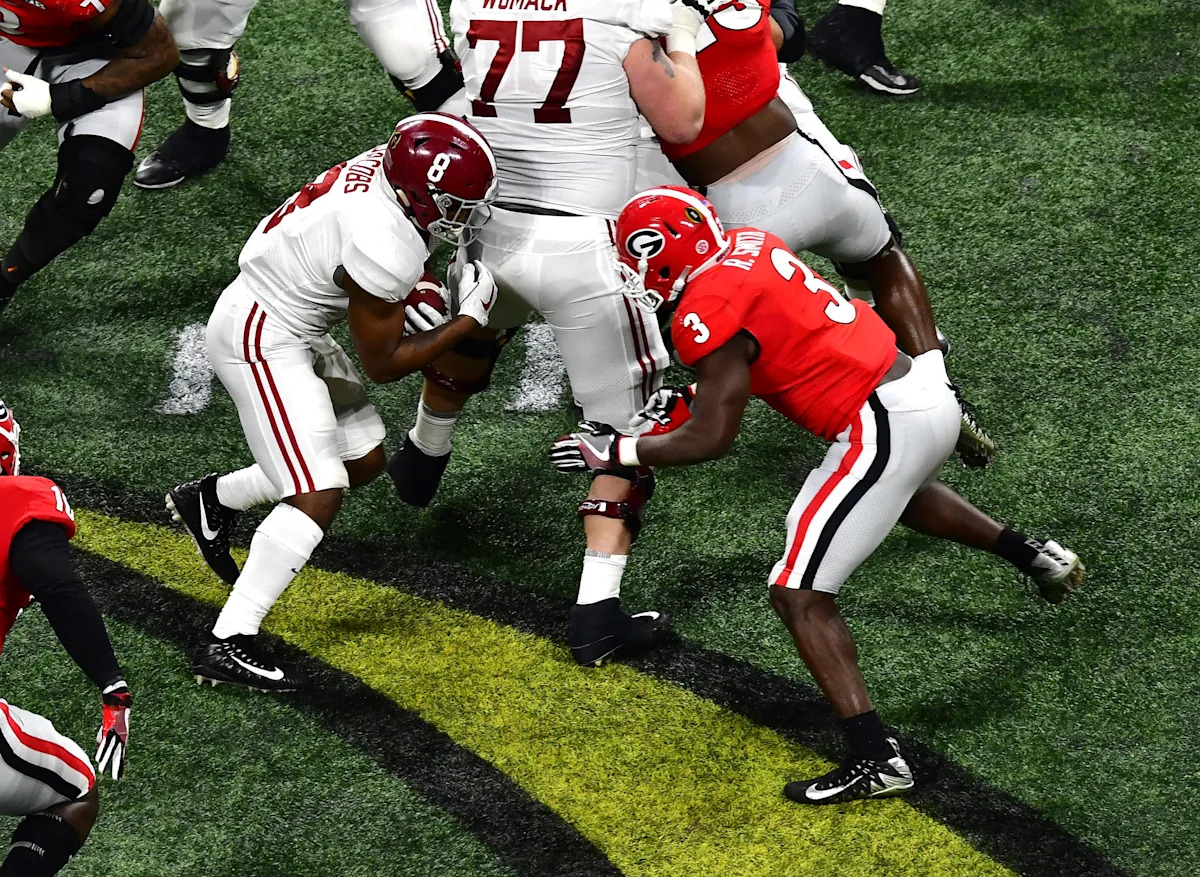
5. Roquan Smith, Linebacker (2016–2017)
Roquan Smith has became one of the most dominant linebackers in the NFL, a four-time Pro Bowler and first-team All-Pro with the Baltimore Ravens. Before that however he was a two-year force in Athens who redefined the standard at the position for the Red and Black. Smith was the 2017 winner of the Butkus Award, given annually to the nation’s best linebacker, and his ability to apparate sideline to sideline was simply breathtaking.
Advertisement
At 6-foot, 236 pounds, Smith possessed an almost uncanny instinct for reading opposing offenses. He could stack and shed blockers, blow up screen passes before they developed, cover tight ends and slot receivers in man coverage, and still arrive like a sledgehammer as a pass rusher when needed. In college, he recorded 97 tackles and seven sacks across two seasons and was widely regarded as the best linebacker prospect in the country upon leaving for the 2018 NFL Draft.
Dropping him onto the 2026 Georgia defense would be a delightful luxury, but perhaps less transformative than the names above him on this list. The Bulldogs have consistently recruited and developed elite linebacker talent under Coach Smart. In 2026 veterans Chris Cole, Justin Williams, and Raylen Wilson all return inside along with promising sophomore Zayden Walker. Smith would be extraordinary, but the position is not one where Georgia is really lacking. His impact would be enormous, but it would represent an upgrade rather than a revelation.
4. Andrew Thomas, Offensive Tackle (2017–2019)
Perhaps the most underappreciated name on this list, Andrew Thomas was a dominant left tackle during his three years in Athens and became the fourth overall pick in the 2020 NFL Draft. He has since developed into one of the premier offensive linemen in the entire league, earning Pro Bowl recognition with the New York Giants.
Advertisement
At 6-foot-5 and 315 pounds with exceptional length and footwork, Thomas was the kind of anchor that allows an entire offense to function at a higher level. Quarterbacks throw with more confidence. Running backs find cleaner lanes. Play-action develops more naturally. The ripple effect of an elite left tackle is enormous and often invisible until he’s gone.
The reason Thomas ranks fourth rather than higher comes down to Georgia’s current offensive line identity. The Bulldogs have consistently signed and developed NFL-caliber linemen. Earnest Greene’s return was surprisingly less of a splash than I would have figured, perhaps owing to some of his injury-I diced struggles in 2025. If Greene stays healthy in 2026 he has All-SEC potential. If he doesn’t, I would expect sophomore Juan Gaston to move over to that spot, and he could also play at a high level. Inserting Thomas would make Georgia’s offense significantly more explosive, but as with Roquan the marginal gain at a position of existing strength keeps him from the top tier of this exercise.
No player in Georgia’s dynasty era captured the program’s spirit quite like Stetson Bennett. A walk-on who left and came back, who was benched and returned, who climbed every mountain put in front of him, who simply refused to be denied. The Prince of Pierce ultimately became a two-time national champion and the most decorated quarterback in program history.
Advertisement
His numbers speak for themselves. In his final season in 2022, Bennett threw for 3,425 yards and 27 touchdowns, leading Georgia to a 65-7 destruction of TCU in the national championship game. He was composed under pressure, a natural leader in the huddle, and an expert at operating within Todd Monken’s system, controlling the game when needed and attacking when the opportunity arose.
The argument for Bennett is primarily emotional but also substantive. Quarterback is the most important position in football, and a veteran, battle-tested signal caller with national championship experience is worth its weight in gold at the college level. I love Gunner Stockton, he won a SEC title while playing some of his best football toward the end of the season, and he will almost certainly be a better player in 2026. But the Georgia quarterback room still feels like it has a void that a figure like Bennett would fill decisively. His competitive fire alone would be invaluable.
However, Bennett was never a transcendent physical talent. He succeeded through intelligence, toughness, and extraordinary preparation. Against elite competition, those traits matter enormously. Gunner Stockton’s seems to have them as well, and assuming he develops he would make Bennett unnecessary as well, hard as that may be to believe.
2. Honorable Mention: Brock Bowers, Tight End (2021–2023)
Brock Bowers was not merely the best tight end in Georgia history. Many who watched him play consider him the most dominant tight end in the history of college football, full stop. In three seasons in Athens Bowers caught 175 passes for 2,538 yards and 27 touchdowns. He is the only player ever to win back-to-back Mackey Awards, given to the nation’s best tight end, and he did so at ages 19 and 20.
Advertisement
What made Bowers historically unique was his combination of size, speed, hands, and run-after-catch ability. He was impossible to cover with a single defender. Safeties couldn’t keep up with him in space. Linebackers could not match his precise route-running. Cornerbacks could not handle his physicality after the catch. Defensive coordinators across the SEC and in two College Football Playoff runs were simply left without answers.
Bowers was the Las Vegas Raiders’ fourth overall pick in the 2024 NFL Draft, and he has continued his excellence at the professional level. Returning him to Georgia in 2026 would immediately make the Bulldogs’ passing offense a nightmare to defend.
Don’t get me wrong, Georgia’s current crop of tight ends including Lawson Luckie, Elyiss Williams, and Jaden Reddell (to say nothing of five star freshmen like Kaiden Prothro) are elite talents. But no one has ever played it at the college level the way Bowers did.
He misses the top spot by the thinnest of margins, and only for one reason.
1. Nick Chubb, Running Back (2014–2017)
Nick Chubb is the answer, no matter the question. In four seasons at Georgia, Chubb rushed for 4,769 yards on 758 carries and scored 48 touchdowns. He averaged 6.3 yards per carry across his career and was, by any metric, one of the best running backs in the history of college football. He did all of this while sharing a backfield first with Todd Gurley, then with Sony Michel and recovering from an injury that would have ended many players’ careers. He still managed to rank among the SEC’s elite ball-carriers in every healthy season he played.
Advertisement
What separates Chubb from Bowers in this exercise is position scarcity meeting historic ability. Running back is the position most responsible for controlling tempo, shortening games, and reducing the margin for error in close games. A back like Chubb, who gained yards after contact the way few players ever have, who broke tackles with a combination of power and burst that seemed physically impossible, would take enormous pressure off Gunner Stockton and a youngish receiver rotation.
Chubb’s 2017 season, in which he rushed for 1,345 yards and 15 touchdowns while sharing touches with Michel, came on a team with a first-year starting quarterback in Jake Fromm. The parallel to 2026 Georgia is striking. A dominant running back transforms a program’s identity, and Nick Chubb was the most dominant running back of the Kirby Smart era..
Brock Bowers would make Georgia’s passing offense elite. Nick Chubb would make Georgia’s offense simply unfair. While I like Nate Frazier and Chauncey Bowens, and have confidence in both to deliver in 2026, Chubb would be a substantial, even transformative, upgrade.
Final Verdict
Each of these five players would be extraordinary in their own right. Roquan Smith would anchor a great defense. Andrew Thomas would anchor a great offensive line. Stetson Bennett would stabilize the most critical position on the field. Brock Bowers would create a nightmare matchup at tight end that no coordinator in college football could solve.
Advertisement
But Nick Chubb, at full health and in his prime, playing behind a veteran Georgia offensive line in 2026, would be as close to an unstoppable force as college football allows. He is the answer, and it isn’t particularly close. Until later…
Go ‘Dawgs!!!
Read the full article here