






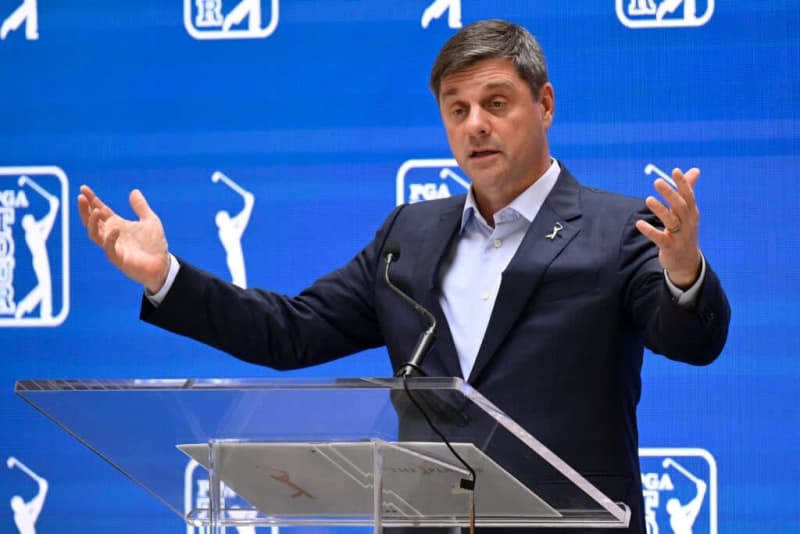
CEO Brian Rolapp just announced sweeping changes for the PGA Tour which will be coming in the near future.
The former NFL executive said he won’t be overly bound by golf’s traditions in his introductory press conference last summer, and he’s stayed true to those words so far.
Advertisement
Prior to The Players Championship, Rolapp revealed that there are plans for the PGA Tour to introduce promotion and relegation across two “tracks”, turn the postseason into a match play event, and make sweeping changes to the schedule, which could see the season cut down to 21 events.
It was a clear breakdown of all of the PGA Tour’s plans for the future, but Rolapp admitted that there were still plenty of discussions to be had, and decisions to be made, before he can announce anything official.
So here are the five biggest questions he is yet to answer on the PGA Tour’s future.
Photo by Orlando Ramirez/Getty Images
1. How will promotion and relegation work?
When discussing the concept of promotion and relegation, Rolapp drew a direct parallel to the English Premier League, suggesting a “two-track” system where players can play their way into, or out of, the elite events.
Advertisement
However, he didn’t specify the mechanics. Will relegation happen annually, at the end of the year, or in-season? How many relegation and promotion places are there between the two tracks, and what happens to players on lifetime exemptions who have hit slumps?
If a player like Justin Thomas is injured for an extended period of time, will he suddenly be at risk of relegation due to time off, or will he somehow get a pass for the events he misses?
All these things need to be cleared up when a clear outline is set for these plans.
2. Which tournaments will be “Relegated” to the Second Track?
Along with player relegation, Rolapp announced a two-track system for which courses will be played by which players. He plans to double the number of Signature Events (to roughly 16), creating a “First Track” of 21–26 elite tournaments (including Majors and Playoffs).
Advertisement
Rolapp said that he’d like to start the season at a top-class golf course in California, so that would likely be Pebble Beach or Riviera. But we don’t have a clear idea as to which courses will be considered first-track worthy.
For the dozens of long-standing tournaments not selected for the first track, what is their future? Sponsors for these second-track events are understandably anxious about whether they can maintain their valuation if the top 50 players rarely show up.
And will it be possible for them to be promoted to the first track, the same as the players? Time will tell.
3. What are the details of the match-play postseason?
One of the most popular teasers was the possibility of a win-or-go-home match-play component in the FedEx Cup Playoffs.
Advertisement
The current postseason setup has been widely criticised for being confusing and too similar to the rest of the PGA Tour season. Rolapp looks to amend that by turning the playoffs into a match-play event.


Photo by Jared C. Tilton/Getty Images
But Rolapp admitted he is still figuring out the postseason. Fans want to know whether this replaces the current stroke-play format at East Lake entirely and whether the Tour Championship will finally begin rotating to major markets like New York or Chicago, as he hinted.
4. What is the “International Component”?
Despite his America First focus on major U.S. media markets, Rolapp briefly mentioned that the schedule would have an “international component.”
Advertisement
There’s still plenty of ambiguity here. Does this mean a formal partnership with the DP World Tour, or is it a defensive move to combat LIV Golf’s global footprint, taking the PGA Tour around the world?
Could we see PGA Tour events expand to Australia and around Europe?
5. Will the PGA Tour actually adopt the Rollback?
This is the elephant in the room for equipment manufacturers and elite players. While the governing bodies have mandated a universal rollback, the PGA Tour is a private entity that could, theoretically, choose not to adopt it for its own sanctioned events.
Rolapp admitted he is still “getting up to speed” on the issue, but the industry has been discussing it for years.
Advertisement
Titleist, TaylorMade, and Callaway are some of the Tour’s biggest sponsors. They loathe the idea of making two different versions of their flagship balls. Rolapp’s refusal to give a yes or no keeps these billion-dollar partners in a state of expensive limbo.
Read the full article here


