



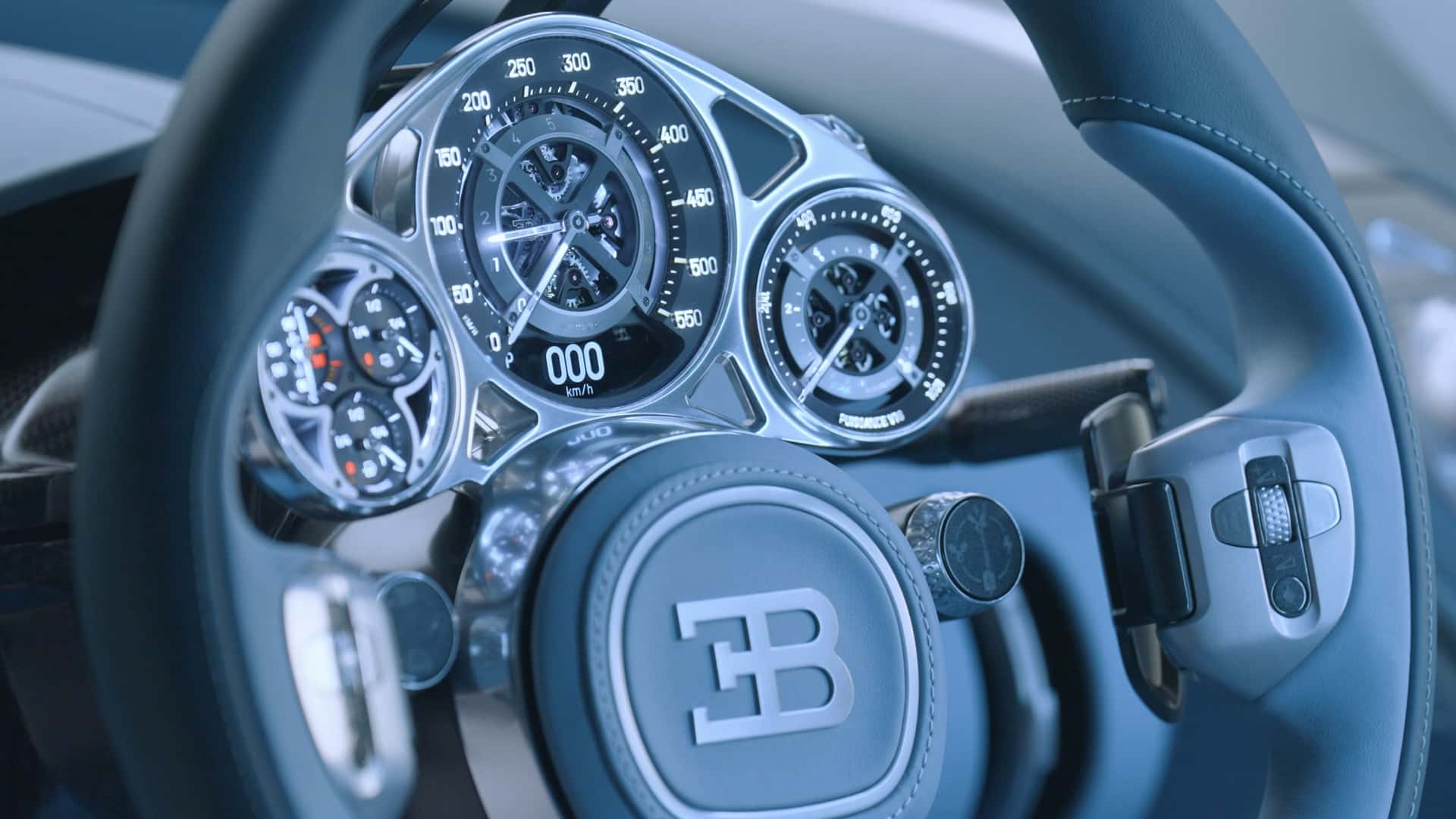
- Bugatti replaces large digital screens with a fully mechanical instrument cluster developed by Swiss watch specialists.
- The display is made of more than 650 hand-assembled parts and built to withstand automotive stresses.
- It combines traditional watchmaking craftsmanship with modern vehicle electronics.
Even in the ultra-high-end luxury segment, too many automakers think massive screens are the ultimate must-have—just look at the recently refreshed Mercedes S-Class. Bugatti, however, proves that a deliberately analog approach can be just as compelling, as demonstrated by the remarkable effort behind the Tourbillon’s cockpit.
While many of today’s hypercars rely on oversized displays and digital interfaces for driver information, the Bugatti Tourbillon takes a strictly analog path. Its instrument cluster was developed in collaboration with Swiss firm Concepto, a specialist in highly complex mechanical watch movements. An episode of Bugatti’s documentary series A New Era highlights the development and manufacturing of this extraordinary component.

The car’s name reinforces the concept. A “tourbillon” is a watch-making mechanism patented in 1801 to counteract timekeeping deviations caused by gravity. Unlike earlier Bugatti models named after racing drivers, the Tourbillon references a technical innovation. That choice was deliberate; the goal was to create an instrument display without a primary digital screen—one designed to endure for decades.
The instrument cluster consists of more than 650 individual parts and is hand-assembled at Concepto using traditional haute horlogerie techniques. These include intricate finishing methods, precisely machined components, and meticulous manual assembly. However, the requirements differ significantly from those of a wristwatch. The scale is larger, and the components must withstand automotive-level stresses like temperature fluctuations, vibration, and acceleration.


Bugatti Tourbillon Interior
One of the main development challenges of the Tourbillon was integrating mechanical assemblies with electronic components. Circuit boards, sensors, and LED elements had to be incorporated into an architecture originally rooted in purely mechanical watchmaking. Standard watchmaking tools proved inadequate due to the size of the parts, requiring the development of specialized manufacturing processes.
For the visible surfaces, customers can choose from decorative techniques such as Clous de Paris, guilloché patterns, and Tapisserie textures—classic elements of traditional watch design. Materials include aventurine and various metal finishes. Ruby bearings reduce friction within the mechanism, while sapphire crystal protects exposed components. Gears and other key elements were engineered specifically for this application.
Customization is carried out using physical sample parts rather than relying solely on digital renderings, allowing clients to evaluate the visual effect and tactile quality of materials firsthand.
The instrument cluster serves as the centerpiece of the interior. Supporting this layout is a steering wheel with a fixed central hub: the rim rotates around the center, ensuring the display remains visible regardless of steering angle. This design prevents the spokes from obstructing the driver’s view.
Despite its mechanical emphasis, the system meets the demands of a modern high-performance vehicle. It combines traditional analog display principles with contemporary electronic data capture and processing, creating a hybrid solution that blends classic craftsmanship with cutting-edge automotive technology.
The result is a driver display that intentionally avoids a dominant digital screen, placing mechanical precision front and center. It functions both as an essential vehicle component and as a standalone work of technical art within the cabin.
58
Motor1’s Take: In a world overrun by touchscreen technology, the Bugatti Tourbillon offers a fresh take on high-end luxury with real, mechanical elements built to stand the test of time. It’s stunning
Read the full article here