




No team has made more 3-pointers, nor launched more, than Alabama in the past four seasons. And nothing will shake coach Nate Oats from believing they’re at the core of building a winner in modern basketball.
Teams might struggle to match the Crimson Tide’s sheer volume heading into March Madness, but they’re leaning into those long-distance shots, too.
Advertisement
“Finding efficient shots is at the top of what we do,” Oats said recently. “It’s at the top of what everybody in the NBA is looking at is generating efficient shots. And if you’re not thinking about how to get open catch-and-shoot 3s, I don’t think you’re thinking about creating efficient shots.”
This marks the 40th season with the 3-pointer fully integrated into college basketball, an advancement that has transformed the sport since its 1986-87 introduction. Years of pounding the ball inside to bigs have given way to skilled players stretching defenses to create space for shooters to take those matchup-tilting shots.
In the NCAA Tournament, the 3 is an equalizer capable of igniting seismic upsets like Middle Tennessee’s takedown of Michigan State in 2016 or the first-ever 16-vs-1 win with UMBC beating Virginia in 2018. Going cold can just as easily mean an abrupt end to the season. So the question remains: How much should a team rely on the 3 in March?
Division I teams fittingly have taken nearly 40% of their shots from behind the arc in this 40th season of the 3, yet a fraction of Final Four teams and NCAA champions in the 3-point era have utilized it to this year’s levels with their seasons on the line.
Advertisement
Higher volume
At its core, the 3-pointer is a volatile bet.
The reward can be far-reaching offensive efficiency beyond simply the 50% added value compared to a traditional field goal. But it boasts a tougher conversion rate as officials have moved the arc back multiple times — from 19 feet, 9 inches to 20 feet, 9 inches in 2008-09, then to 22 feet, 1 3/4 inches to match the international distance for 2019-20.
As a result, the 3-point shooting percentage has barely moved. Division I teams have bounced from around 33-35% shooting on 3s going back to the 2002-03 season, with this year at 34.1% entering the week.
Advertisement
Yet 3s have gone from accounting for 32.1% of all shot attempts in 2002-03 to a 24-season high of 39.5% this year, according to SportRadar. And 3s account for 29.8% of all made shots in Division I, up from around 25% in 2002-03.
Those are thresholds rarely reached by teams that have pushed all the way to the sport’s final weekend:
— Only 28 of 152 (18.4%) teams to reach the Final Four in the 3-point era have had 3s account for this year’s percentage of their made shots;
— Only 21 of those Final Four teams (13.8%) had 3s account for this year’s percentage of shot attempts;
— And seven of 38 champions (18.4%) have had 3s account for more than 39% of their shot attempts, including the past three winners in UConn (2023-24) and Florida (2025).
Advertisement
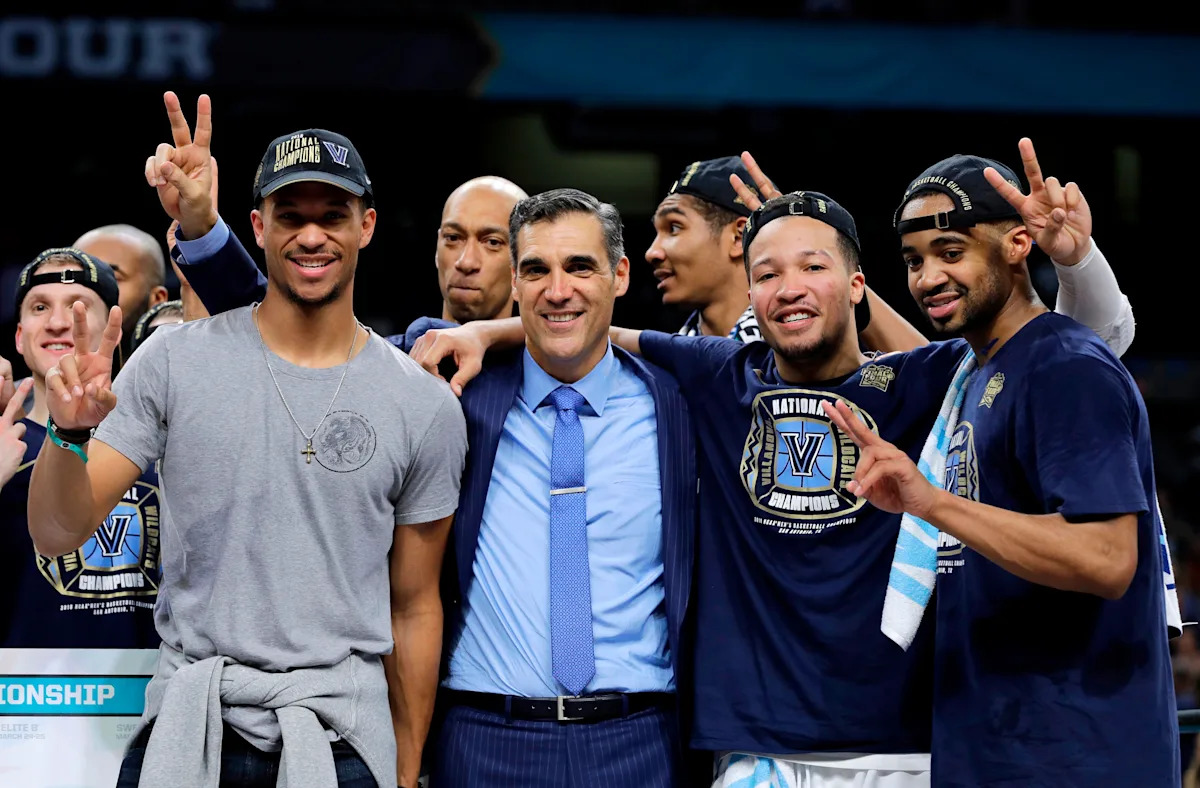
Villanova’s two championships under Jay Wright remain outliers. Notably, his 2018 winner that blew through six tournament games to win it all behind eventual NBA players Jalen Brunson, Mikal Bridges and Donte DiVincenzo held the all-time highest marks among the champs; 3s accounted for 38% of the Wildcats’ made shots and 47.5% of their attempts.
His other champion, in 2016, won on a buzzer-beating 3-pointer by Kris Jenkins.
“You’ve got to be able to shoot the 3 to go deep in the tournament,” the retired Wildcats coach said. “Not just because 3s are more valuable than 2s, but now the way teams play defense, if you can’t shoot 3s, they’re going to load up on your 3-point shooters and take them away. And they’re gonna force you to make non-shooters make plays.”
The right looks
That’s Oats’ focus, too.
Advertisement
The Crimson Tide’s 4,436 attempted 3s are 339 more than the next closest Division I team, according to SportRadar. Alabama has shot 35.5% behind the arc in that span, with 3s accounting for 48.3% of Alabama’s shot attempts.
The approach helped make Alabama the No. 1 overall seed in 2023 and powered a Final Four run in 2024 and last year’s trip to the Elite Eight after hitting a tournament-record 25 3s in a Sweet 16 romp against BYU.
“The math part of it is how can you create the most efficient offense, and how can you try to keep the other team from running the efficient offense?” said Oats, whose team is the Midwest Region’s 4-seed. “Well if you’re all in on getting the most efficient shots you can, the 3-point line and taking 3s has to be a part of that. It just does.”
Yet two of those runs ended when the Tide couldn’t hit from outside. That 2023 team led by eventual No. 2 overall NBA pick Brandon Miller went 3 for 27 (11.1%) on 3s in a Sweet 16 loss to San Diego State. The Tide went 8 for 32 (25%) in last year’s regional-final loss to Duke.
Advertisement
Hall of Fame coach Rick Pitino, now at St. John’s, has never shied from the 3, going back to Providence’s unexpected Final Four in the first season of the 3-pointer to cutting down the nets at Kentucky in 1996, followed by Louisville in 2013 in a later-vacated title push.
Can a team win it all firing off all these 3s?
“100% – if you defend the 3. That’s the key,” said Pitino, whose Big East champion is the East Region’s 5-seed. “It all comes down to defense. It’s not how many you make, how many you take, but how many you stop. So, if everybody is shooting the 3, the team that’s gonna win it is the team that defends the 3.”
Gravity’s pull
Duke coach Jon Scheyer is only in his fourth season as successor to retired Hall of Famer Mike Krzyzewski, so he’s been willing to adjust his approach in these early years of his tenure. That’s included an uptick in 3-point usage.
Advertisement
“For me, it’s actually not even the fact of shooting more 3s,” Scheyer said. “It’s about having the threat to shoot the 3. And I think that’s the biggest key, is spacing. … Because that’s what opens up drives. That’s what open up free throws. That’s what opens second-chance points. So I think naturally by having really good spacing, you do end up shooting more 3s.”
Duke’s first two teams took 36.4% of their shots from 3-point range, with 3s accounting for 28% of their made baskets. Last year, those numbers jumped to 44.6% and 34.9%; it made sense considering Duke was led by No. 1 overall NBA draft pick Cooper Flagg and No. 4 pick Kon Knueppel — who has set an NBA rookie single-season 3-point record and has a league-best 238.
This year’s team uses what Scheyer has likened more to a “smashmouth” approach with a big frontline led by freshman NBA prospect and Associated Press first-team All-American Cameron Boozer. And yet, even as the No. 1 overall tournament seed has routinely pummeled teams in the paint and on the glass, the 3-pointer accounts for a similar percentage of Duke’s attempted shots (44.4%) and made baskets (31.8%).
Scheyer figures it’s about finding the right balance in shot selection, along with a good shooter’s “gravity” in pulling defenders from the paint.
Advertisement
“You can still establish yourself inside while you still shoot 3s,” Scheyer said. “Now if you’re shooting other shots and just living on the perimeter, well yeah, I think it’s tough to win that way, because the best shot you can get is a layup or a dunk or get to the free-throw line. But if you’re shooting 3s, you better be really good at it.”
___
AP Sports Writers Mike Fitzpatrick in New York and Dan Gelston in Philadelphia and AP freelance writer Kennington Lloyd Smith III in Tuscaloosa, Alabama, contributed to this report.
___
AP March Madness bracket: https://apnews.com/hub/ncaa-mens-bracket and coverage: https://apnews.com/hub/march-madness
Read the full article here


