




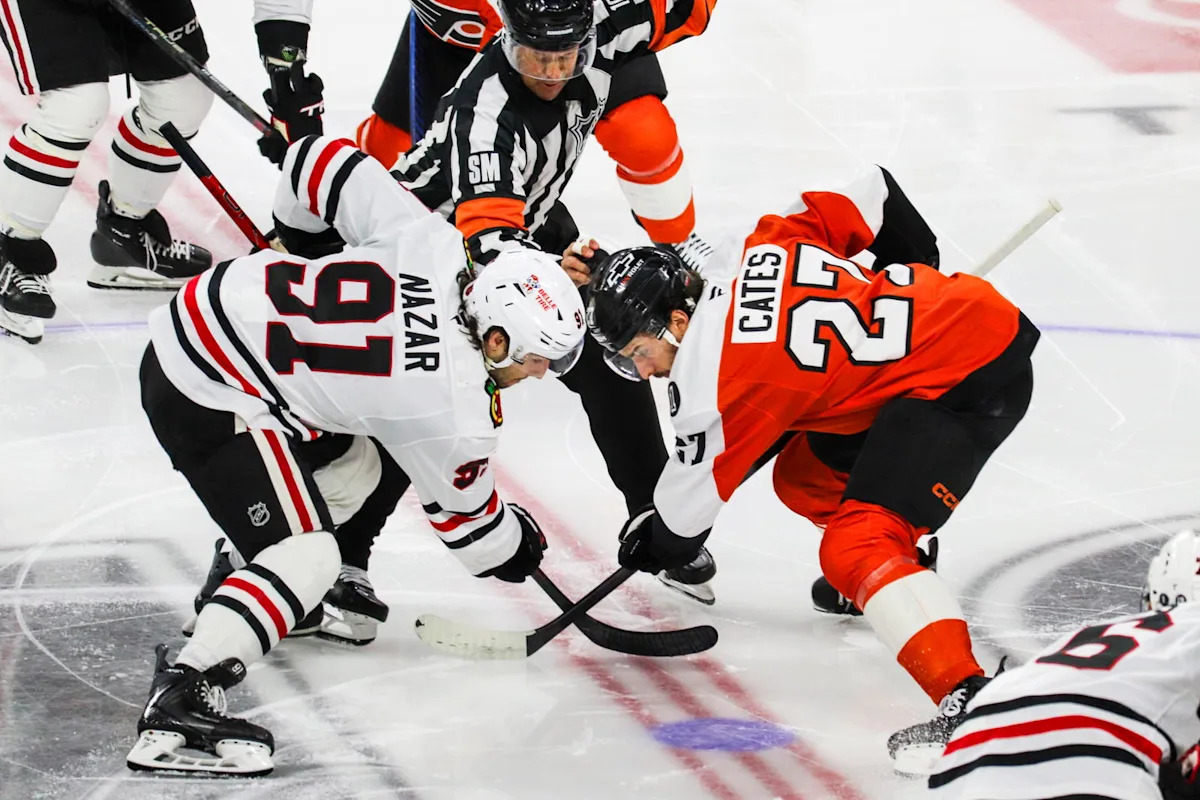
A win like Thursday’s can be read two ways.
At the surface level, it was straightforward: the Flyers beat a weaker team, scored five goals, and handled their business after a disappointing loss earlier in the week. In a playoff race, the ability to bank those points without overcomplicating the night is part of the job.
Advertisement
But the more useful reading is less about the score and more about the way the Flyers produced it. On the surface, it’s a comfortable win over a rebuilding opponent. But it was also a game that showed how Philadelphia wants to attack, and which parts of its current success are real enough to trust.
1. The Flyers Are Scoring in a Way That Should Travel
The biggest tactical difference in this game was where the offense came from. Against Columbus, the Flyers spent too much time chasing cleaner looks than the game offered. Against Chicago, they stopped waiting.
They attacked the middle of the ice earlier and put pucks to the net without overhandling them. They created offense from inside the dots instead of trying to work everything into the perfect passing lane.
Advertisement
A team that relies on perimeter possession can look productive without being dangerous. A team that gets to the interior creates rebounds, scrambles, and second chances. That was the Flyers’ better version here.
Rick Tocchet’s comment about “playing interior” was the key phrase. It’s not just coach-speak. It describes a measurable shift in how the Flyers are trying to win games. They are getting pucks on net quicker, occupying the crease more consistently, and forcing defenses to collapse instead of getting to sit and shape the play.
That is a real adjustment, and it is more meaningful than a simple five-goal result against a team at a different stage of its cycle.
2. Alex Bump’s Night Says More About Depth Than Fireworks
Alex Bump’s first multi-point game was perhaps the most encouraging individual development of the night, but not because it means he is suddenly going to singlehandedly drive a playoff push. It matters because of what it says about the Flyers’ options.
Advertisement
Bump has six points in 10 NHL games, which is a solid start for a young winger adjusting to a very different level of pace and decision-making. More important is how he is producing. He’s not floating through shifts waiting for play to find him. He’s active on retrievals, quick through touches, and willing to make the next play without trying to force the ideal one.
Philadelphia Flyers forward Alex Bump (20). (Megan DeRuchie-The Hockey News)
That is relevant in a bigger roster sense. The Flyers have been trying to build enough forward depth that they can absorb lineup churn and still generate offense without leaning too heavily on one line. Bump’s emergence helps in that regard, but it also clarifies something: the organization is beginning to find real NHL contributors in roles that do not require huge minutes to matter.
That is not nothing. Teams with playoff ambitions rarely get far without at least a few young players who can enter the lineup and not look out of place.
Advertisement
Bump looked like that on Thursday.
3. The Flyers Are Getting More From Their Middle
Christian Dvorak’s goal and assist showed not only his continued individual contributions to the offense, but also how the Flyers are getting more consistent production from the second and third layers of the lineup.
When teams get to March, the first line can still drive play, but it can’t realistically carry every game. Philadelphia’s recent stretch has shown more contributions from players like Noah Cates, Dvorak, Luke Glendening, and Garnet Hathaway than it did earlier in the year. That creates something the Flyers did not always have: the ability to keep pressure on when the top players are off the ice.
Advertisement
Cates has become a particularly important part of that profile. His 16th goal tied his career high, but the more meaningful number is his 14 points since the Olympic break. That is not a small stretch; that is a middle-six player actually influencing the shape of games.
4. A Useful Test in Net-Front Control
The Blackhawks may not be a league benchmark, but that does not make this result any less important. If anything, lower-end opponents are often more revealing in one specific area: whether a team can impose its preferred style without forcing it.
The Flyers did that here by controlling the net-front battle. Tocchet’s note that the team had “good presentations” and that players were “always around the net” is backed up by the structure of the scoring itself. The Flyers did not depend on point shots and hope. They got inside and stayed there. That’s a mature approach, and it’s also one the Flyers had not always consistently embraced.
5. What This Win Does and Does Not Mean
This is the part that matters most.
Advertisement
A 5–1 win over Chicago doesn’t tell you the Flyers have solved the season. It doesn’t prove they are a finished playoff team. It doesn’t erase the structural questions that still exist around their offensive consistency, their home-ice struggles, or the degree to which their recent success depends on playing a cleaner brand of hockey than they were earlier in the year.
What it does tell you is that the message is getting through.
The Flyers are no longer relying on hope or a single line to produce all of their offense. They’re getting better at playing to the game in front of them instead of the game they wish they had. They’re using their depth more effectively, and they’re generating offense from more areas. And when they face a team they are supposed to beat, they are not making the night harder than it needs to be.
That sounds simple. In practice, it’s not.
Advertisement
Teams in the Flyers’ position often win and still leave the game feeling unresolved, because the process doesn’t match the result. This was different. The process and the scoreline lined up.
That is the useful takeaway—not simply that the Flyers blew out the Blackhawks.
It is that they looked like a team that understands what it needs to do to keep winning games like this. And at this point in the season, that is the kind of lesson that actually matters.
Read the full article here


