





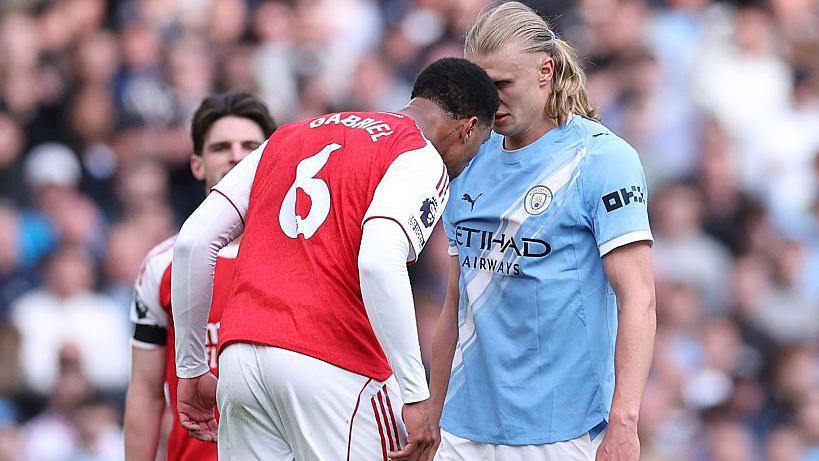
The running battle between Erling Haaland and Gabriel was a theme of the title showdown between Manchester City and Arsenal.
The Norway forward had already had his undershirt partially ripped in one physical tussle during City’s 2-1 win on Sunday.
Advertisement
It was the kind of scrap fans love to see in big games, and referee Anthony Taylor had allowed both players some latitude.
However, things boiled over in the 83rd minute after Haaland and Gabriel competed in an aerial duel.
Following a push by the City striker, the two men squared up to each other, with foreheads pressed together.
What happened next could easily have resulted in a red card for the Brazil centre-half, who pushed his head towards Haaland’s face.
The Arsenal defender escaped with a yellow card. But should this not be seen as violent conduct?
Why did the VAR not get involved?
Gabriel would have been suspended for three matches if he had been sent off for violent conduct [Getty Images]
What exactly is a headbutt?
Advertisement
The laws of the game do not specifically reference it, so it is wrapped up in the description of violent conduct.
That requires a player to have used or attempted to use “excessive force or brutality”.
It opens up a level of subjectivity where pushing your head towards another player might not be seen as violent.
For the video assistant referee (VAR), what the refereeing team say they saw is crucial.
On Sunday, it was the assistant referee who said the incident was “not excessively aggressive or violent”.
Referee Taylor took this advice on board and chose to book both players for their aggressive attitudes.
Advertisement
VAR John Brooks first has to consider that the incident has clearly been seen by the assistant.
Could Brooks really say Gabriel’s actions definitely were excessively aggressive or violent? That would be required for a VAR red card.
Even if the VAR thinks a red card is the better decision, it is difficult to get involved if an official has had a decent view and provided a supportable explanation.
So what came into that judgement?
It was felt that because Gabriel pushed with his head rather than struck – he did not pull his head back first and create space before driving it forward – a yellow card was supportable.
Advertisement
But many were likely expecting a VAR review for a red card.
So why did Martinez get sent off for hair pull?
The VAR’s decision to stay out of it will probably leave Manchester United fans a bit miffed.
Just six days earlier, Brooks was in the VAR chair when Lisandro Martinez was sent off against Leeds United.
The Argentina defender had briefly grasped the ponytail of striker Dominic Calvert-Lewin, and was shown a red card after referee Paul Tierney was sent to the screen.
Is a small grab of someone’s hair more violent than dragging your forehead across an opponent’s face?
Manchester United fans may well say it is not. Yet it was Martinez who saw red and was banned for three games, with Red Devils manager Michael Carrick calling it “one of the worst” decisions he has seen.
Advertisement
If Gabriel had been sent off, he would have been suspended for three of the Gunners’ last five matches. Instead he will be available for the fixtures against Newcastle, Fulham and West Ham.
There can be no retrospective action as VAR has effectively made it obsolete in the Premier League. If an incident has been assessed by the on-field team or the VAR, then the Football Association is unable to seek a charge.
How could Brooks, who is one of the most trusted VARs and regularly appointed to some of the biggest fixtures, make such different decisions?
It is primarily about the hair pull not being identified by the on-field team.
Advertisement
That meant the VAR had no initial description to go off – so there was no bar for the clear and obvious mistake.
And that makes it far more straightforward for the VAR to intervene.
Could this encourage players to play-act?
Gabriel has a lot to thank Haaland for. Had the striker gone down, embellishing the level of contact, a VAR review feels like it would have been a certainty.
This is often the problem. A VAR is looking for evidence of impact to convince them there has been a mistake.
If a player does not react, be that to a headbutt or a trip or a push, it is far more difficult to be sure there has been an offence.
Advertisement
Yet that only encourages players to play up for the cameras to make sure they get the decision they want.
For instance, had Calvert-Lewin not gone down holding his hair would Brooks have even picked up on that potential red card?
And we have a perfect example for comparison.
In November 2020, Taylor was in charge of Leeds against Arsenal when, with the referee’s back turned, Nicolas Pepe walked up to Ezgjan Alioski and placed his forehead into the face of the North Macedonia international.
The level of contact does not seem too much different to Gabriel and Haaland’s clash, yet Alioski fell to the ground holding his face.
Advertisement
Pepe was sent off after a VAR review, with Gunners boss Mike Arteta saying at the time that his actions were “unacceptable”.
One problem the Premier League has is the high threshold for VAR intervention, which often means the most logical decisions are not reached.
It is why there are far more missed interventions (15) so far this season compared to incorrect ones (three), a trend which has been there throughout all seven seasons with video reviews.
Yet in an era where players seem eager to throw themselves to the ground, it is refreshing that Haaland did not over-react.
“If I go down like any other guy, it’s a red card,” Haaland said after the game.
Advertisement
“It’s not something I would do. My father taught me to stay on your feet.
“Should I have gone down? Maybe. Then it would’ve been easier.”
City boss Pep Guardiola will be hoping it does not come back to haunt his team if Gabriel proves to be a match-winner for Arsenal over the next three games.

Read the full article here