





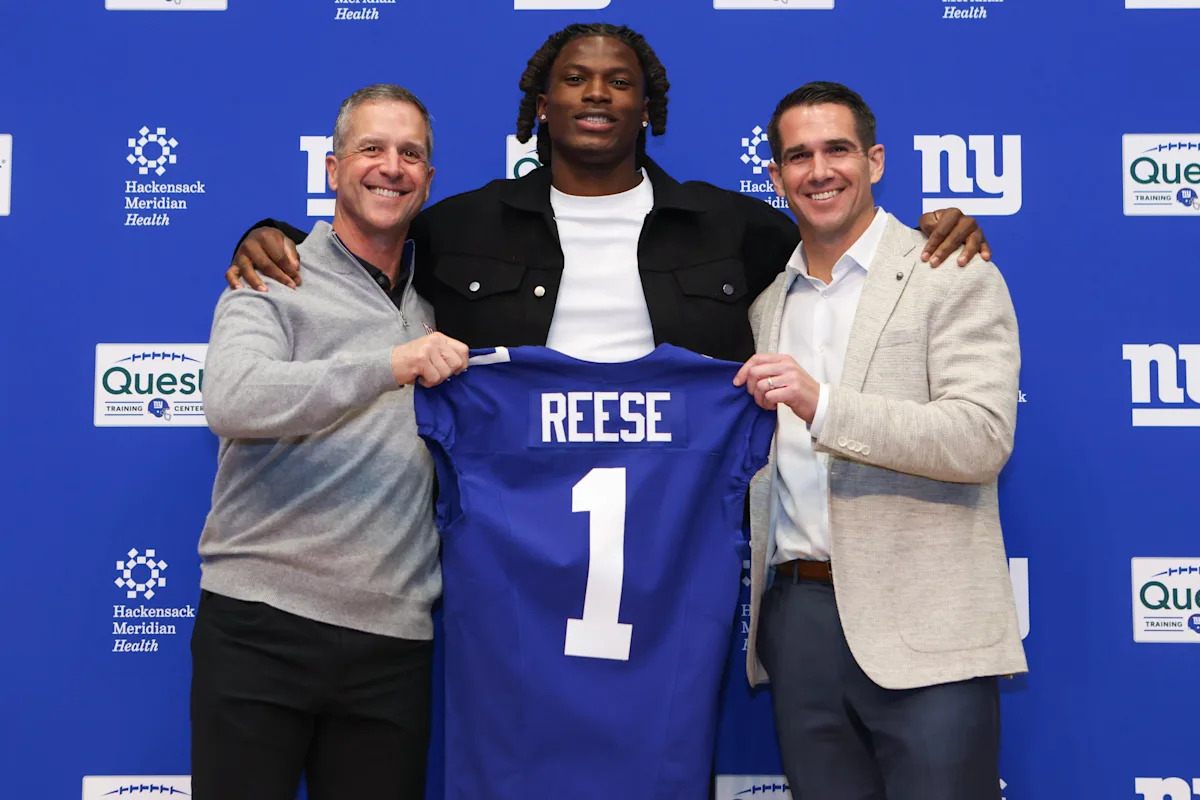
It was regarded as a surprise when Ohio State defender Arvell Reese fell to the New York Giants at No. 5 overall in the 2026 NFL Draft.
Reese was widely projected to be drafted somewhere in the range of picks 2 to 4. And even then, Reese was not widely considered an option for the Giants because he was almost universally evaluated as an edge prospect in the mold of Micah Parsons and Abdul Carter.
Advertisement
And given that the Giants already boast Brian Burns, Carter, and Kayvon Thibodeaux at edge defender, the idea of them drafting another pass rusher was widely dismissed.
Right up until the Giants drafted Reese. John Harbaugh and Joe Schoen told the New York media up front that while Reese would rush the passer as a blitzer, he would be playing (weak side) linebacker. Rather than treat him as a convert and a project, the Giants are going to play Reese in the same way he was used at Ohio State.
In that light, it now seems like something of a blind spot that Reese is still being evaluated as an edge defender and not a linebacker — a blind spot that’s enabling poor analysis of the Giants’ defense elsewhere.
So in an effort to fix that blind spot, I dove back into Reese’s tape to evaluate him purely as a linebacker. That’s a different grading sheet with different traits from my original scouting report in April.
Advertisement
In a change from my usual scouting reports, I’ll be peeling back the curtain a bit in this one and sharing some of my process. As part of that, I’ll share the 11 traits on which Reese was graded, the grades for each of those, and the final grade.
Ed has repeatedly asked me to add grades to my scouting reports, but I’ve consistently refused. I generally believe they’ll detract from a more nuanced conversation. However, in this case, I think they might be constructive.
Universal traits
These traits that every football player should have are the same for every single prospect scouted. Obviously, different positions are held to different standards, and a guard who runs a 4.9-second 40-yard dash with a 30-inch vertical would be considered to be much more athletic than a receiver with the same numbers. That said, tape is king, and a player who moves well with quickness and fluidity, or visibly keeps up with a player we know to be an excellent athlete, can score well, too.
Advertisement
Likewise, we’re looking for the other traits on tape. That means things like quickly recognizing and reacting to opponents’ plays, giving high effort in pursuit, limited hesitation or indecision, or winning physical one-on-one matchups.
Athleticism: 9
Mental Processing: 8
Competitive Toughness: 9
Play Speed: 8
Play Strength: 9
We only have Reese’s 40 time (4.46 seconds at 6-foot-4, 241 pounds), but we don’t need a stopwatch and tape measure to tell us that he’s an excellent athlete for the linebacker position. Reese is obviously fast in a straight line, but also shows impressive quickness and twitch when moving laterally. He’s able to quickly cover ground in coverage zones, as well as flow around blockers while maintaining an “athletic ready” position like an industrial-sized MC Hammer.
Reese also has excellent body control and the fluidity to drop his hips and change his center of gravity, or bend the edge as a pass rusher.
Advertisement
The two things that really leap off the screen in watching Reese’s tape are his versatility and play strength.
Reese’s position and duties evolved significantly over the course of the 2025 season. He started the year as a fairly standard off-ball linebacker, usually lining up on the weakside of the offense and only occasionally walking up to the line of scrimmage. As the year progressed, Reese was deployed all over the Buckeyes’ defensive front. He lined up in every gap, from A to D, and on both left and right sides, as well as deployed as a SAM, WILL, and MIKE linebacker. He was even used as a primary communicator at the second level, relaying calls and helping to get his teammates lined up.
Reese split time almost perfectly between the line of scrimmage (327 snaps) and an off-ball alignment (320 snaps), and as such, watching Reese’s tape was a definite “Where’s Waldo” exercise.
While that certainly highlights his prodigious athleticism, it also points to his Football IQ and processing. Reese rarely looked lost, showing a clear understanding of his various responsibilities and how everything fits together from multiple positions in Matt Patricia’s complex defense.
Advertisement
Finally, Arvell Reese is freakishly strong. As long as he’s engaging with leverage (which is fairly easy thanks to his lower body fluidity), Reese is routinely able to stalemate, stack, and shed linemen 60 or 80 pounds heavier.
(Reese is the Ohio State linebacker wearing number 8)
We’ll get to his run defense in a minute, but it’s worth pausing here to appreciate how Reese uses technique to maximize his play strength. Reese takes on blockers with excellent technique that’s reminiscent of how offensive linemen should take on defenders. He comes up to aggressively attack blockers, establishing leverage with low hips, and fires his hands inside the defender’s chest plate to control them. He then uncoils to drive them off the ball before accelerating into the backfield.
Advertisement
He has heavy, violent hands and isn’t afraid to use them to stack and shed defenders, and is also a very secure tackler. He’s able to bring down most offensive players with the minimum of leaky yardage.
Position-specific traits
These traits are (obviously) specific to each position. Off-ball linebackers have some of the most diverse duties in football. They may be asked to be effective both downhill as run defenders, drop into coverage to help disguise or simulate pressure, actively cover running backs, tight ends, or receivers, or rush the passer as a blitzer.
It’s obviously great for a linebacker to excel in all of these, but that’s also incredibly difficult for teams to find. Part of the modern offensive explosion has been a concerted effort to attack the second level and force defenses to choose between nickel and base sets.
Advertisement
Run Defense: 9
Space Play: 9
Pass Defense: 8
Pass Coverage: 8
Playmaking: 8
Blitzing/Pass Rush: 9
Reese is one of those rare linebackers with the traits to be a true “three-down defender”. That’s a misnomer anymore, as teams are equally likely to run or pass on a given down or distance, but that’s also beside the point.
Reese’s strength and toughness make him a highly capable run defender, who can both make the play himself as well as take on blockers to eliminate running lanes and leverage the ball back to his teammates.
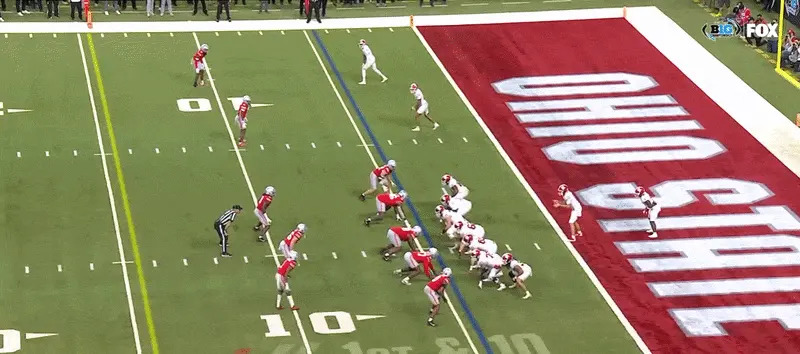
Those are also the traits that allow Reese to walk up to the line of scrimmage as a psuedo-EDGE.
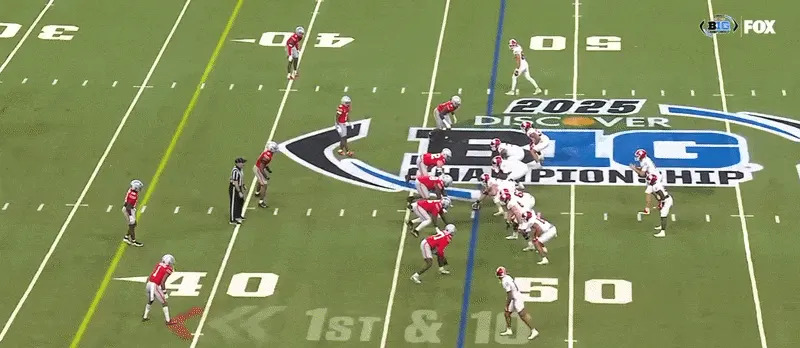
(Reese is the edge defender on the defensive left / offensive right)
Advertisement
Reese became one of the main pivot players in Ohio State’s formidable defense. His presence allowed defensive coordinator Matt Patricia to change their look on a moment’s notice, adapting to offensive formation and personnel without having to change subpackages.
Interestingly, while Reese split his time evenly between the line of scrimmage and off-ball, he only had 119 pass-rush snaps. That averages out to 8.5 pass-rush snaps per game, and while that was obviously influenced by Ohio State pulling their starters in blowouts, it’s still remarkably low for a player who was originally evaluated as a prospective edge defender.
Instead, Patricia used Reese’s athleticism and mental processing to play “Run to Coverage” techniques. In other words, Patricia routinely asked Reese to step up and play the run, read the play, then drop into coverage in the flat or hook-curl area. That not only made use of Reese’s run defense, it also used his athleticism to be a factor in zone coverage.
Additionally, it leveraged the threat of Reese as a pass rusher to simulate pressure, force blockers to account for him, and create favorable matchups elsewhere.
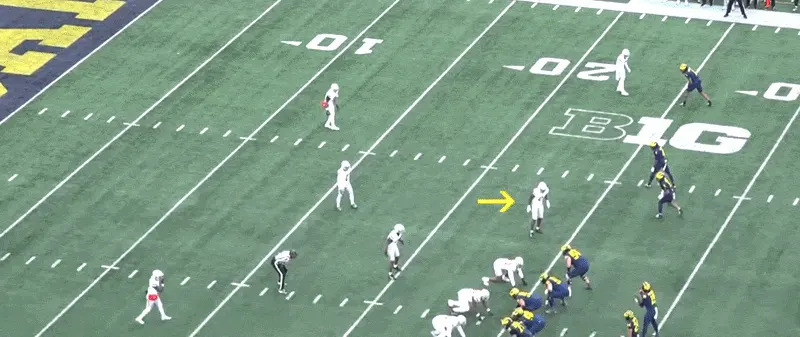
To be clear, there were instances in which Reese was fooled by play design or misdirection. Reese is a very young player who only has limited experience at any position, let alone the myriad duties he was asked to perform in Patricia’s defense. There are also some instances where he turns and runs to get depth in his drops rather than backpedaling. That takes his eyes out of the backfield and can make it tough for him to regain his sense of the play as it develops.
Advertisement
There are obviously going to be times when he doesn’t trust what he sees or bites on well-executed misdirection. That being said, he typically recognizes the mistake and corrects quickly.
His athleticism allowed him to make up the lost time in college, but those margins will be much tighter in the NFL.
Reese was also asked to match up in man coverage on occasion, whether by design in a pure “man coverage” call, or as a response to the offense in “man match” coverage rules.
He probably shouldn’t be asked to match up with wide receivers, or even particularly quick and shifty running backs.
However, Reese’s own speed and quickness should allow him to cover most tight ends or backs out of the backfield.
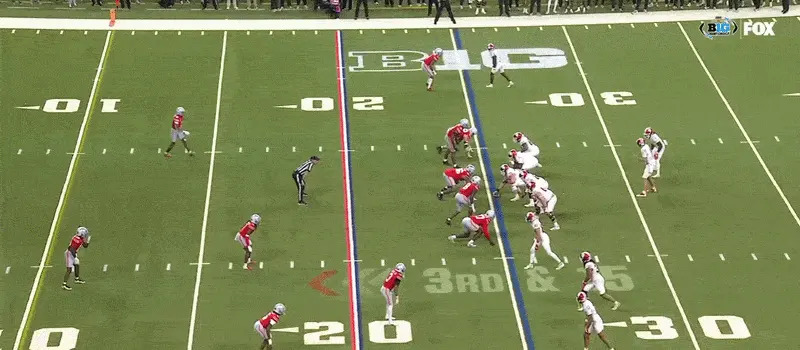
(Note: Reese does a great job of covering the back and getting in position to defend the swing pass. Given his quickness, length, and play strength, that probably wouldn’t have gone for much. However, this was just an absolutely beautifully designed play by Indiana.)
Advertisement
Finally we come to the blitz, where Reese’s upside caused many (including yours truly) to initially evaluate him as an edge defender and not an off-ball linebacker.
Reese typically times the snap well and has a legitimately explosive get-off to go with second and third-step acceleration. Whether he’s lined up at the second level, inside, or is rushing off the edge, he’s a problem for the opposing blocker.
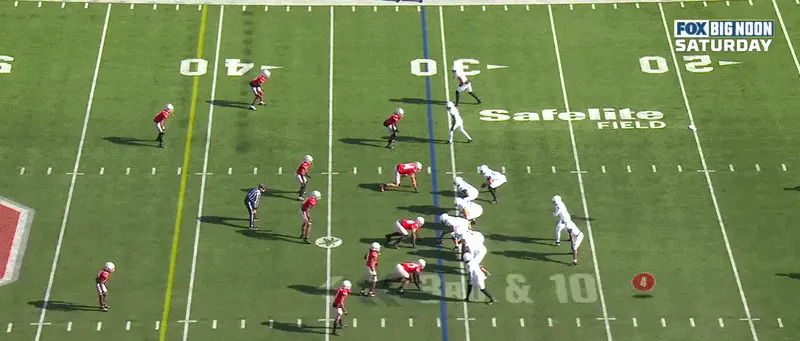
Reese’s arsenal of pass-rush moves is a definite work in progress. Right now he’s mostly dependent on his speed to put blockers off balance or taking them by surprise with his power. He’s able to dip under their blocks thanks to his flexibility, but he still needs to learn how to use his hands to fully unleash his athletic traits.
Advertisement
Reese won’t need a vast pass-rush arsenal, however something like a polished club-rip and long-arm to play off a bull rush would make him incredibly dangerous as a fourth or fifth rusher.
Final thoughts
Final grade: 8.55
All in all, the Giants were likely shrewd to immediately state that Reese will play linebacker. It will allow him to stay at a familiar position and develop at his own pace, as well as allow them to use his versatility to facilitate a more sophisticated defense than we saw over the last two years.
The Giants will have to be careful to avoid putting too much on Reese too soon and force him to wear too many hats. However, he showed an aptitude for processing a significant amount of information in Patricia’s defense, so he might be able to handle more than the average rookie.
Advertisement
Reese’s length, athleticism, processing, strength, and spatial awareness all give him a very high upside as an off-ball linebacker. His upside as a blitzer should allow a dangerous Giants’ pass rush to be even more fearsome, even as he needs to hone his game in that area.
It makes sense in hindsight that both the Jets and Cardinals passed on Reese. It takes a team with a much more stable environment to develop a player like him and get the most out of him. Likewise, it makes sense that so many were evaluating Reese as an edge defender — his upside there is legitimately exciting, and this was a draft with few blue chip prospects at premium positions. And while a versatile second level player (be he a linebacker or a box safety) is crucial to modern defensive scheming, it still isn’t as valuable as a hyper-athletic pass rusher.
Even so, it still feels like a stroke of luck that he fell to the Giants, and it’ll be absolutely fascinating to see how a coach with as diverse a background as Dennard Wilson uses Reese.
Read the full article here