




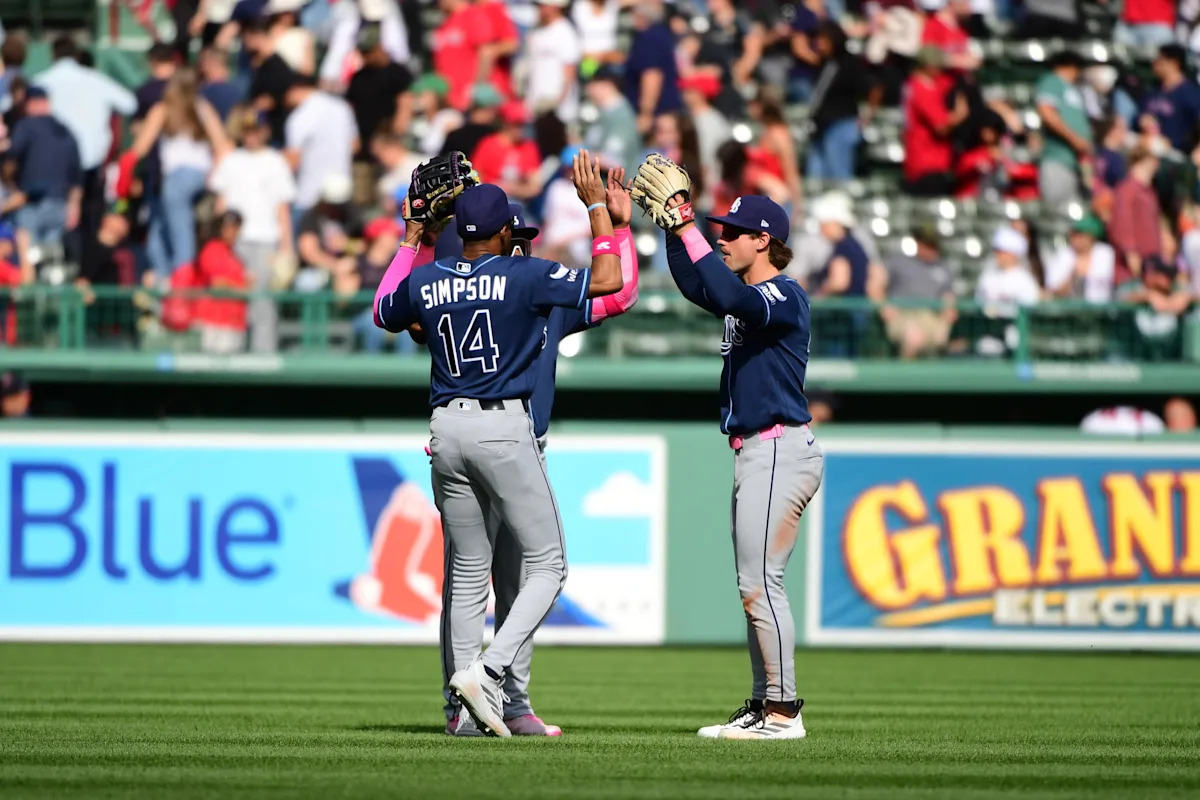
Following the hiring of Corey Dickerson this offseason — who has received significant buy-in from the Rays outfielders this season — and by having Kevin Kiermaier in camp during Spring Training, the Rays outfield has quietly become one of the better defensive groups in baseball. They have taken an unconventional approach to doing so as well, as they consistently post the fastest reactions off the bat, emphasizing initial speed rather than running perfect routes.
In other words, the Rays outfielders appear to prioritize getting to full speed immediately and trusting their athleticism to make up the difference. Here’s how Rays outfielders stack up in several key defensive metrics:
Advertisement
-
3rd best rate converting fly balls and line drives into outs
-
5th most outs above average
-
5th best fielding run value
-
9th most outfield assists
-
10th most defensive runs saved
The Rays were bottom 10 in the league in every one of these statistics last season.
Personnel changes have helped this to an extent (for example, swapping Christopher Morel for Ryan Vilade, Cedric Mullins instead of Kameron Misner, and returning Jonny DeLuca from injury), but one player remains the same. Instead, another big reason though is the defensive growth we’ve seen from Chandler Simpson. His jumps (how many feet an outfielder covers in the first three seconds in the correct direction towards a batted ball) have gone from roughly average to plus-plus territory. Statcast measures an outfielder’s jump using three components:
-
Reaction: How many feet are covered in any direction from 0 to 1.5 seconds of a ball being put in play
-
Burst: How many feet are covered in any direction from 1.6 to 3 seconds
-
Route: Feet covered against direct route to the ball from 0 to 3 seconds
Here’s how the outfield defenses around the league have compared so far based on jump and its components:
You might notice that big blue label for the Rays outfielder’s routes. The Rays take the worst routes in baseball on average, yet still cover the third-most ground above average. This appears to be by design; take a look at their reactions and you’ll find they’re the best in the league by a large margin.
Advertisement
Intuitively this makes some sense, even if you weren’t raised on watching B.J. Upton lead the Rays outfield to the World Series with a similar approach.
Once an outfielder hesitates, that lost acceleration is almost impossible to recover. An imperfect route taken at full speed can often beat a perfect route taken after a delayed first step. The Rays appear to be optimizing for the one thing that can’t be made up later: immediate acceleration.
To be clear, Simpson’s new defensive strategy of “get to top speed first, figure out the route later” is actually something the entire Rays outfield group has bought into. All four of the Rays primary outfielders (Simpson, Mullins, Vilade, and DeLuca) included in the data rank in the top 20 in reactions in the league with Simpson ranking 2nd and Mullins ranking 4th. If fifth outfielder Victor Mesa Jr. had enough opportunities to be included, he would rank 3rd just behind Simpson. If the injured Jake Fraley had enough opportunities to qualify, he would be tied with Michael Harris II of the Braves at 14th — just behind Vilade at 13th and ahead of DeLuca at 17th.
The resurgence of Mullins as a quality defender really helps drive this home. Take a look at his reactions in each season as a professional:


Mullins is having his quickest reactions ever and his best jumps since 2021 despite being the slowest and oldest he has ever been (sorry Cedric, no offense). His sprint speed in 2021 was in the 86th percentile at 28.5 feet per second, clearly plus and one of the faster players in the game. In 2026, he’s still above average as he’s in the 63rd percentile with 27.8 feet per second, but it’s clear he has lost a step from elite.
Advertisement
While Mullins hasn’t fully regained his reputation as one of the best defenders in the league like he was during his prime, he has transformed from a roughly average defender across the last couple of seasons into a plus one once again, and the player credits Corey Dickerson for the improvement, as noted in Adam Berry’s article linked above:
Mullins told a similar story. He wasn’t happy with his defensive performance last season, but admitted he didn’t fully grasp what needed to change or how to go about doing it. After one conversation with Dickerson, he did. “I know that’s not me as a defensive player. I wanted to definitely improve upon that as quickly as I could,” Mullins said. “He came in with a true plan for us, and it’s been working really well.”
[How Dickerson and the Rays revamped their outfield defense this year — mlb.com]
It seems clear this is indeed an organizational emphasis rather than a coincidence, and that the Rays may once again be ahead of the curve. It wouldn’t be surprising if outfield defense is simply the next frontier in what is frequently written about as The Rays Way.
Overall, these improvements become both intuitive and intriguing when you consider who’s teaching it. Dickerson and Kiermaier posted below-average route efficiency during their playing careers while consistently excelling in jump metrics by getting to top speed immediately and trusting their athleticism. Now young coaches, Dickerson the team’s first base and outfield coach and Kiermaier an organizational consultant, it’s fascinating to see those same tendencies emerge throughout Tampa Bay’s current outfield.
Read the full article here


