




A 1994 episode of Friends featured a trivia game in which Ross asked how many categories existed for Monica’s towels. Joey and Chandler specified four—“Everyday Use, Fancy, Guest, Fancy Guest”—before arriving at the correct total of eleven. A similar exercise on the PGA Tour’s priority ranking for its members would last longer and expose an even greater zeal for hierarchical classifications, without the benefit of a laugh. It is golf’s version of a Medicare manual, the product of decades worth of perks, privileges, compromises, concessions and backroom deals.
Most of those prioritized for starts are obvious and well-earned, like winners of majors, the Players, elevated invitationals and regular events, as well as top finishers on the FedEx Cup points list from the prior season. Further down the ranking—beyond the current PGA Club Professional champion, who is entitled to six exemptions—the pool shallows. You’ll find status based on career money (63-year-old Vijay Singh is using that category in 2026, but has played only one tournament), on making 300 Tour cuts, on medicals (major and minor), on past wins, and on being a veteran with 150 made cuts. In all, the priority ranking has 48 categories, and befitting a member organization it’s weighted toward rewarding those who have given years of service rather than elevating the next generation.
Advertisement
Reforming that is a fraught process, which is why the Tour’s CEO, Brian Rolapp, was notably silent on particulars around eligibility when he unveiled the broad strokes of the structure coming in ’28. Much of the reaction focused on particular tournaments and which tier they might land in, but those questions will largely be determined by economics rather than by decree. Is a sponsor willing to pay upwards of $20 million for a Championship tier stop? If not, do they see a sufficient return on the roughly $4 million for a Challenger event? But the locker room cares more about where they’ll play, how they’ll earn a card, and how they’ll keep it.
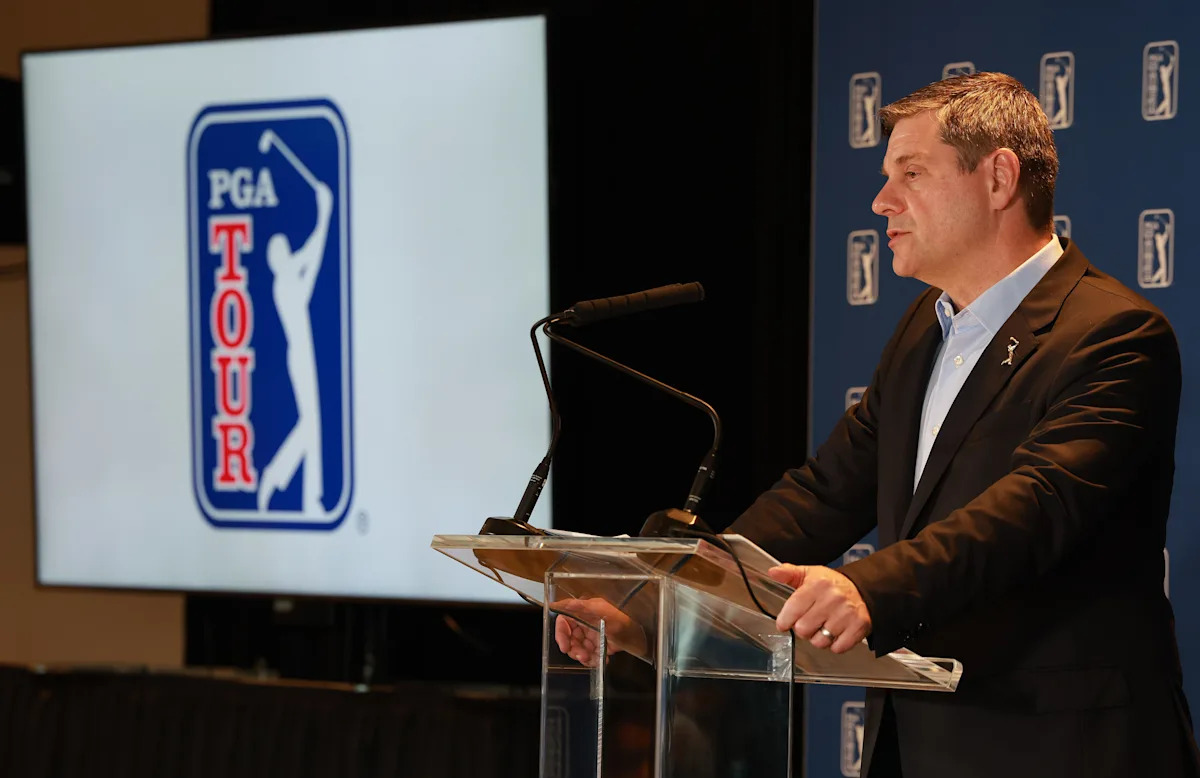
PGA Tour CEO Brian Rolapp takes questions at a news conference ahead of the 2026 Travelers Championship at TPC River Highlands.
Rolapp admitted that a priority problem exists. “Golf has an amazing tradition of meritocracy, probably the best sport in the world that I can see about you earn what you earn and you do it inside the ropes and you’re rewarded for it, and our athletes are conditioned that way. I think we got away from that,” he said on June 23. Still, he dodged questions about the future of the exemption into signature events that was created for anyone with 80 wins. Tiger Woods hasn’t used it yet, but its mere existence suggests meritocracy zealots have their limits, as do governance advocates since Woods remains the only member of the Tour’s board without an expiration date on his term. Ain’t no one gonna tell Tiger to play better or pack his briefcase.
But Rolapp did suggest that priorities will soon tilt more toward current performance and future potential than past glories: “As we work through eligibility for both series, we will continue to focus on our developmental pathways… which will play a critical role in identifying and preparing the next generation of PGA Tour players.”
Advertisement
According to one person familiar with ongoing conversations at the GloHo, there may be as few as 12 categories in 2028, prioritized around winners, the top 90 in season-long points, career milestones, medicals and graduates from the Challenger tier, DP World Tour, Q School and PGA Tour University. That would represent a radical shake-up of an antiquated buddy system, but by increasing field sizes in elite events to 120, Rolapp is effectively daring the 121st best player to whine that the Tour isn’t protecting him (where have you gone, Ryan Moore, the mules turn their lonely eyes to you!).
The now-public plan from the Future Competition Committee to remake the PGA Tour shouldn’t shock members who have paid attention. In August of 2022, Woods and Rory McIlroy called a player meeting in Delaware that laid out the organization’s perceived weaknesses—a dated structure that impeded progress, a product that couldn’t guarantee its stars appearing, players insufficiently compensated and a diluted schedule.
According to players who were present, the possible remedies discussed in Wilmington included a for-profit business model; a two-tiered system (named Champions and Challengers); 12-15 upper tier tournaments with 60-man fields and no cuts, with guys free to play lower-tier stops; a streamlined eligibility system with promotion and relegation; and an international series in the fall. Some of those ideas have evolved over the past four years or simply evaporated. It turned out that the Tour’s biggest stars wouldn’t accept being required to play elevated events, that the product still can’t be guaranteed while the talent won’t be contracted, that permitting stars to compete in lower-tier events will alienate upper-tier sponsors, that smaller fields were a failed experiment, that some guys aren’t eager to dust off their passports in Q4, and that both Tour executives and members were slow to grasp the imperative for structural realignment.
The meeting took place two months after the launch of LIV Golf, which was at the time deemed an existential threat. That LIV today is about as threatening as the mini-league Alps Tour doesn’t mean those weaknesses are any less so, or that the need for significant change is any less urgent if the PGA Tour is to compete in the modern sports economy. The Future Competition Committee is basically Delaware for slow learners.
Eamon Lynch is a columnist for Golfweek.
This article originally appeared on Golfweek: PGA Tour’s radical changes can only shock players who ignored the warning shots four years ago
Read the full article here


