




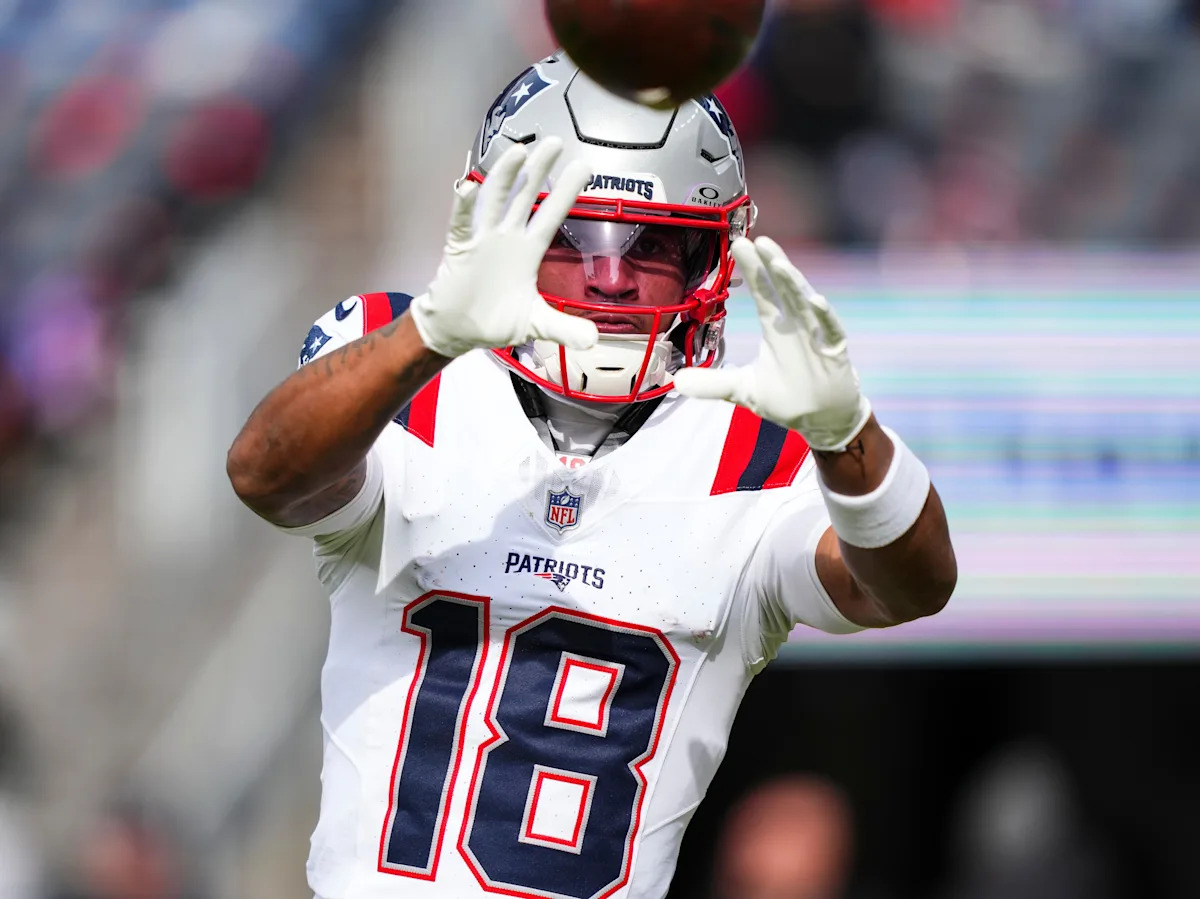
One of the New England Patriots’ biggest shortcomings of the Bill Belichick era was an inability to draft and develop wide receivers. In that sense, Belichick’s legacy lives on under his successor as de facto GM, Eliot Wolf: in Wolf’s first draft in 2024, he selected a pair of wideouts who were both let go within 17 months of their arrival.
What does all of that have to do with Kyle Williams, though? He became the latest in that long list of receiver prospects when selected in the third round in 2025. And much like others before him, he did not exactly jump off the page as a rookie — something that will have to improve heading into his sophomore season.
Advertisement
Hard facts
Name: Kyle Williams
Position: Wide receiver
Jersey number: 18
Opening day age: 23 (11/13/2002)
Measurements: 5’10 5/8”, 190 lbs, 30 1/8” arm length, 73” wingspan, 8 3/4” hand size, 4.40s 40-yard dash, 36 1/2” vertical jump, 9’11” broad jump, 6.34 Relative Athletic Score
Experience
NFL: New England Patriots (2025-) | College: UNLV (2020-22), Washington State (2023-24)
A dual-threat quarterback early in his high school career, Williams made the move to wide receiver (and defensive back) upon joining Santa Monica, CA, High School for his senior season. His first year at his new position was a productive one, and he was eventually courted by several FBS-level schools as a three-star recruit.
Advertisement
Williams decided to join UNLV, where he started all 25 of his games over a three-year period. During that time, he was on the receiving end of 117 passes that he took for 1,568 yards and nine touchdowns. Following the firing of head coach Marcus Arroyo after the 2022 season, however, he decided to enter the transfer portal and ended up at Washington State to close out his college career.
The change of scenery was a positive one and allowed Williams to set new career highs in receptions, yards and touchdowns in back-to-back seasons. In total, he started 25 more games in his two seasons as a Cougar and added 131 catches for 2,040 yards and 20 TDs to his résumé.
Williams entered the 2025 NFL Draft among the top-level wide receiver prospects and was selected 69th overall by the Patriots. In his first season with the club, he saw action in 21 combined regular season and playoff games and caught 12 passes for 223 yards and a trio of touchdowns.
Scouting report
Strengths: Williams is an explosive receiver whose game is built around his ability to quickly get up to his 4.4-second speed. He goes through breaks without losing much momentum via wasted movement, all while varying his speed to put additional pressure on cornerbacks. His burst also makes it hard for would-be tacklers to get hold of him, which in turn allows him to be a threat with the ball in his hands as well as, in theory, a productive player in the screen game. He finished his rookie year with a solid average of 6.5 yards after catch.
Advertisement
A true three-level wideout who has potential splitting out wide and aligning in the slot, Williams had solid production in the short and intermediate areas in college. In the NFL, meanwhile, he used his speed and ball-tracking abilities to establish himself as a big-play option. While his connection with quarterback Drake Maye left a lot to be desired — more on that in a second — his average depth of target (18.7) and yards per catch (18.6) show that he was trusted to stress defenses deep.
While used in a limited and oftentimes odd capacity in his rookie season, his college tape shows that he can indeed find success against man and zone coverage. His different release packages, efficient hand usage, and sharp footwork make him an intriguing developmental prospect in that regard.
Weaknesses: Even though he did add to his frame in his second NFL offseason and is now five to eight pounds above his “soaking wet” 2025 playing weight of 185 pounds, Williams is not the most physically or athletically imposing athlete. He is more fast than quick and also offers relatively modest play strength as both a receiver and a blocker in the run game. Williams can struggle against physical coverage both at the release point and throughout his routes, with press man cornerbacks being able to re-route him once they get their hands on him.
Consistency also is an issue for Williams that showed up in his first season in the NFL. He struggled at winning contested catches (14.3% success rate), getting on the same page as Drake Maye, finding success against zone defenses. He also made some questionable decisions as a kickoff returner. In all, his 2025 season was a rollercoaster whose lows prevented him from earning a regular role.
Advertisement
2025 review
Stats: 21 games (0 starts) | 411 offensive snaps (30.3%), 30 special teams snaps (5.5%) | 27 targets, 12 catches (44.4%), 223 receiving yards (18.6/catch), 3 TDs, 2 drops | 2 carries, 3 yards (1.5/carry) | 12 kickoff returns, 312 yards (26.0/return) | 0 penalties
Season recap: Even though they had invested two early-round picks at the position the previous year, and later brought in veteran free agents Stefon Diggs and Mack Hollins, the Patriots were not done adding to their wide receiver group once the third round of the 2025 NFL Draft came around. With the 69th overall selection, they selected Williams to add another flavor to their receiving corps: he was to bring an element of explosivity the group had been lacking.
That explosivity did show up repeatedly in 2025, and allowed Williams to become a home-run threat for the Patriots. His 18.6 yards per receptions are indicative of that, and allowed him to finish his rookie year ranked fifth in that category among all NFL wide receivers with double-digit catches.
Advertisement
Of course, he barely qualifies for that classification: Williams hauled in just 12 passes on the year.
His production came in spurts and was not just the result of him being a talented deep-field target. After all, he spent most of the season as a rotational player, effectively serving as the next X-receiver up behind the perimeter duo of Kayshon Boutte and Mack Hollins. Whenever one of the pair was unavailable, Williams saw a bump in play time and by extension targets.
Such was the case when Boutte was sidelined with a hamstring issue in early November, and again when Hollins was on injured reserve in late December and early January. During those periods, Williams made some of his best plays of the season, including catching his first touchdown in the league.
Plays like this one show what Williams can be in the NFL. However, they also happened infrequently: he only partially capitalized on his opportunities and quickly returned to rotational duty upon the veterans being healthy enough to reenter the lineup.
Advertisement
The same was true on special teams as well. Williams was one of the players tabbed to replace the injured Antonio Gibson in the kickoff return game, and looked like a potential future contributor. However, he was removed from the role again after a four-game stretch late in the season and finished with only 12 total runbacks.
In general, Williams’ rookie campaign was both promising and disappointing at the same time. Schrödinger’s season, if you will. He was uneven at times, with his chemistry with Drake Maye lacking and the pair repeatedly finding itself operating on two different planes of offensive existence. The young pass catcher also seemingly was learning the intricacies of facing pro-level competition on the fly, both mentally and physically.
And yet, amid it all, he still managed to show flashes of brilliance and why the Patriots used a Day 2 draft pick to bring him in.
2026 preview
Position: Z-receiver | Ability: Fringe starter/Role player | Contract: Signed through 2028 (2029 UFA)
Advertisement
What will be his role? Williams was a backup X-receiver in 2025, but it would not be a surprise if he was used differently in his second season. His dynamic skillset, after all, would make him a prime candidate to fill a Stefon Diggs-like role as a hybrid inside/out receiver. Of course, unlike Diggs, a high number of starts and snaps might still not be in the cards for him with Romeo Doubs added in free agency and A.J. Brown likely to come aboard via trade once the calendar turns to June. Williams therefore looks destined to be a rotational and package receiver yet again, even in a newly-defined role tailor more to his strengths.
What is his growth potential? Based on his rookie season, there are two big areas of improvement for Williams: his connection with Drake Maye and his ability to better withstand NFL physicality. If he can show strides, he should be able to earn more consistent playing time in a receiver corps by committee. What might also help is the possible change of role mentioned above. Eventually, he still has the talent to develop into a starter-caliber player before his rookie deal is up.
Does he have positional versatility? The Patriots used Williams in a rather narrow and somewhat surprising fashion in 2025. Instead of exploring his skillset as a possible multi-faceted option, they almost exclusively lined him up as an X-receiver. It was trial by fire, and something that might not be indicative of his future role. From our point of view, he should be able to flourish as a Z-receiver with some slot reps added. Furthermore, he had some flashes returning kickoffs as well and with some more experience can take over that position full-time as well.
What is his salary cap situation? Williams is counting $1.524 million against the Patriots’ salary cap at the moment. As with most rookie contracts, the number consists entirely of a non-guaranteed base salary ($1.14M) as well as a fully-guaranteed signing bonus proration ($379k).
Advertisement
How safe is his roster spot? Even though his production was not necessarily impressive in 2025, and the Patriots’ receiver group remains a work in progress, Williams should still be able to make the team in his second season. The bigger question is in what capacity he will do so. Assuming that A.J. Brown and Romeo Doubs are locked into two of the starting roles, he would compete with the likes of Mack Hollins, DeMario Douglas, Efton Chism and Kayshon Boutte — if the latter remains on the team — for playing time. New England is unlikely to use a clearly-defined pecking order, but Williams would project to fall into the WR2/WR3 range depending on the formation and situation.
Summary: Williams faced some challenges as a rookie, but he should be in a better position to develop in 2026. The keys are his own growth as a player as well as the Patriots giving him a better shot at success through his usage within their offense.
What do you think about Kyle Williams heading into the 2026 season? Will he earn a bigger role? Or will he remain a part-time weapon only? Please head down to the comment section to share your thoughts.
Read the full article here


