





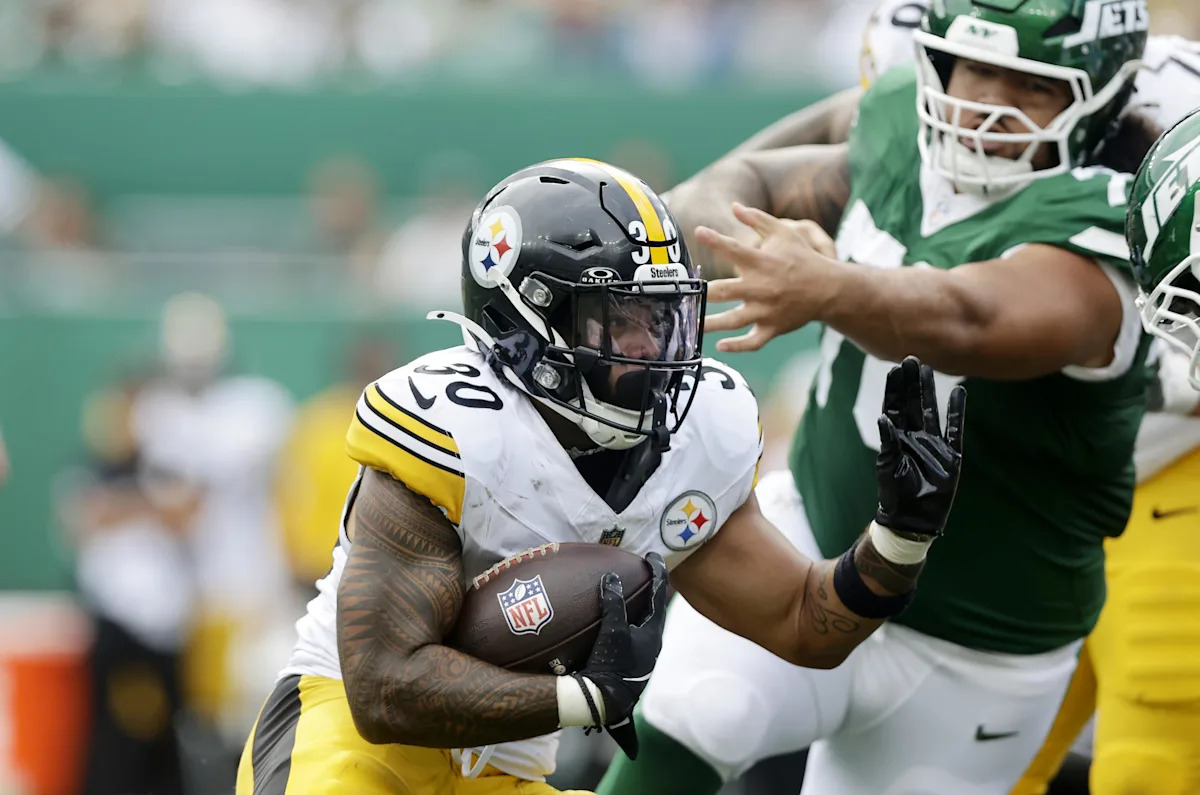
Welcome back to the Steelers offseason, where the demand for content remains high even if there’s not always enough news to properly supply it.
In some ways, it’s not the best time of year to be a football writer. But in a glass-half-full way, it’s an excuse to fill out my article quota with more out-there ideas.
Advertisement
In that spirit, I’m bringing back my “One random Steelers play” series from last year.
It’s a bit long-winded, but here’s how I introduced the concept in June of 2025:
Readers have mentioned wanting more X&Os content on the site, and while I’m not a genius when it comes to that aspect of football, tackling the minute details of one Steelers play at a time is a way to get into some bite-sized discussions about scheme, players, and breaking down tape.
I’ll be sharing my takeaways from each play this series spotlights, but I hope to see yours in the comments as well. Spaces like BTSC are some of the best online for learning more about the game that draws us here in the first place.
So, whenever one of these articles runs, I’ll be selecting one random Steelers play from last season using a random number generator. That gives me what week of the season to pull from, and then I’ll use it again to pick one play from that game.
For full transparency, these plays won’t be completely random — for instance, the first play that was selected for this exercise was blown dead early due to a penalty, so I redid the process to find one that at least counted. So, there will be some light quality control, but otherwise, the plays selected could be anything — there’s no agenda or overarching theme to these breakdowns.
I broke out the Google random number generator again, this time to choose a play from the 2025 season. It chose Week 1, and then play No. 111 of the game, the Steelers season-opening, 34-32 victory over the Jets.
Context: Steelers ball on the Jets’ 14-yard line. There are 53 seconds left in the third quarter. Pittsburgh is down 26-17. It’s second and seven.
Here’s the play:
The Steelers get a six-yard run, setting up a third and one. They eventually scored a touchdown on this drive.
Advertisement
As always, we’ll start by pausing pre-snap:
There isn’t anything particularly groundbreaking here. The Steelers are in 11 personnel (one running back, one tight end), but with the tight end being Darnell Washington and one of the wide receivers being Ben Skowronek in a tight formation, the team is signaling there’s a good chance it’ll be a run.
What follows is a run play that also isn’t all that complicated, but it does re-open one of the internet’s most well-tread football arguments: inside zone or duo?
There’s a lot of football content online written by brighter minds than myself explaining this distinction, so if you’re looking for a more in-the-weeds breakdown, check out articles such as this 2023 piece from BTSC sister site Big Cat Country.
Advertisement
But we can get into the basics here. TL;DR: I’m calling this duo.
Zone runs, on their most basic level, involve the offensive line flowing in the direction of the play (as opposed to power/gap runs where they block “down”) and lack a pulling lineman (one of the easiest power/gap indicators). The issue with duo runs is that they are basically a power run without the puller, taking away that easy indicator. And inside zone, as it’s more north-south than outside zone, doesn’t have as much horizontal flow.
As a result, sometimes it’s very difficult to tell the difference between duo and inside zone.
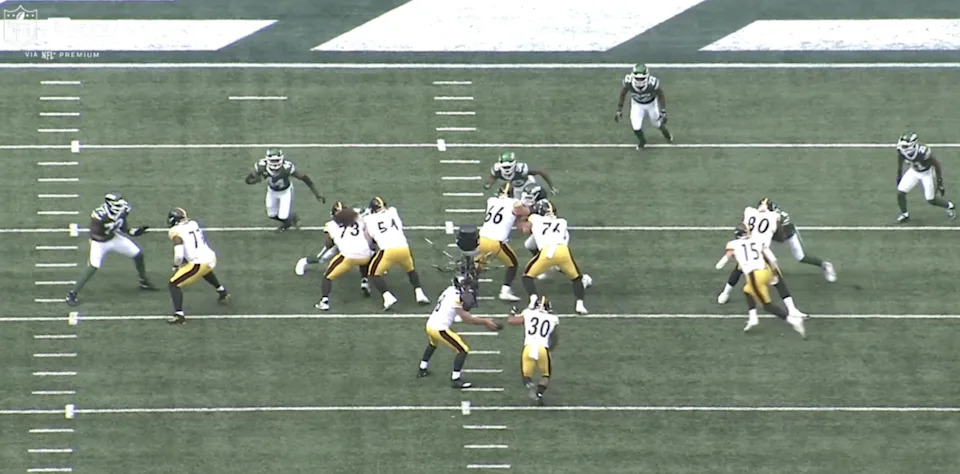
Duo presumably gets its name from the two double-teams the offensive line generally creates up front. Check out Isaac Seumalo/Zach Frazier and Mason McCormick/Troy Fautanu immediately attacking the two defensive tackles and instantly giving running back Jaylen Warren some room to work. (Pro tip: you’ll get the most out of running plays by watching the end-zone view of the all-22).
I like this distinction from the BCC article:
A good starting point is observing the double teams. While both run schemes can have double teams depending on the defensive front, there are some tells that give away the play. If the OL is working around a defensive tackle to get up to the second-level defender, it’s most likely inside zone. If the offensive line is working through the defensive tackle up to a linebacker, it’s most likely duo.
Of course, inside zone is also built on immediate combo blocks, with the linemen eventually working their way upfield, which the Steelers do here. See Seumalo and McCormick both moving to take on the linebackers?
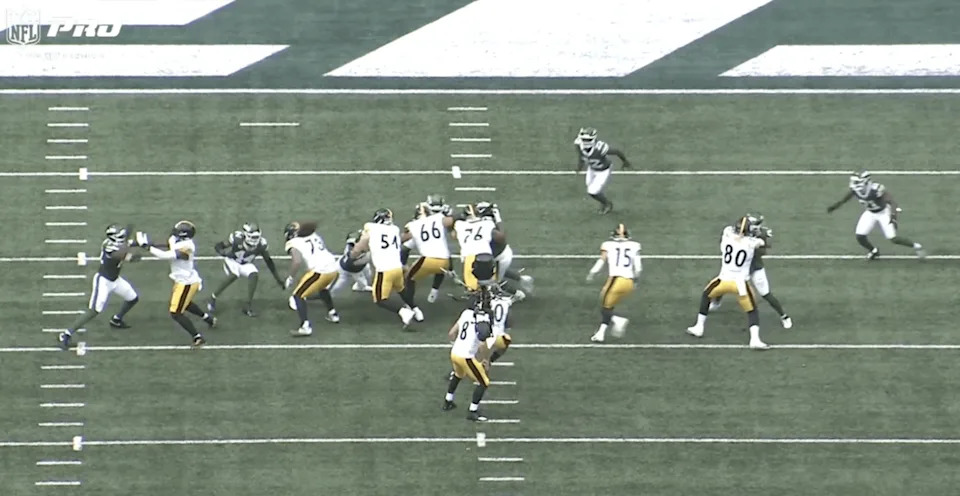
But look where Jaylen Warren is headed at this point: Away from where the offensive line is flowing — another duo indicator.
Advertisement
Yes, on zone concepts running backs absolutely have the ability to bend their track to the backside of the run, but Warren takes the handoff and immediately starts running towards the right side of the line despite the offensive line moving left. Remember how duo runs use the down blocking of a power scheme, just without the puller? That’s what’s happening here.
Also, the Steelers insert Ben Skowronek into the C-gap on the right side as a sort of lead blocker, and left tackle Broderick Jones seems more concerned with containing his defensive end than driving him forward. This run has all the makings of one that was designed to go to the right — making it a likely case of duo.
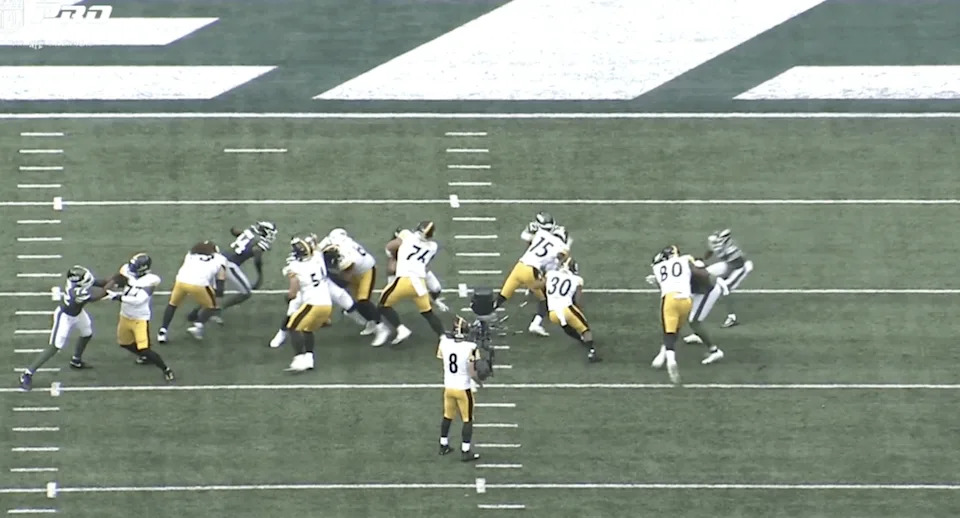
In a more classic duo run, the running back would have the option to either take the ball inside or bounce it outside depending on how the linebackers fit the run. But with Skowronek inserting, Warren has a lead blocker on the inside while Jets cornerback No. 21, who’s close to the box as a result, has the angle on the outside. The result is still a successful six-yard gain.
Scheme debates aside, this is a great play from the right side of the Steelers offense. A few things:
Advertisement
-
The play comes together because Troy Fautanu is able to easily cut off Jets defensive tackle No. 76, creating a gaping hole in the C gap. Fautanu’s wide base, lateral mobility, drive, and block sustain is nothing short of fantastic here.
-
Tight end Darnell Washington has an easier blocking angle than Fautanu, but it still shouldn’t be taken for granted that a tight end is able to handle the defensive end one-on-one to clear the other side of the hole Warren runs through.
-
Ben Skowronek is the rare blocking madman at wide receiver, and by attacking the downhill safety head-on, he also gets a piece of the incoming corner, springing Warren for the extra yards at the end of the run.
-
Finally, Warren does a great job reading the blocks, hitting the gap the linebacker doesn’t crash and quickly cutting and getting skinny to move past Skowronek’s block. He also fights for extra yardage after the play — the definition of a downhill runner.
By this point, you might be wondering why this “One random Steelers play” series even matters considering the Steelers will be running a new offense in 2026 under Mike McCarthy and Brian Angelichio.
That’s fair, but keep in mind that duo was a staple of the McCarthy offense during his time in Dallas. It’s also a great fit for the north-south playing style of new Steelers (and former McCarthy-era Cowboys) running back Rico Dowdle.
So, even if the Steelers offense certainly won’t carry over everything from the Arthur Smith days, expect duo — which Smith actually didn’t run much — to stick around.
What are your takeaways from this play? Join the BTSC community and let us know in the comments.
Read the full article here