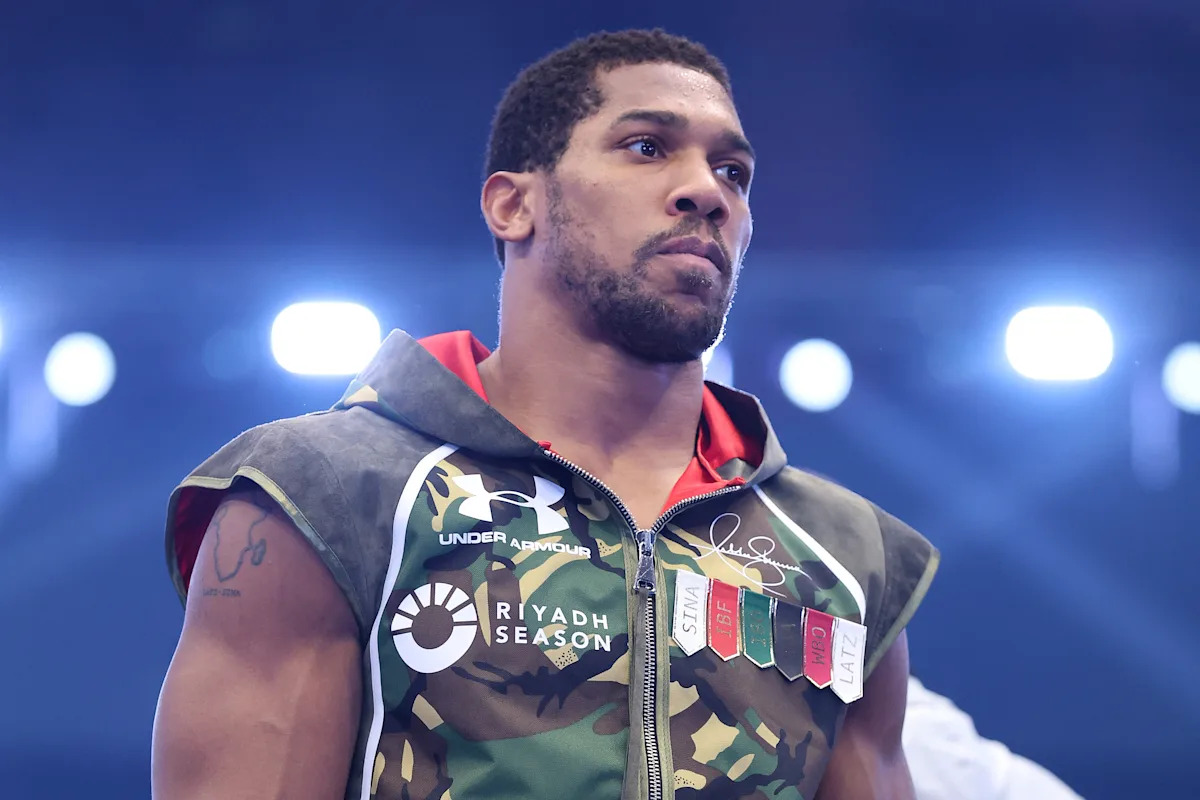
Sometimes the kindest thing a person can do before you enter a situation is offer this advice: “No, really, you don’t want to go in there.”
If ever you hear this, you can be sure it is a preventive measure. You know its primary aim is to protect you from your own curiosity. It only pertains to things you are better off avoiding like a restaurant serving bad food, or a restroom you have been advised to give a wide berth to until the air freshener kicks in. It can also pertain to specific websites, or viral videos, as well as to tune-up fights.
Advertisement
One such fight took place Friday in Pattaya, Thailand. That was where Tyson Fury and Mariusz Wach, a couple of heavyweights, went through the motions in a glorified spar nobody really wanted or needed to see. It was, after all, no more than a workout for Fury; a bout he opted to take only because Anthony Joshua, the man he wants to fight next, had the temerity to take one of his own that same weekend. That’s ultimately why Fury vs. Wach was held in Thailand and why only 1,500 tickets were available (the proceeds from which went to the Father Ray Foundation, a charity dedicated to caring for underprivileged, orphaned, and disabled children in Pattaya). It is also why the fight was not aired on any television network, streaming service, or website, but instead returned us to a time when round-by-round accounts carried power and the word of ringside observers was gospel.
It was a mismatch treated the way all mismatches should be treated. For once, rather than find ourselves strung along, any prospective viewer was encouraged to avoid it — “Nothing to see here,” was the message — and so most of us did. The only thing that mattered was that it happened and that Fury came away both unscathed and victorious. He wanted some rounds, he said, just to turn the engine over, and in Wach he had selected a 46-year-old Pole still capable of providing them. In the end, he got seven. After those seven rounds, Wach decided he’d had enough and that was that.
Thankfully, we had missed nothing. The fight, such as it was, had gone as we expected — justifying the belief that it was one to skip — and highlights of it filmed on phones at ringside were more than sufficient in terms of coverage. On reflection, that might even be the best way to present and consume a Tyson Fury fight in 2026. Stripped back to just the essentials, the lack of access helped generate a series of short clips and headlines designed to make you click to discover more: Was Fury HURT by Wach in Round 2? Did Fury KISS Wach on the lips in Round 6? Watch as Fury lands five CONSECUTIVE UPPERCUTS and SHOUTS to the crowd after each of them!
Yes, Tyson Fury did indeed kiss Mariusz Wach.
(Thananuwat Srirasant via Getty Images)
Perhaps, in the age of the endless scroll and short attention spans, all fights should be shown this way. They should be served to us in pieces, digestible chunks, with all the fat, seasoning and nuance removed. They should find a home not on mainstream platforms but instead on social media timelines, shoved somewhere between images of Vinícius Júnior’s new face, Charli XCX’s latest album rollout and Sydney Sweeney’s newest R-rated gif.
Advertisement
Besides, on account of its inevitability, who really needed to see how Fury broke Wach down in front of 1,500 locals in Thailand? All we needed was the result and a few decent clips to farm engagement in the immediate aftermath. All we needed to know was whether Fury was still keen on fighting Anthony Joshua, his countryman, later this year.
“I got through my test. Let’s see if [Joshua] gets through his test,” said Fury (36-2-1, 25 KOs). “The biggest test of it all is how big his balls are. I think he’s a big s***house.
“In Tottenham [Hotspur Stadium] in front of 70,000 people, he never had the guts to get in the ring and face me. Let’s see if he ever does. I’m not convinced.”
Had he been convinced, Fury may well have made the trip from Thailand to Saudi Arabia to watch Joshua fight Kristian Prenga the following evening. Instead, he opted to go home, with his manager, Spencer Brown, left to confirm his no-show an hour or so before Joshua and Prenga entered the ring in Jeddah. “He won’t be here,” Brown said. “But he will be here in spirit.”
Advertisement
For three minutes we wondered if the same was true of Joshua. Dropped by Prenga’s right uppercut after just 20 seconds, Joshua traveled on unsteady legs for the remainder of Round 1 before touching the canvas for a second time when a left uppercut, every bit as sneaky as the first, again upended him. In between those two knockdowns he was nailed by all manner of shots, including a long right hand from Prenga which would have produced another knockdown had the ropes not kept Joshua on his feet.

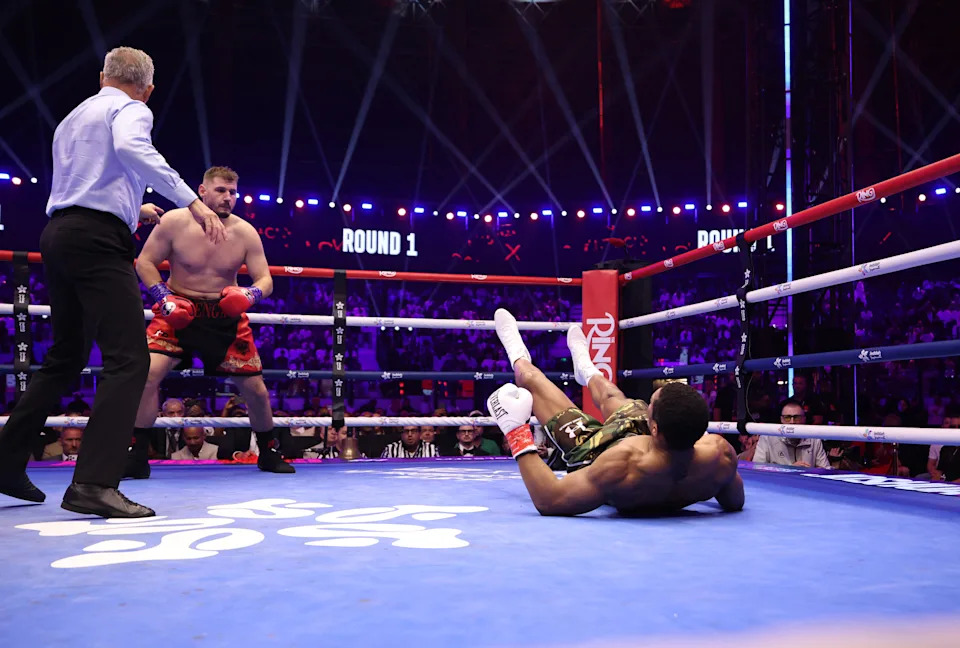
Anthony Joshua appeared to be heading toward a nightmare in Round 1 against Kristian Prenga.
(Mark Robinson via Getty Images)
At that point, the dream had died. There would be no fight between Fury and Joshua, and Fury, as if sensing it, had done the right thing by choosing not to attend what had become the fight’s death knell. One even began to question whether Fury was watching the fight at home, or whether, like many others, he had decided the £19.99 required to watch Joshua-Prenga, a tune-up, on DAZN represented both daylight robbery and a guaranteed way to restrict its potential audience. Regardless, we know one thing: Joshua, in those opening three minutes, wished his tune-up with Prenga had been kept away from the cameras, witnessed only by the smattering of sheikhs sitting at ringside.
Because now Joshua was exposed, his every flaw visible. Worse than that, he was suddenly in danger of being embarrassed by a 35-year-old Albanian whose name was unfamiliar to most until he was identified as Joshua’s sacrificial lamb back in April. We suspected Kristian Prenga could punch — the 20 stoppages on his 20-1 record suggested that — but never before had he fought a heavyweight of Joshua’s caliber and never would we have believed he’d be the man to derail what Tony Bellew, the former world cruiserweight champion, called “the biggest fight in British boxing history” on DAZN last night.
Advertisement
And yet, he so nearly was. In fact, were it not for Prenga freezing and then folding in Round 2, a fight 10 years in the making would have joined the ranks of the many delayed by greed and finished off by an unforeseen catastrophe. Only Joshua’s courage, power, and superior technique kept the Fury fight on track in the end. There was a jab, a right cross, another right cross, a left hook, and a final right hand. With that, Prenga collapsed onto the bottom rope and Joshua’s fight with Fury was revived no sooner than it had flatlined.

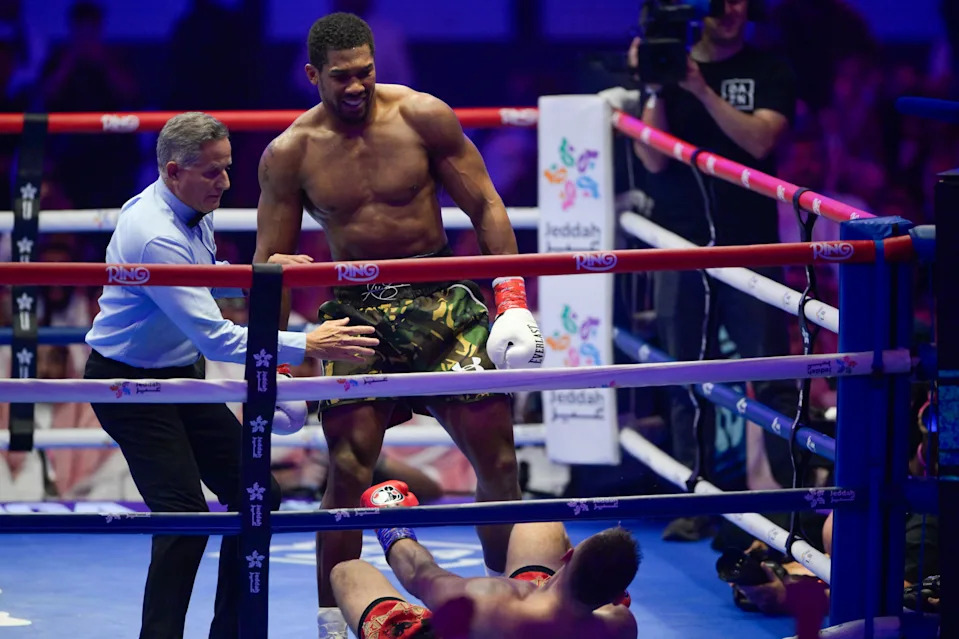
Anthony Joshua salvaged the Tyson Fury fight with a come-from-behind knockout of Kristian Prenga.
(Khalid Alhaj/MB Media via Getty Images)
“Is he here or not?” Joshua (30-4, 27 KOs) asked in the ring, referring of course to Fury, his longtime rival and fellow former world heavyweight champion. “There are two sides to this thing. One is the fighter. You have to have that vim. But also, there’s respect. I respect everything he’s done and everything he’s achieved. But, as a fighting person, and as someone who has been calling for this fight for a long time, we’re here now. I hope the fans will be in for a lovely treat.”
Given events of the past 48 hours, both seen and unseen, it is hard to attach the term “treat” to Fury vs. Joshua in 2026. At best, the treat is akin to finding a wrapped sweet in an old winter coat not worn for some time. It still has a certain appeal and merit, absolutely, yet the fight, like the sweet, is a little tougher to chew than is ideal and possesses a white crust indicative of the time it has spent in a rather deep pocket.
Advertisement
This sense of time having passed is then only magnified by the general impatience and anxiety-inducing habits of the day. “Next episode starts in 10 … 9 … 8 … 7 … 6 … 5 … 4 …” is the mantra by which most of us tend to live in 2026, and anything less immediate starts to irk and is easily ignored. We want it now, not tomorrow, and have grown accustomed to living and being entertained in this way and only in this way.
Now just imagine that instead of seconds, those numbers represent years. In that instance, the anticipation to watch, or simply maintain a passing interest, might not be so great. Chances are, with countless other options available, one might swiftly move on and find something else to watch over the top of one’s phone.
Moreover, for those of us who still care about quality, there can be no avoiding the fact that Fury-Wach and Joshua-Prenga revealed only the extent of the regression in both Fury and Joshua. Shadows of their former selves, Joshua now looks in danger of unraveling whenever in punching range of another man, while Fury moves like his own tribute act, remembering all the poses but noticeably stiffer in his actions and struggling to hit the same notes.
There is an old Chinese proverb which says, “When you keep someone waiting, you give him time to count up your faults,” and in boxing this applies to fans as much as the fighters. In other words, just as Fury and Joshua can now see the faults in each other, we too, having followed them both for so long, are every bit as sensitive to the deviations in their styles and form. This awareness, rather than helping to build our appreciation and anticipation, works only to chip away at the lingering interest we had in a fight that should have by now happened. Sometimes it’s true that you can both know and see too much.
Advertisement
“I’ll regroup,” said Fury on Friday. “Hopefully the next big fight is signed next week, and we head wherever we’re going to head.
“Is it going to be in Vegas? Is it going to be in New York? Is it going to be in Ireland? Is it going to be in London? Who knows? Belfast, maybe? It might even be here in Pattaya, Thailand!”
In Britain, where Fury-Joshua matters most, any deterioration, both in the fighters and the fight’s value, is far less of an issue. It can be sold there, in the UK, on the basis of their histories and their names, and the diminishing importance and quality of the fight won’t impact the size of the event. Even now, with Fury age 37 and Joshua age 36, there will be a hunger to see the pair collide. What is more, such is the fracturing and burying of the sport in recent years, many of the people still intrigued by Fury-Joshua will have been oblivious to the events of this weekend, much less invested enough to follow them on social media or an app. To them, Fury is still Fury and Joshua is still Joshua and a fight between the pair still counts for something.

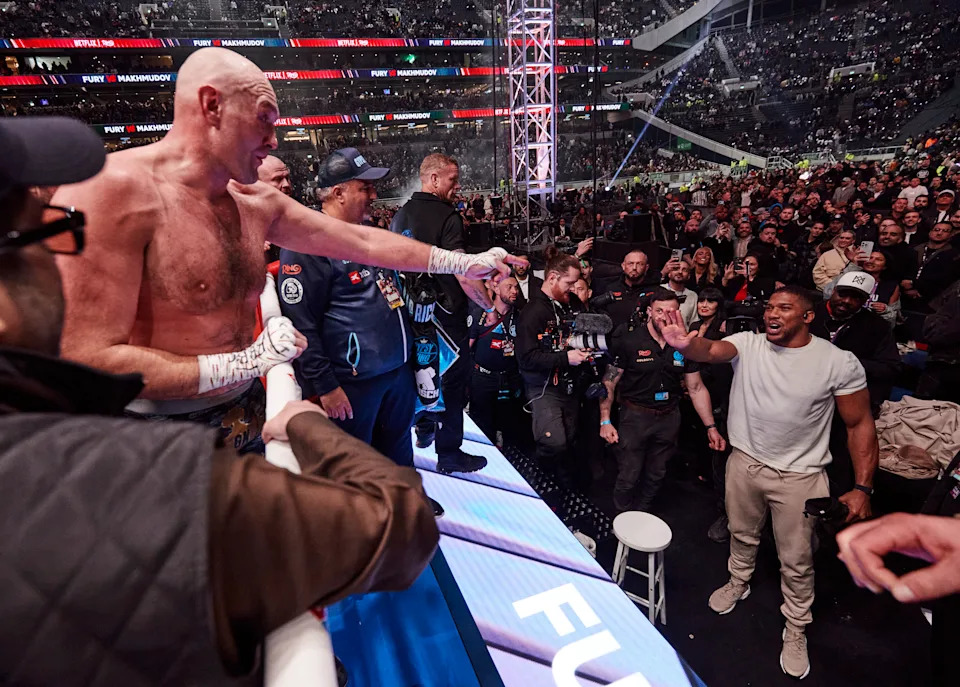
Soon.
(Mark Robinson via Getty Images)
Elsewhere, though, the same cannot be said. In Saudi Arabia, for example, a fight with dwindling significance becomes all the more insignificant by virtue of the backdrop and lack of noise. Similarly, should the fight end up in New York, by all accounts the frontrunner, you can expect the same collective shrug of indifference.
Advertisement
Worse, should the fight land in New York, fans in the UK will be expected to watch it unfold in the wee hours of the morning (somewhere between 3 a.m. and 5 a.m. BST), the impracticality of which would likely rule out the majority of those casual fans for whom the fight, as a spectacle, still resonates. It would, in a sense, be robbing the fight of its remaining unique selling point.
Bellew again: “The biggest number of pay-per-view buys is going to be in the UK. No one cares in America. What are you going there for? I’m sick of appealing to America. Why? America don’t care about us. They want what we’ve got. We’ve got the best crowds in the world. We’ve got the most passionate fans in the world. That’s why it should be with us. These are the two stalwarts of British boxing.”
He is right, too. Whereas in the UK, Fury vs. Joshua still has a slim chance of bringing the country to a standstill, relatively speaking, there will be no such possibility should it go overseas. If that were to happen, some fans in the UK will watch the fight, but many more will consider it too late — the making of the fight, the time of night. Regardless of its history and its domestic appeal, now is not the time to be watching two men throw punches, they will decide. It is instead time for bed. That is the usual response to feeling tired and that is what we, British boxing fans, have sadly become. We are tired of Fury and Joshua. We are tired of waiting. We are so bloody tired.
Some will say, “Don’t bother,” when the time eventually comes. They will say, “It is too hard to watch,” but then fail to specify whether they are alluding to the faded state of the two heavyweights or rather the confusion created by the sport being passed around by various platforms — DAZN, Netflix, Sky Sports, and so on — and hidden behind various paywalls. The more clued-up, meanwhile, might say, “Wake me up when it is happening,” which is something many of us have said for years.
Read the full article here