







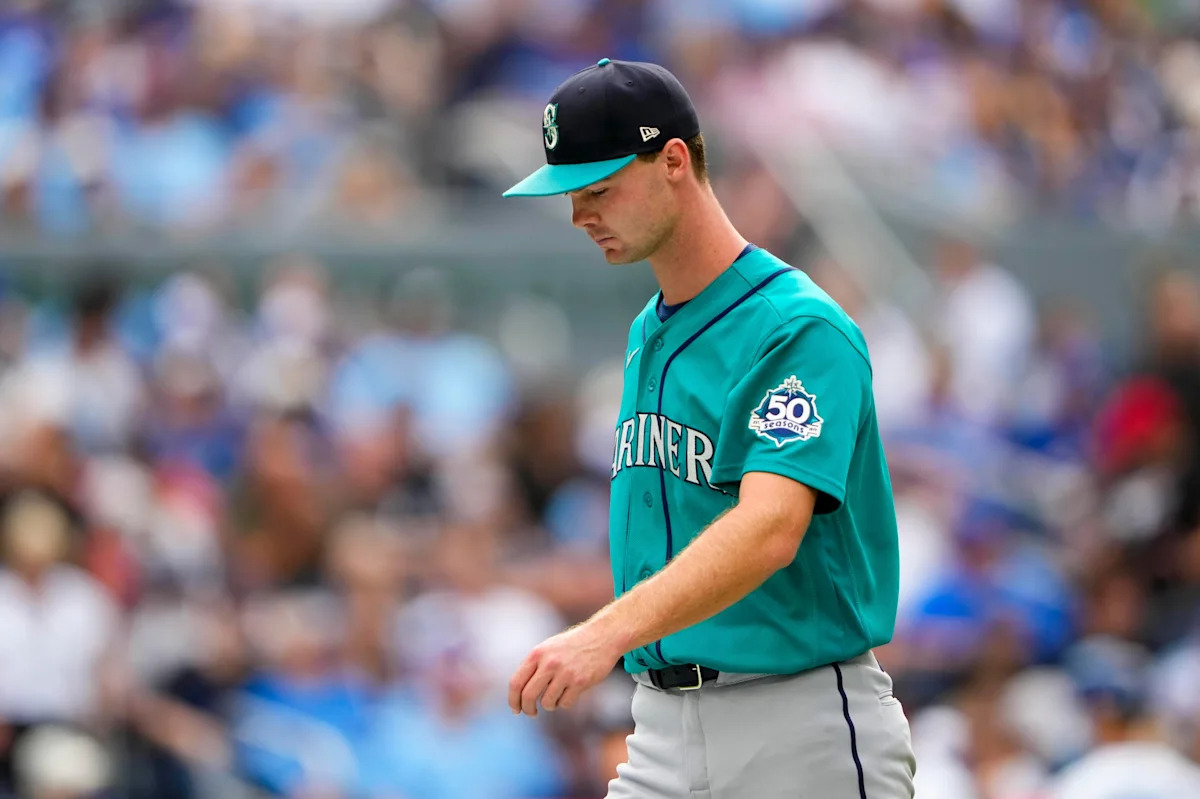
After blistering through the minor leagues, Kade Anderson’s big-league career is off to a slower start. In his first three games, he gave up a combined nine runs and an uncharacteristic seven walks, struggling with command and playing more defense than offense in his at-bats. It’s unfamiliar territory for the champion collegiate who spent this past year setting records in the minor leagues, but for now, there’s nowhere to go but through. Anderson spent this year proving he hasn’t got anything else to learn at Double-A, and there’s little developmental value in sending him to the bounce houses of Triple-A; even if the Mariners wanted to send him to Triple-A for some seasoning against the hitters there, there’s only a week left in Tacoma’s season. With time running out on the Mariners’ own season, Anderson finds himself in a position those of us in the working world can relate to all too well: fake it until you make it.
The arrow is trending up after Anderson’s most recent outing against the Rangers, his best start to date as a big-leaguer: six innings of one-run ball with five strikeouts and just one walk. The single free pass is the metric to hone in on as an encouraging sign that Anderson is getting back to the version of himself that dominated at Double-A. At his best, Anderson gets ahead in the count early with his pinpoint command and ability to coax poor contact, forcing batters to react to him rather than the other way around. There were signs of that in his outing against Toronto, as well, where he was ahead of hitters for his first few innings despite not having perfect command of his four-seamer, missing armside up with the pitch a little too often.
Advertisement
Unfortunately, development often isn’t linear, and Anderson’s next outing against the A’s was his worst yet. He missed locations, one particularly egregious one to Gelof resulting in a first-pitch homer, shook his catcher Cal Raleigh multiple times (once resulting in a walk), got into some long battles with hitters, issued a four-pitch walk, and wasn’t able to land his curveball for strikes. A shell-shocked Anderson faced the media after his five-inning, four-run outing, calling his performance “unacceptable.”
Fortunately, development often isn’t linear, and Anderson followed up his worst performance as a big-leaguer with his best one yet. He credited his improvement largely to an improved mentality, inspired partially by his catcher Cal Raleigh, who said something to Anderson after he’d given up an early home run to the Rangers’ Jake Burger – Anderson declined to say exactly what, but said the adjustment allowed him to be more aggressive in the zone.
“The best pitchers trust their stuff, and the dudes that have the most confidence are the ones that are getting the most whiffs and getting deep into games,” said Anderson postgame. “It was more of a mentality [change], like, attacking guys. It felt like when I made that adjustment, my velo shot up, I was throwing things more aggressively in the zone. It felt like at some points I was trying to over-locate like throwing something by a dude, and I think that was the biggest game changer.”
“It felt like I was out there pitching again.”
Advertisement
“Fake it until you make it” maybe isn’t where the highly decorated pitcher expected himself to be a month into his big-league career, but Anderson is fortunate to have both Raleigh, his veteran catcher, to guide him, and a fellow former SEC pitcher who knows a little bit about struggling at the next level in Emerson Hancock.
“I mean, I’ve been through a lot,” said Hancock jokingly when asked about his mentorship of the young pitcher.
“It’s just part of every person’s journey of what they go through. Like y’all experience different things, whether it’s injury, success, failure. And that’s what’s cool about this game. It’s a challenge. It’s ongoing. It’s a daily commitment and practice. So it’s all just part of the journey.”
The uber-competitive Anderson is maybe not entirely soothed by Hancock’s reassurances that it’s all just part of the journey, but he’d do well to heed what Hancock has learned about managing his energy and not getting too high or too low – hard-won lessons for Hancock that have come through years of struggle and his own non-linear development before arriving this year as one of the steadiest hands in the Mariners rotation.
Advertisement
“There have been times when you get super fiery and focused, but I also think as you go on and you play more, you’re like, all right, I’m learning more about myself, and you ask yourself: What do I need? How am I feeling when I’m thinking this way, or when I’m flowing?” said Hancock. “So I think you learn that about yourself, but there’s also other games where you flip the switch and say, you know what, I want this one. I’m ready for this one. So it’s a balance.”
That’s a balance Anderson will continue to navigate over these last few starts remaining in the 2026 season. But he’ll have plenty of support in doing so, not just from the coaching staff, but from his peers, as well, pulling on relationships that began being built in the spring.
“It was fun getting to know him during camp, like with all the guys we draft,” said Hancock. “It’s fun. That’s what I think makes a good organization, that you can establish that relationship with the guys early on. That way when they get here, it’s not so crazy to them. I’ve leaned on the older pitchers that we have, and you try to pass it down and help the next guys out.”
Eventually, it will be Anderson’s turn to pass on his hard-fought knowledge to the next pitcher, his own understanding of the journey. For now, he’s just trying to take it one day at a time. Fake it until you make it.
Read the full article here


